September 8, 2026
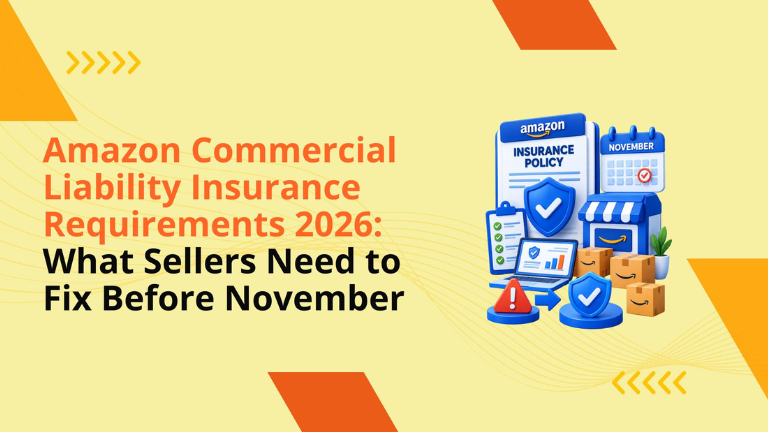
Amazon Commercial Liability Insurance Requirements 2026: What Sellers Need to Fix Before November
Amazon sellers are used to thinking about insurance as something that becomes urgent after a sales milestone.
That mindset now needs to change for sellers in higher-risk categories.
Effective November 2, 2026, Amazon is updating its commercial liability insurance requirements. The existing rule still applies: sellers must obtain and maintain commercial liability insurance within 30 days if their gross proceeds from Amazon.com sales exceed USD 10,000 in any month, with minimum coverage of USD 1 million per occurrence and in aggregate.
The bigger update is that sellers with products listed in categories with enhanced safety listing requirements must now maintain commercial liability insurance for those products regardless of whether they cross the USD 10,000 monthly sales threshold. Amazon says this change applies to both new and existing listings.
For Amazon sellers, this is not just an insurance update.
It is a compliance, catalog health, and revenue protection update.
If your listing sits in a category Amazon considers safety-sensitive, your ability to sell may depend on whether your Certificate of Insurance is ready, accurate, and accepted.
Amazon is adding two major updates to its commercial liability insurance requirements.
First, sellers with products in categories that have enhanced safety listing requirements must carry a commercial liability insurance policy covering those products. The minimum coverage must be USD 1 million per occurrence and in aggregate, even if the seller does not reach USD 10,000 in gross Amazon.com sales in a month.
Second, sellers based in Mainland China must obtain insurance through the Amazon Insurance Accelerator program. Amazon says newly submitted policies not obtained through AIA will be rejected starting November 2, 2026, although valid third-party policies submitted before that date may continue until they expire.
The key takeaway is simple:
For certain categories, insurance is no longer only triggered by monthly sales volume. It can be triggered by product risk category.
Amazon’s stated goal is to help protect customers and help sellers protect their businesses from financial loss in the event of a product-related incident.
That matters because some products carry more risk than others.
A phone case and a child restraint system do not create the same exposure.
A notebook and a lithium battery product do not create the same safety risk.
A decorative item and a home medical device do not create the same compliance burden.
For safety-sensitive products, Amazon wants sellers to show that they have commercial liability coverage in place before the product creates a larger customer or financial risk.
This also signals a broader marketplace direction: Amazon is tightening compliance expectations around product safety, documentation, testing, insurance, and Account Health.
Sellers who treat compliance as an afterthought may face more friction moving forward.
Amazon says enhanced safety listing categories include, but are not limited to, children’s products, cosmetic and ingestible products, and lithium battery products. Amazon’s category page also lists several broader groups that may carry enhanced safety requirements, including fire-related products, home medical devices, outdoor power and heating equipment, personal safety equipment, sleep products, transport-related products, and water or marine safety products.
Examples may include:
The list can change as Amazon adds categories, so sellers should not rely only on memory or old category assumptions.
The safest move is to check Seller Central and Account Health for requirements tied to your actual ASINs.
Amazon’s commercial liability insurance criteria are specific.
Sellers may use commercial general, umbrella, or excess liability insurance, but the policy must meet Amazon’s requirements unless applicable law or regulation requires otherwise.
The policy generally needs to include:
This is where many sellers run into problems.
A policy may look acceptable at first glance but still fail Amazon verification because the legal entity name does not match, Amazon is not named correctly, the deductible is missing, the coverage is incomplete, or the insurer rating does not meet Amazon’s criteria.
One of the most important details in the update is that it applies to both new and existing listings.
That means sellers cannot assume older ASINs are automatically safe.
If an existing product falls into an enhanced safety category, the seller may need insurance coverage even if the product has been active for years and even if monthly sales are below the old USD 10,000 trigger.
This can affect sellers with long-tail catalogs, seasonal products, low-volume products, and older ASINs that were launched under different compliance expectations.
For example, a seller may have a small number of lithium battery-powered accessories that do not generate high monthly revenue. Under the updated approach, the low sales volume may not remove the insurance requirement if Amazon classifies the product under enhanced safety listing requirements.
This is why catalog review matters.
A single overlooked ASIN can create Account Health friction.
Many sellers separate insurance from catalog management.
That is a mistake.
On Amazon, product data, compliance documentation, insurance, testing, category classification, and Account Health are increasingly connected.
If a product is classified under a safety-sensitive category, the seller may need to provide more than a good title and clean images. They may also need testing documentation, direct product validation through a TIC provider, ongoing testing readiness, and proof of insurance.
For sellers managing multiple ASINs, the best approach is to build a compliance tracker.
That tracker should include:
This turns compliance from a last-minute panic into a managed business process.
Commercial liability insurance may sound like a back-office issue, but it can affect front-end performance.
If a listing becomes blocked, suppressed, or restricted due to missing compliance documentation, PPC performance can suffer immediately.
Ads cannot scale a product that loses selling eligibility.
SEO cannot recover sales if the listing is not active.
A+ Content cannot convert if the offer is blocked.
Inventory can sit while compliance issues are being resolved.
Launch timelines can break if insurance is handled too late.
For sellers in competitive categories, delays matter.
If your product is paused during a peak season, a competitor may capture the ranking, reviews, and customer demand you were building toward.
This is especially important for sellers launching products in children’s, wellness, battery-powered, medical, safety, and home appliance categories.
Before investing heavily in PPC, deals, influencer campaigns, or inventory expansion, sellers should confirm that insurance and compliance requirements are already handled.
Sellers should act before the deadline rather than waiting for Amazon to flag an issue.
Start with a category audit.
Review every product in your catalog and identify whether it could fall into an enhanced safety listing category. Do not only check obvious products. Some items may be classified differently than expected, especially if they involve children, batteries, heating, safety, ingestion, topical use, medical use, or home electrical function.
Next, review your current insurance policy.
Confirm whether it covers all Amazon-listed products, not just some SKUs. Make sure the policy limit is at least USD 1 million per occurrence and in aggregate. Check whether Amazon is named correctly as an additional insured. Review deductible, insurer rating, policy dates, legal entity name, and coverage details.
Then check your Seller Central Account Info.
Your insured name should match the legal entity name you provided to Amazon, except for certain single-member LLC situations where trade name matching may be acceptable.
After that, upload or update your Certificate of Insurance through Seller Central’s Business Insurance verification process.
Finally, document the renewal date.
A policy that is compliant today can become a problem later if it expires quietly.
Amazon’s update includes a specific requirement for sellers based in Mainland China.
Starting November 2, 2026, Amazon says Mainland China-based sellers must obtain insurance through the Amazon Insurance Accelerator program unless Amazon agrees otherwise in writing. Newly submitted policies not obtained through AIA may be rejected.
If a seller already submitted a valid third-party policy before November 2 and it meets Amazon’s requirements, Amazon says the seller can continue using it until it expires. After expiration, the seller will need to obtain insurance through AIA.
This requirement is based on seller location, not simply product manufacturing location.
Sellers should confirm the exact requirement in Seller Central and work with qualified insurance professionals when needed.
This update can create problems for sellers who wait too long or assume their current setup is already compliant.
Avoid these mistakes:
The cost of fixing insurance late can be higher than preparing early, especially if a listing loses momentum.
At Big Internet Commerce, we help Amazon sellers and D2C brands grow through Amazon PPC management, Amazon SEO, listing optimization, A+ Content, catalog health, Store Management, compliance support, and marketplace growth strategy.
We focuses on helping sellers fix bottlenecks, scale PPC, improve SEO, optimize creative assets, and create conversion-ready listings for brands that are launching or already selling.
This insurance update is exactly the kind of operational detail that can become a growth blocker.
A strong listing can win attention.
Strong PPC can bring traffic.
Strong images can improve conversion.
But compliance keeps the listing eligible to sell.
For high-safety categories, sellers need a complete growth system:
Growth is not only about traffic. It is also about keeping the product live, trusted, and ready to scale.
Effective November 2, 2026, sellers with products in enhanced safety listing categories must maintain commercial liability insurance with at least USD 1 million coverage per occurrence and in aggregate, regardless of whether they cross the USD 10,000 monthly sales threshold.
Yes. Amazon’s existing rule still requires sellers to obtain and maintain commercial liability insurance within 30 days after gross Amazon.com proceeds exceed USD 10,000 in any month.
Sellers with products in enhanced safety listing categories may be affected. This can include products such as children’s products, cosmetic and ingestible products, lithium battery products, safety equipment, home medical devices, and other listed categories.
Yes. Amazon says the enhanced safety category requirement applies to both new and existing listings.
Amazon generally requires at least USD 1 million per occurrence and in aggregate.
A Certificate of Insurance, or COI, is a document from the insurer that verifies policy coverage and key policy details. Sellers submit this through Business Insurance verification in Seller Central.
Sellers outside Mainland China may use any provider that meets Amazon’s requirements. Mainland China-based sellers must use Amazon Insurance Accelerator unless Amazon agrees otherwise in writing.
No. This content is for general informational purposes only. Sellers should consult qualified legal counsel or an insurance professional for policy-specific guidance.
We can help Amazon sellers review catalog risks, Account Health requirements, listing readiness, PPC impact, and compliance-related growth blockers.
Amazon’s updated commercial liability insurance requirements change the way sellers should think about compliance.
For many sellers, the old trigger was simple: cross USD 10,000 in monthly Amazon.com sales, then obtain insurance within 30 days.
Now, sellers in enhanced safety categories may need qualifying insurance even below that threshold.
That makes insurance part of listing readiness.
If your catalog includes children’s products, ingestibles, cosmetics, lithium battery products, home medical devices, safety equipment, sleep products, outdoor equipment, or other safety-sensitive items, review your insurance position now.
We can help sellers review Amazon catalog risks, Account Health issues, listing readiness, PPC impact, and marketplace growth gaps before they affect sales.
Schedule a strategy call with our team.
Follow Big Internet Ecommerce (BIE) on Instagram & LinkedIn to stay updated with the latest trends in Amazon selling.
Fill out the form and our experts will get back
to you within 24 hours.
.webp)
.webp)
.webp)
We respect your privacy. Your information is safe with us.