Shopify Store Revamp Services: UX, Theme, Performance, and Functionality
Your Shopify store should do more than look modern. It should help customers discover products, understand your offer, navigate the store, evaluate products, and move through the purchasing process.
Big Internet Ecommerce helps brands improve existing Shopify stores through UX and visual updates, theme customization, mobile responsiveness, performance review, product pages, navigation, functionality, integrations, and structured testing or optimization where appropriate.
The appropriate approach may involve targeted theme improvements, new sections, template changes, app or integration work, performance cleanup, a broader redesign, or a combination of these. Scope depends on the current theme, Shopify plan, apps, integrations, and business requirements.
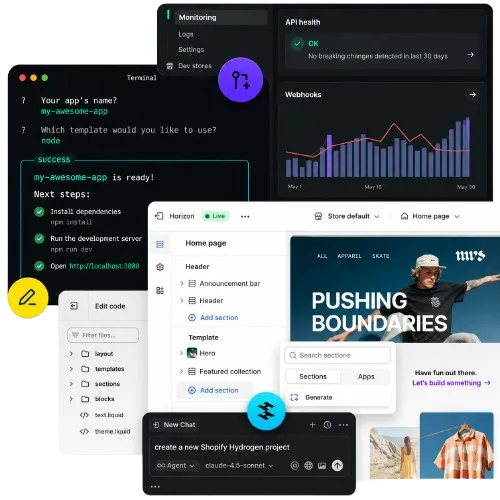
BIE ecommerce illustration. Not a client website.
Is Your Shopify Store Ready for a Revamp?
A Shopify store can become difficult to manage and less effective as products, apps, content, and business requirements grow.

Your current store may need attention if:
Depending on your store, the right approach may be theme improvements, targeted UI/UX changes, custom sections, template updates, app cleanup, performance work, integration changes, or a broader redesign. A revamp may not require replacing the entire store, but the available solution can depend on the current theme architecture, Shopify plan, third-party apps, integrations, and whether required functionality is supported through Shopify’s available extension framework.
Shopify Store Revamp Services
Revamp work can be completed on an existing theme or as part of a broader theme migration. Before development begins, BIE can assess the current theme, templates, apps, integrations, content, and technical constraints.
BIE’s Shopify revamp services cover the visual, functional, technical, and user-experience elements that shape your online store.
Shopify Store Redesign
We redesign outdated Shopify stores with modern layouts, clearer visual hierarchy, stronger product presentation, and a structure aligned with your brand. A redesign may use the existing theme, a new theme, or a staged migration to a more suitable theme architecture. Shopify provides migration paths from older themes to Online Store 2.0 themes, including manual migration and new theme installation.
A redesign can include:
Shopify Theme Customization
Your Shopify theme should support your brand and your store’s requirements rather than forcing your business into a generic layout. Available customization depends on the theme architecture, Shopify plan, existing code, app compatibility, and the sections or extensions supported by the storefront.
Our Shopify theme customization work can include:
Shopify UI/UX Design
Good ecommerce UX helps shoppers move through your store without unnecessary friction. UX recommendations should account for product discovery, search, filtering, variants, cart actions, mobile navigation, accessibility, and the actual capabilities of the theme and installed apps.
We improve areas such as:
The goal is to make important information easier to find and key actions easier to complete.
Shopify Product Page Optimization
Your product page needs to answer the questions shoppers have before purchasing. Product-page work may include product templates, media, pricing, variants, inventory messaging, purchase actions, related products, reviews, and supporting content.
Our product page optimization can include:
- Product information hierarchy
- Image and media presentation
- Product descriptions
- Feature and benefit sections
- Product recommendations
- Reviews and social proof sections
- Variant selection
- Calls to action
- Custom content sections
- Mobile product-page improvements
Homepage Redesign
Your homepage often creates the first impression of your ecommerce brand. Homepage sections should connect clearly to collections, product templates, navigation, merchandising priorities, campaigns, and the intended customer journey.
We can improve:
The objective is to give shoppers a clearer path from the first visit to relevant products.
Collection Page Improvements
Collection pages should help shoppers browse products efficiently. Collection work may include product grids, filtering, sorting, pagination or lazy loading, collection content, product cards, and mobile browsing. Shopify’s theme requirements address collection templates, sorting, pagination or lazy loading, and responsive behavior.
Our work can include:
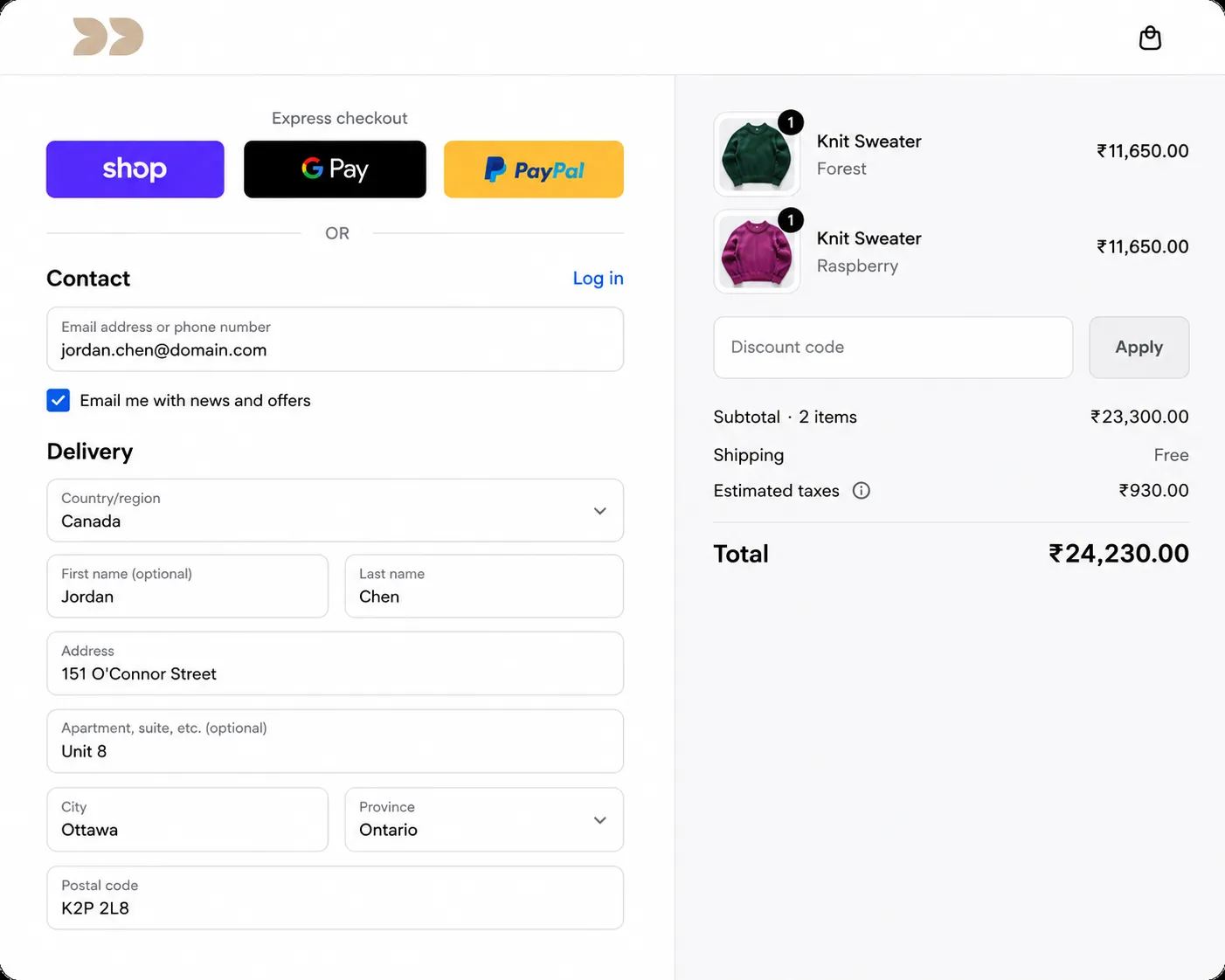
Cart and Checkout-Related Experience Review
Depending on the store, Shopify plan, checkout extensibility options, and available functionality, we can review and improve:
- Cart layout
- Cart information
- Upsell and cross-sell opportunities
- Checkout-related user flows
- Calls to action
- Mobile cart experience
- Shipping and payment information presentation
- Purchase-path usability
Shopify checkout customization is subject to Shopify’s checkout extensibility framework, plan-level access, app compatibility, and available extension points.
Shopify Speed Optimization
Store performance affects the shopping experience across desktop and mobile.
Our optimization work can include:
- 01Image optimization
- 02Script review
- 03App impact review
- 04Theme code improvements
- 05Media optimization
- 06Page structure improvements
- 07Performance-focused development
We focus on practical improvements that may reduce avoidable storefront friction and improve loading or responsiveness, subject to Shopify’s theme, app, script, and platform constraints. App scripts and third-party code should be reviewed carefully because they can introduce performance issues or conflict with themes.
Mobile-First Shopify Optimization
A Shopify store needs to work across different screen sizes, not just on desktop.
We review and improve:
- Mobile navigation
- Responsive layouts
- Product pages
- Collection pages
- Buttons and CTAs
- Images and media
- Forms
- Cart experience
- Content spacing
- Mobile page performance
The goal is a consistent shopping experience across devices. Testing should cover supported browsers, screen sizes, navigation, forms, variants, cart interactions, sticky elements, and media behavior.
Conceptual layouts only. Not a client website.
Shopify App & API Integrations
Your store may depend on multiple systems for marketing, operations, customer management, shipping, inventory, analytics, and more.
BIE can support integrations involving:
Integrations are planned around the functionality your store actually needs.
Integration work depends on API access, authentication, data mapping, rate limits, app capabilities, Shopify plan, and the responsibilities of the third-party provider.
Custom Shopify Functionality
When standard theme features are not enough, custom development can help extend your store.
Custom functionality may use Liquid, theme sections, JSON templates, app blocks, app embeds, Shopify Functions, or external integrations depending on the requirement. The available approach depends on the store architecture and Shopify plan. Shopify’s current app-extension model supports app blocks and app embed blocks for online-store themes.
Custom functionality may include:
Shopify SEO Structure
A store redesign should not ignore search visibility.
SEO is considered alongside the redesign so improvements to the user experience do not unnecessarily compromise your existing search structure. A redesign should preserve important URLs where possible, map redirects when URLs change, review canonical and metadata behavior, maintain internal links, and verify structured data and analytics after launch.
Our Shopify optimization work can consider:
A Complete Shopify Store Revamp
Your store is made up of many connected experiences. We can work on individual sections or coordinate improvements across the wider store.
Conceptual layout. Not a Shopify screenshot.
Homepage
Improve first impressions, product discovery, messaging, navigation, and calls to action.
Product Pages
Make product information, media, variants, benefits, and purchase actions easier to understand.
Collection Pages
Improve browsing, filtering, sorting, product cards, and category discovery.
Navigation
Create clearer menus and pathways that help shoppers reach relevant products faster.
Cart
Improve cart presentation, product information, recommendations, and the path toward checkout.
Mobile Experience
Adapt layouts, interactions, content, and functionality for smaller screens.
Landing Pages
Create focused pages for campaigns, product launches, categories, promotions, and specific audiences.
Custom Sections
Add branded and purpose-built sections beyond what your existing theme provides.
Store Functionality
Connect or review the tools, applications, and features required to support your ecommerce operation, subject to Shopify, app, API, and plan-level limitations.
How We Revamp a Shopify Store
Review the Existing Store
We begin by understanding your current Shopify store, including its design, structure, navigation, product pages, functionality, mobile experience, performance, and existing requirements. We review the current Shopify plan, theme architecture, templates, apps, integrations, analytics, product catalog, and existing technical constraints.
Identify the Improvement Areas
We identify where the current experience can be improved, whether that means a visual redesign, better UX, theme customization, performance work, new functionality, or a combination of these. We distinguish between design problems, content problems, theme limitations, app conflicts, performance issues, integration requirements, and Shopify platform constraints.
Plan the New Experience
Before development, we define the page structure, content hierarchy, user flows, functionality requirements, and design direction. We define the required templates, sections, blocks, navigation, user flows, functionality, redirects, data dependencies, and launch requirements.
Design & Develop
Our Shopify designers and developers work on the approved improvements, including theme customization, custom sections, templates, responsive layouts, integrations, app configuration, and other agreed development.
Optimize Across Devices
We review the updated store across desktop, tablet, and mobile experiences to identify layout, usability, and responsive issues. We review supported screen sizes, browsers, product templates, collection templates, navigation, forms, variants, cart actions, and responsive behavior.
Test the Store
We check key pages, navigation, product interactions, forms, cart functionality, integrations, and other relevant store elements before launch. Testing may include functional QA, responsive QA, app and integration checks, analytics verification, redirects, forms, product interactions, and purchase-path review.
Launch & Continue Improving
After the revamp, the store can continue to be monitored, maintained, and improved as products, apps, customers, and business requirements evolve.
Do You Need a Shopify Revamp or a New Store?
Not every Shopify store needs to be rebuilt from the ground up.
A Shopify Revamp May Be Right When:
- Your existing theme can support your requirements
- The store structure is still useful
- Your brand needs a visual update
- Specific pages need improvement
- You need better mobile responsiveness
- You want new custom sections
- Your current functionality can be improved
- The current theme architecture is maintainable
- Existing apps are compatible with the desired changes
- Required functionality can be supported through available Shopify extensions
- The current product and collection data can be retained
A Broader Rebuild May Be Worth Considering When:
- The existing theme heavily limits your requirements
- Multiple parts of the store need to be redesigned
- The current codebase has become difficult to maintain
- Major functionality needs to change
- The existing user journey needs a complete restructuring
- The theme uses outdated or heavily modified code
- Multiple apps create conflicts or duplicate functionality
- The current theme cannot support required sections or templates
- A migration to a newer Online Store architecture is needed
- The store requires major data, integration, or URL restructuring
We can assess your current store, theme, apps, integrations, and customer journey to determine whether targeted improvements, theme migration, or a broader rebuild is the appropriate direction.
Shopify Revamp Features
Frequently Asked Questions
What is a Shopify store revamp?
+
A Shopify store revamp is the process of improving an existing Shopify store’s design, user experience, functionality, performance, structure, or other ecommerce elements. Depending on the store, a revamp can involve targeted improvements or a broader redesign. A revamp can include changes to an existing theme, a theme migration, template restructuring, custom sections, app or integration work, performance review, SEO migration, and responsive QA.
What do Shopify Store Revamp Services include?
+
BIE’s Shopify Store Revamp Services can include theme redesign, homepage improvements, product page optimization, collection page improvements, navigation, mobile optimization, speed optimization, custom sections, app integrations, SEO structure, cart improvements, and custom functionality. The exact scope depends on the Shopify plan, existing theme, apps, integrations, product catalog, and functionality required.
Can BIE redesign my existing Shopify theme?
+
Yes. Shopify theme customization and redesign can be part of a store revamp. The work can focus on visual design, layout, responsiveness, functionality, or a combination of these areas. The available approach depends on the theme’s codebase, Online Store architecture, existing customizations, app compatibility, and Shopify plan.
Can you improve Shopify product pages?
+
Yes. Product page improvements can include layout, product information hierarchy, images and media, benefits, variants, calls to action, recommendations, reviews, and mobile usability. This may include product templates, media, variants, pricing, inventory messaging, reviews, related products, product information, and purchase actions.
Can you improve my Shopify store’s mobile experience?
+
Yes. Mobile optimization can include responsive layouts, navigation, product pages, buttons, forms, images, cart experience, and other mobile-specific usability improvements. Testing should cover supported browsers and device sizes, navigation, product templates, collection pages, forms, variants, cart actions, media, and page performance.
Can you add custom functionality to a Shopify store?
+
Yes. Depending on the requirement, BIE can support custom sections, dynamic content, app blocks, app embeds, product recommendations, filtering and search, landing pages, third-party integrations, and other functionality supported by Shopify’s current platform and the store’s plan.
Can you integrate third-party Shopify apps and tools?
+
Yes. BIE can support integrations involving payment solutions, CRMs, shipping systems, inventory tools, email marketing platforms, analytics, customer reviews, and other third-party applications or APIs. Integration feasibility depends on API access, authentication, data mapping, app compatibility, rate limits, platform permissions, and third-party support.
Will a Shopify revamp improve my conversion rate?
+
A revamp can address elements that influence the shopping experience, such as navigation, product presentation, calls to action, mobile usability, speed, and checkout-related friction. However, no redesign can guarantee a specific conversion-rate improvement. Conversion changes should be validated through appropriate analytics, testing, and business-context review rather than assumed from design changes alone.
Will a Shopify redesign affect SEO?
+
It can. Changes to URLs, templates, navigation, content, metadata, structured data, images, internal links, and page performance can affect search visibility. A redesign should include URL mapping, redirects where needed, metadata review, sitemap and indexing checks, analytics verification, and post-launch monitoring.
Do you need to rebuild my entire Shopify store?
+
Not necessarily. Some stores only need targeted improvements to their theme, pages, navigation, functionality, or performance. We can assess the existing store before determining the scope of work. The decision should consider the theme architecture, app dependencies, data structure, integrations, URL changes, Shopify plan, and required functionality.
Can BIE optimize Shopify store speed?
+
Yes. Shopify speed work can include reviewing images, scripts, apps, theme code, media, third-party tools, and page structure. Results depend on Shopify’s platform constraints, the theme, app behavior, media, and available implementation options.
Can you customize my Shopify checkout?
+
Checkout-related work depends on the Shopify plan, checkout extensibility options, available apps, and the specific requirement. Shopify controls the checkout environment, so unrestricted custom checkout development is not available in the same way as storefront theme development.
Can Shopify apps affect store performance?
+
Yes. Apps and third-party scripts can affect theme behavior and performance. BIE can review app usage, script impact, duplication, and integration requirements, but changes may require approval or support from the app provider.
Turn Your Existing Shopify Store Into a Better Shopping Experience
A focused revamp can address outdated design, difficult navigation, product-page clarity, mobile usability, performance issues, limited functionality, app conflicts, and other areas that may be creating friction in the shopping experience.
BIE can help you identify what needs to change and plan a Shopify store experience that is clearer, more functional, maintainable, and aligned with your ecommerce goals.