November 6, 2026
Amazon FBA New Selection Program 2026: Turn Lower Launch Costs Into Stronger Product Growth
Amazon is an opportunity for further growth, but also poses serious financial risks. Before an ASIN starts generating consistent sales, a seller might need to cover the costs of manufacturing, international freight shipping, preparation for FBA, product photography, writing for listings, paying for Amazon Vine, applying coupons, running ads, storage, refunds and recovering inventory. If demand builds slower than expected, these costs can weigh down margin, especially before the product even has a chance to prove itself.
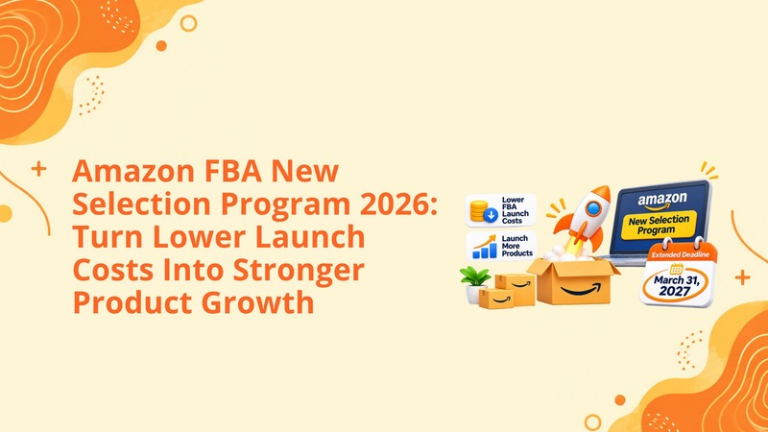
The Amazon FBA New Selection Program 2026 aims to alleviate some of these early challenges for new brands that are coming to FBA for the first time. Amazon expanded the enrollment period until March 31, 2027, allowing sellers to learn more about the program and benefit from it.
Nevertheless, only enrolling won’t ensure success. Sellers must know about what the program entails and which products qualify for it along with the timing of benefits’ activation so that they are able to incorporate savings into their practices.
We will clarify what the Amazon FBA New Selection Program 2026 is about, how the program can help sellers, and what actions have to be taken before the enrollment deadline by businesses.
The Amazon FBA New Selection Program 2026 is meant to support the launch of parent ASINs having a brand that have never been sold by any seller using FBA before.
A parent ASIN being new to FBA means that this product has not had any delivery made through that service by any seller in the past 12 months. This distinction is important because simply launching an offer for new products does not necessarily mean that these products are eligible.”
The new program completely replaces the previous version of the program for qualifying ASINs used throughout the period after July 30, 2026. Products that have been already receiving benefits from the previous program can keep receiving them for the period while they remain eligible for them.
The program launched in 2026 provides new opportunities to reduce some initial expenses when selling selected products and facilitating their discovery in the marketplace. Some of the benefits that can be gained in the result of joining the new program include reduced referral fees, storage relief, promotional credits, returns processing support, and liquidation assistance.
The enrollment/confirmation period has been extended by Amazon until March 31, 2027. Although sellers may view this as giving more time for eligible sellers, they should not use this as an excuse to procrastinate on their preparations.
A strong Amazon launch can require several months of coordinated work. Sellers may need to:
If sellers wait until the deadline arrives, they may miss out on crucial time for planning their future actions. Getting the necessary enrollment early helps sellers plan their activities before the deadline takes effect.
This time is most critical for the Provisional sellers since they get benefits only until March 31, 2027.
The main point which makes this program beneficial is the price fluctuation during different phases of the product launch.
The online merchants are eligible for loans which can lead to a decrease in the commission amount to 10% (or to the lowest percentage under the rules for this category) for the first 100 units.
With the second batch of 100 units the sellers would have either a 5% commission or the current commission if it is less than 5%.
The customer should be able to claim these advantages within the following 120 days after making the first shipment. It can be assumed that there is going to be a significant change in sales prices during the first batch of units, therefore the reduced sum of the commission becomes an efficient tool for ensuring profit during the pricing experiments.
At the same time, the sellers should take into account that saving on the commission fee may rise. This means that the discounted commission may be based on the full price, which includes shipping and some other costs.
In case you qualify the first 200 successful units you will receive your monthly storage free of charge for 120 days following your first FBA inbound date.
This will help sellers lower their launch inventory carrying costs while demand develops.
Especially if a seller has to keep enough inventory to avoid stockouts but does not have a solid sales history yet.
One should not take advantage of free storage without restraint as the period of free storage takes only up to 120 days after which units not meeting the limit will incur standard fees. When planning their stock they should be guided by realistic demand forecasts and replenishment plans.
During the 120-day period of the program, the first 200 qualifying units may be exempted from low inventory level charge.
New ASINs do not have a long sales history, making it hard to forecast their demand. The waiver provides flexibility to sellers while Amazon collects performance information and the marketplace understands the speed of product sales.
The exemption is only more of a cushion than a replacement for inventory management. Stockouts can still disrupt advertising and remove organic visibility and slow the collection of the reviews.
Eligible Units must avoid storage utilization charges during the benefit window.
Such charges provide some financial relief in paralyzing the growth of the product during the introduction period; however, the seller must monitor aged inventory, sell-through, and weeks of cover. Post-benefit period, slow-moving stock can become more expensive.
Qualified Parent ASINs may qualify for up to $75 in credits towards the cost associated with enrolling in the Vine program, which depends on the level of Vine involved.
Amazon Vine allows the product that is a part of the program to receive honest reviews from invited reviewers. Reviews received early can help consumers understand the product’s quality, benefits, and limitations.
The product must be sent and registered during the time of the early-launch. Thus, sellers must prepare the inventory intended for taking part in the program in advance.
It is not appropriate to use Vine as a substitute for a low-quality product. Early reviewers can quickly identify problems with the product, and therefore all issues related to the design, instruction and quality should be solved before joining the program.
Eligible products may receive coupon variable fee credits amounting to $50 from the program which ideally should be executed in the first 60 days of posting a sale.
Coupons have the power to create awareness and stimulate initial sales; however, it is important for merchants to assess total expenses incurred for running the promotion. Promotion that boosts sales but takes away contribution margin does not guarantee success.
The best coupon strategy takes into consideration selling price, item cost, FBA fees, promotional expenses, sales conversion rates, and customer’s lifetime value.
The program has a choice of doing away with the burden of client returns processing costs and liquidation costs with the first 200 units within 120 days. This type of loss mitigation will help in case a new product is returned unexpectedly or does not meet anticipated demand. Providing liquidation for free will mean that a new exit for the unsold stock becomes possible.
Nevertheless, a high return rate might indicate that some deeper issue has to be addressed. Sellers should analyze the reasons for returns, ratings of the products, complaints of the customers, and the correctness of the listings. Understanding the problems is more valuable than simply using a short-term exemption from the fees.
Sellers are required to have a Professional selling plan and FBA enabled for qualifying ASINs. Generally speaking, for accounts that have been assigned an Inventory Performance Index score, the account will require a trailing 6-month maximum of at least 300 in terms of the IPI score.
Product-level requirements include:
Both standard size and non-standard-size products qualify per the revised rules.
Not eligible are products in the categories of books, DVDs, music, software, computer and video games, videos, video game consoles and accessories, and Amazon Haul ASINs. Sellers must check their account eligibility before they buy or send inventory.
Excluded are non-branded ASINs.
Careful consideration is necessary for the relationship between New Selection Program and New Seller Incentives.
Both programs provide the same benefit, such as referral-fee credits, Vine credits, or coupon credits—but their benefits do not stack. The eligible New Seller Incentives will typically be used first.
Any benefit that is specific to New Selection Program, be it the storage exemptions, customer returns processing, or liquidation support, will likely continue to apply based on the relevant terms. Once New Seller Incentives run out or become expired, the New Selection benefits will then begin to be applied.
Sellers should not combine the value of the two programs when computing future savings from the launch process. The Seller Central incentive dashboard can provide the relevant information about the benefits which can be used in each case.
The New Selection Program incentive dashboard can show one of four statuses:
Currently, the account is not availing itself of any benefits. The seller concerned may either not fit the eligibility criteria, has failed to send in qualifying ASINs, or has to rectify an eligibility issue.
The seller is eligible to avail itself of the assigned criteria, however completing the enrollment process is still necessary to avail the benefits. The seller will enable the enrollment option to accept the program terms.
Benefits could be received until March 31, 2027, and the seller must check its enrollment to avoid losing benefits on the newly added ASINs after that date.
The seller has been enrolled in the program and qualifying ASINs can get benefits from it. The seller's enrollment remains active as long as the seller fulfills the program requirements.
The sellers must maintain both screenshots or other records confirming the fulfillment of their requirements.
Enrollment should be part of a larger launch-readiness process.
Before you can trust the advantages in a financial forecast, make sure you have searched through Amazon's product eligibility tool and checked the ASIN history. Even if you have purchased a product, this does not guarantee that the product will be eligible for your FBA.
Include:
Calculate profitability with and without program benefits. The product should not become financially unviable the moment the introductory benefits end.
Creating a listing that is focused on SEO involves the utilization of clear titles, bullet points focusing on benefits, appealing descriptions of the products, proper search terms backend content while ensuring the presence of important images and A plus content if possible.
Oftentimes, the listing should be able to answer all significant questions from the customers prior to the advertising, as sending advertisements before that can lead to budget waste and damaging conversion data.
The early benefit windows are quite rapid. Develop a timeline of product launch, which will display when the product goes to sale, the time when you are enrolled to Vine, coupon launch and when PPC campaigns turn on.
Do not initiate all the tactics at once. Use an incremental approach so that you can understand what influences your impressions, clicks and conversions and sales.
The first 200 units qualify for many of the key features of the program; hence, this is a number worth consideration when planning. This may not necessarily be the exact order that should be placed for any other item.
Consider production minimums, lead times, projected demand per day, seasonality, time needed to replenish stock, and available funds. It should be possible to ensure neither a shortage nor an excessive amount of stock within 120 days.
The New Selection Program can lower costs, but it cannot manufacture demand.
A product still needs:
Short-term savings can mask bad unit economics. The company could be pleased about reduced rates even as it continues to make losses due to increased advertising expenses, poor conversion, returns, or markdowns.
Use contribution margin after accounting for advertising costs rather than revenue or units shipped. The goal should be to leverage the benefit window in order to sustain the offering.
We help Amazon sellers get from enrollment to execution.
Our process starts with a launch-readiness review. We look at the product’s eligibility, the environment, search demand, projected fees, price position, margin, inventory needs and operational risks.
From there, we can build and manage a coordinated launch strategy that includes:
This coordinated approach matters because Amazon launches are connected. PPC success depends on listing relevance and conversion. Conversion depends on pricing, reviews, visuals and how clear the product is, to customers. Inventory planning depends on demand, advertising plans and how long it takes to restock.
We bring all these decisions together into one strategy. The goal is to use the New Selection Program’s short-term benefits to build long-term visibility, conversion and better unit economics.
Eligible sellers have until March 31, 2027, to enroll or confirm continued participation under the updated program terms.
A qualifying parent ASIN generally must not have had an FBA shipment from any seller during the previous 12 months.
No. The 2026 program is intended for eligible branded new-to-FBA parent ASINs.
Overlapping benefits do not stack. New Seller Incentives generally apply first, while unique New Selection benefits may remain available under the program terms.
Many storage, fee-waiver, returns, and liquidation benefits apply to the first 200 qualifying units for 120 days from the first eligible FBA inbound date. Vine and coupon credits generally have a shorter 60-day usage window.
We can help you assess which products qualify, predict the financial results of a launch, create content that drives conversions, organize offers and handle advertising from the start all the way to growth.
We’ll also help you figure out which ASINs are ready for launch, what benefits might be available and what steps need to be taken before your inventory gets to Amazon.
Schedule a strategy call with our team.
Follow Big Internet Ecommerce (BIE) on Instagram & LinkedIn to stay updated with the latest trends in Amazon selling.
Fill out the form and our experts will get back
to you within 24 hours.


We respect your privacy. Your information is safe with us.