October 15, 2026
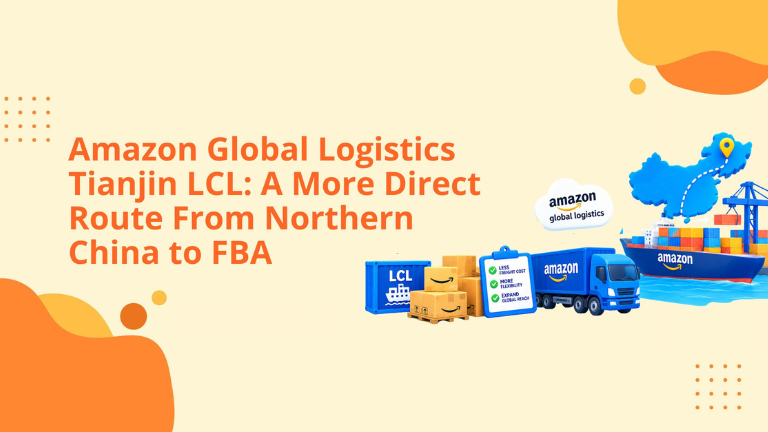
Amazon Global Logistics Tianjin LCL: A More Direct Route From Northern China to FBA
A New Shipping Opportunity for Amazon Sellers Sourcing in Northern China
For Amazon sellers, inventory profitability is influenced long before a product reaches a fulfillment center.
Factory location, inland transportation, shipment size, port selection, freight method, inventory placement, and delivery timing can all affect the final cost of every sellable unit.
Amazon Global Logistics has introduced Standard Ocean less-than-container-load service departing directly from Tianjin, identified by the port code CNTXG. Sellers can deliver eligible loose cargo to Amazon’s local Tianjin warehouse, after which AGL manages its movement toward Amazon fulfillment destinations in the United States, European Union, and United Kingdom.
This creates a potentially valuable alternative for sellers sourcing from Northern China.
Instead of transporting inventory hundreds of kilometers to Shanghai, Ningbo, Shenzhen, or another distant port, eligible sellers can evaluate a shipping route that begins closer to their suppliers.
The update is not only about adding another port. It may help sellers reduce unnecessary inland transportation, move smaller inventory quantities, simplify freight coordination, and create a more flexible FBA replenishment strategy.
Amazon Global Logistics Tianjin LCL is an ocean-freight service for sellers whose inventory does not fill an entire shipping container.
LCL stands for “less than container load.” Under this shipping model, cargo from multiple businesses shares space inside one container. Each seller pays for the space occupied by their shipment instead of paying for a complete container.
With the Tianjin service, sellers can deliver eligible cargo to the local AGL warehouse. Amazon Global Logistics then coordinates the international transportation process and moves the shipment toward the selected Amazon fulfillment destination.
The process generally follows this path:
Exact steps, timelines, documentation, eligibility, and costs may vary by product, destination, and shipment plan. Sellers should review current requirements and quotes through the AGL portal before booking.
The new service gives sellers sourcing from Northern China another way to connect their factories with Amazon’s international fulfillment network.
Previously, some sellers may have transported inventory to a distant port because that was where their freight provider operated or where an established shipping route began.
That domestic journey could add expenses before the international shipment even started.
These costs may include:
If a factory is located closer to Tianjin, using a local origin warehouse may reduce unnecessary movement and make the supply chain easier to manage.
However, sellers should not assume Tianjin will automatically be the least expensive option. The correct decision should be based on total landed cost, transit requirements, route reliability, placement costs, shipment volume, and inventory urgency.
Northern China includes manufacturing regions that supply a wide range of Amazon product categories. Sellers working with factories in Tianjin, Beijing, Hebei, Shandong, Liaoning, and nearby areas may now have a more practical AGL origin option.
The value comes from connecting the shipment origin more closely with the manufacturing location.
A shorter domestic journey may mean fewer transportation handoffs, lower trucking costs, less coordination, and a reduced risk of avoidable delays.
For growing Amazon brands, these improvements can affect more than logistics. They can also influence inventory availability, advertising continuity, sales velocity, cash flow, and overall profitability.
Moving goods across China before export can become one of the less visible costs in an international supply chain.
If inventory is manufactured near Tianjin but shipped through a distant port, the seller may be paying for a long domestic trucking route before paying for ocean transportation.
Using the Tianjin warehouse may shorten that origin journey.
The actual savings will depend on the factory’s location, shipment dimensions, carrier rates, handling charges, and current logistics arrangement. Sellers should compare complete origin costs instead of focusing only on the quoted ocean-freight rate.
Waiting to accumulate enough inventory for a full-container load can delay replenishment and tie up working capital.
LCL shipping allows sellers to move smaller quantities by sharing container space with other shipments. This can be useful for:
This flexibility may help sellers align their shipping volume more closely with actual demand.
Inventory planning rarely moves in a straight line.
Sales may rise unexpectedly, a promotion may outperform forecasts, production may finish in stages, or one SKU may sell much faster than the rest of the catalog.
Tianjin LCL gives eligible sellers another way to move ocean freight without waiting for every product to be ready or committing to a complete container.
Smaller and more frequent shipments may help sellers balance two costly risks: sending too much inventory too early and running out of stock while waiting for a larger shipment.
According to Amazon’s announcement, the Tianjin LCL service supports eligible shipments moving toward fulfillment destinations in the United States, European Union, and United Kingdom.
Amazon identifies routes through 10 US ports, Rotterdam, and Felixstowe.
This broader coverage may help international brands use one AGL origin point for inventory serving several major Amazon markets.
Availability does not mean every seller, ASIN, destination, or shipment plan will qualify. Sellers should confirm current route and product eligibility during the booking process.
Traditional international shipping may involve separate freight forwarders, warehouses, customs brokers, domestic carriers, and delivery appointments.
AGL is designed to create a more connected route into Amazon’s fulfillment network.
That can reduce the number of external providers a seller needs to coordinate. It may also provide better visibility between shipment creation, transportation, placement, and fulfillment-center receiving.
This does not remove the seller’s responsibility to verify product compliance, labeling, documentation, customs information, shipment details, and delivery requirements.
Tianjin LCL will not be the best option for every inventory movement.
It is most relevant when the shipment is smaller than a full container, the supplier is located in Northern China, and ocean transit fits the inventory timeline.
Full-container shipping may be more economical when a seller has enough volume to use most or all of a container. It can provide greater control over the shipment, but it also requires more inventory and working capital.
Air freight may be appropriate for urgent replenishment, product launches, lightweight goods, or stockout recovery. It is faster than ocean freight but generally carries a higher transportation cost per unit.
Shipping through another ocean port may still make sense when the supplier is closer to that location, the seller has better negotiated rates, or the route provides more suitable schedules and destination options.
The best freight method depends on:
Sellers can also use a blended strategy. For example, a small air shipment might protect short-term availability while the larger replenishment quantity moves through Tianjin by ocean.
The lowest freight quote is not always the lowest-cost shipping strategy.
To evaluate the Tianjin option properly, sellers should calculate the complete landed logistics cost per sellable unit.
That calculation should include:
Divide the total logistics cost by the number of sellable units expected to reach Amazon.
This creates a more useful comparison between Tianjin LCL, another ocean route, full-container shipping, air freight, or an independent freight-forwarding arrangement.
Amazon states that Tianjin LCL shipments can support several placement approaches for US-bound inventory, depending on program and shipment eligibility.
Minimal shipment splits can reduce the number of receiving destinations assigned to a shipment. This may simplify preparation and transportation, but sellers should review any applicable placement costs.
With Amazon Managed Placement, Amazon determines how inventory is distributed across its network. This can reduce the seller’s placement planning workload, although the related fees and shipment requirements should be evaluated.
Seller Managed Placement provides the seller with greater responsibility for meeting the selected distribution plan. It can offer more control but may require additional coordination and transportation planning.
Amazon Warehousing and Distribution can provide upstream storage before units are replenished into FBA.
This may help sellers import larger quantities without placing every unit directly into FBA storage. It can be useful for brands that want to maintain reserve inventory closer to Amazon’s fulfillment network.
The right placement option depends on sales velocity, FBA capacity, shipment size, storage economics, and the date by which inventory must become available.
Amazon states that AGL rates are published without hidden fees and that sellers can pay in CNY, USD, EUR, or GBP.
The announcement also says that charges are initiated after the shipment completes processing at the fulfillment center.
This timing may support cash-flow planning for some businesses. However, sellers should still review the complete booking terms and understand which costs are included.
Additional obligations may include customs duties, taxes, storage, insurance, product preparation, inspection, or services outside the standard freight quote.
The payment structure should therefore be evaluated alongside the complete landed cost—not treated as evidence that the shipment has no upfront financial impact.
This service may be a strong option if your business:
It may be less suitable if your factory is closer to another port, your shipment can efficiently fill a container, your products face special transportation restrictions, or ocean transit cannot meet your inventory deadline.
Review whether the product can move through AGL and enter the destination country legally.
Dangerous goods, batteries, oversized products, restricted categories, and regulated products may require additional documents, special handling, or another freight service.
Confirm carton dimensions, shipment weights, FNSKU labels, box-content details, product preparation, pallet requirements, and destination-specific rules.
Incorrect shipment data can create delays, adjustments, or receiving problems.
Work backward from the date the units need to become available for sale.
Include production time, supplier preparation, origin delivery, consolidation, departure schedules, ocean transit, customs processing, destination transportation, and fulfillment-center receiving.
Request a current AGL quote and compare it with your existing route using the same shipment data.
A reliable comparison should include every major expense—not only the international freight rate.
If the ocean shipment will not arrive before existing inventory runs out, consider whether a limited air shipment is needed to bridge the gap.
The objective is to protect availability without moving the entire replenishment order through a more expensive freight method.
Start with one real upcoming shipment instead of making a broad logistics change across the entire catalog.
To understand whether the new route is improving the business, monitor:
A successful route should improve the complete inventory system—not simply produce a lower freight invoice.
Freight strategy and marketplace performance are closely connected.
When inventory arrives late, sellers may lose sales, organic ranking, advertising momentum, and customer visibility. When too much inventory arrives too early, storage expenses and working-capital pressure can increase.
This is why logistics decisions should be reviewed alongside demand forecasting, PPC performance, listing conversion, catalog health, and SKU-level profitability.
Big Internet Commerce helps Amazon sellers and D2C brands strengthen marketplace growth through Amazon PPC management, SEO, listing optimization, A+ Content, creative services, catalog management, inventory health, Store Management, and broader marketplace strategy.
For sellers evaluating Tianjin LCL, the most important question is not simply, “Can we use this service?”
The better question is: Can this route improve inventory availability and profitability for the right SKUs?
If your team needs help connecting inventory decisions with advertising, listings, catalog performance, and marketplace growth.
It is an AGL Standard Ocean service that allows eligible sellers to ship less-than-container-load cargo from Tianjin toward Amazon fulfillment destinations in the US, EU, and UK.
No. LCL shipping allows cargo from multiple businesses to share container space, so sellers can ship smaller inventory quantities.
Sellers sourcing from Northern China who currently transport inventory to distant ports or regularly ship below full-container volumes may benefit most.
Amazon identifies Amazon Warehousing and Distribution as a possible placement option. Sellers should confirm eligibility during shipment creation.
Visit the Amazon Global Logistics portal, create or update your profile, build the shipment in Seller Central, and select Amazon Global Logistics as the shipping method.
Amazon Global Logistics Tianjin LCL gives sellers sourcing from Northern China a potentially more direct way to move smaller ocean shipments toward Amazon fulfillment destinations in the US, EU, and UK.
It may help reduce inland transportation, avoid waiting for a full container, improve replenishment flexibility, and simplify logistics coordination.
However, results will depend on factory location, shipment volume, product eligibility, destination, placement selection, transit requirements, and total landed cost.
Before changing your shipping process, test the route with a suitable shipment and compare the actual outcome with your existing logistics model.
The right decision is the one that protects both inventory availability and profit.
Schedule a strategy call with our team.
Follow Big Internet Ecommerce (BIE) on Instagram & LinkedIn to stay updated with the latest trends in Amazon selling.
Fill out the form and our experts will get back
to you within 24 hours.


We respect your privacy. Your information is safe with us.