October 22, 2026
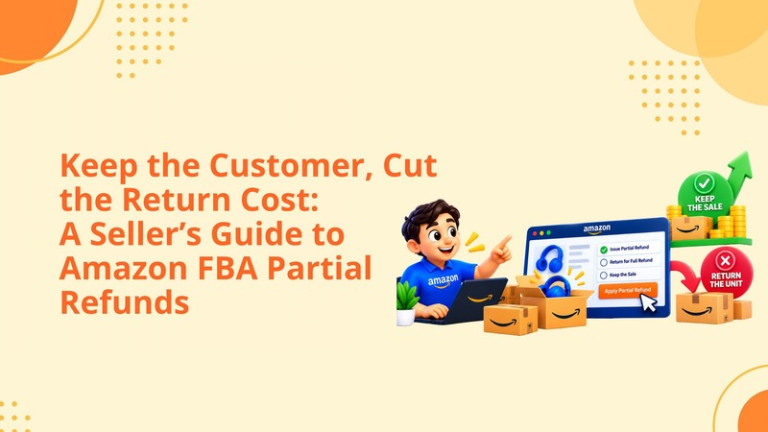
Keep the Customer, Cut the Return Cost: A Seller’s Guide to Amazon FBA Partial Refunds
Not Every Amazon Return Needs to Come Back
For many Amazon sellers, the cost of a return does not end with the customer’s refund.
A physically returned product may generate transportation costs, processing fees, inspection requirements, inventory delays, damage risk, removal charges, disposal expenses, or losses through liquidation. In some cases, the cost of receiving the product back can be higher than the value the seller ultimately recovers.
Amazon FBA Partial Refunds offers another possible resolution.
Eligible customers may be offered a percentage of their money back while keeping the product. Sellers can now choose which customer return reasons qualify and set different refund percentages based on those reasons.
That flexibility could help sellers reduce unnecessary physical returns. However, partial refunds still affect the ASIN’s return metrics, and the seller funds the refund. The program therefore needs to be managed as a financial strategy—not enabled across the catalog without analysis.
Amazon FBA Partial Refunds is a returns-management program that allows eligible customers to keep an enrolled product in exchange for a partial refund.
The basic process is:
The program is available to eligible FBA sellers in the US, UK, Germany, France, Italy, Spain, and Canada. Enrollment is managed separately for each store.
The main update is greater control over when Amazon can present a partial-refund offer.
Sellers can now select which customer return reasons qualify instead of applying a single broad rule without sufficient differentiation.
For example, a seller might decide that a minor cosmetic concern could qualify for a partial refund, while a report involving safety, contamination, missing components, serious damage, or complete product failure should continue through the standard return process.
Amazon provides two configuration options.
Sellers can create as many as three configurations based on return reasons.
Each configuration can use a different refund percentage. This approach may be easier for catalogs in which products have similar prices, margins, return economics, and risk levels.
However, applying a broad policy across all eligible ASINs can be risky when the catalog contains products with very different costs and resale values.
Sellers can download Amazon’s Excel template and specify the ASINs, return reasons, and refund percentages they want to include.
Multiple rows can be added for the same ASIN when different reasons require different refund percentages.
Products and reasons not included in the uploaded file continue through the regular return process.
This option requires more setup, but it gives sellers stronger control. It is generally the more appropriate starting point for brands that want to test the program without exposing their entire catalog.
The strongest potential benefit is avoiding a physical return when retrieving the product would destroy more value than it recovers.
If a product does not travel back to Amazon, sellers may avoid costs associated with transportation, processing, inspection, storage, removal, disposal, or liquidation.
The actual savings will differ by ASIN. Sellers should compare the partial-refund amount against the full cost of the standard return route.
A partial refund may resolve a minor issue without requiring the customer to repackage the item, print a label, visit a drop-off location, and wait for a replacement or full refund.
That convenience can support the customer experience when the product remains useful despite a limited concern.
Some returned products cannot be economically resold, even when they remain functional. Avoiding unnecessary transportation and disposal may reduce operational waste.
A customer reporting a small cosmetic concern should not necessarily receive the same resolution as one reporting that the product is defective.
Return-reason controls allow sellers to create more deliberate policies.
Amazon states that the high return-rate fee is not charged when a return is successfully resolved through FBA Partial Refunds because there is no physical return.
This does not mean the transaction is cost-free. The seller still pays the partial refund and must include that amount in the profitability calculation.
Sellers should not confuse “no physical return” with “no effect on return performance.”
Amazon states that partial refunds:
This distinction matters because a partial-refund strategy cannot fix the underlying cause of excessive returns.
If customers repeatedly report inaccurate sizing, poor quality, misleading images, incompatibility, missing components, or unexpected performance, partial refunds may reduce physical-return costs—but the ASIN can still experience increasing return metrics and customer dissatisfaction.
The program should manage the cost of selected returns, not replace product and listing improvements.
The most suitable ASINs are generally products for which:
Possible candidates may include selected low-cost home goods, accessories, replacement components, craft supplies, or products for which opened returns have little resale value.
The decision should always be based on actual unit economics rather than category assumptions.
Partial refunds may be inappropriate for:
Amazon already excludes hazmat, hygiene products, and non-returnable items from the program. Sellers should create their own additional restrictions based on risk and profitability.
The refund percentage should not be selected simply because it sounds attractive to the customer.
Start by estimating the financial result of a standard return:
Then compare that outcome with the proposed partial refund.
For example, imagine that retrieving and processing a low-value item would generate $12 in combined costs and the seller expects to recover only $4 from the unit. The standard return route creates an estimated net cost of $8, in addition to the customer refund.
If a $6 partial refund resolves the issue without a physical return, it could create a better financial outcome.
That is only a simplified example. Sellers should use actual ASIN-level figures and include the product cost, fees, contribution margin, return frequency, refund percentage, and recovery value.
Return reasons provide the context needed to determine whether a keep-the-item resolution is appropriate.
A partial refund may make sense when the customer reports a limited issue but still receives meaningful value from the product.
It may be unsuitable when the reason suggests:
Sellers should also monitor patterns. If one reason becomes unusually common, investigate the underlying product, packaging, or listing problem instead of increasing the refund percentage.
Not every customer who requests a return will receive a partial-refund offer.
Amazon states that it evaluates the customer’s profile and purchase history before approving participation. Its systems also monitor refund requests for possible abuse.
Customers do not know in advance which products are enrolled. When the customer or order does not qualify, the product follows Amazon’s standard return process.
This screening may reduce some abuse risk, but sellers should still monitor program performance rather than assuming every approved transaction is financially beneficial.
Yes.
Accepting a partial refund does not necessarily end the customer’s right to return the product during the applicable return period.
If the customer later completes a physical return, the amount already issued as a partial refund is deducted, and Amazon refunds only the remaining eligible balance.
This possibility is important when evaluating results. A transaction initially marked as a partial refund may later become a physical return.
Amazon advises sellers to check the FBA Returns dashboard after the relevant waiting period to verify the final resolution:
These periods allow time for customers who accepted a partial refund to subsequently return the product.
Eligible sellers can manage the program through Seller Central:
Amazon states that changes take effect immediately. Only return requests created after the setting is enabled can qualify.
Sellers using an Excel upload are responsible for the accuracy of the submitted information, so ASINs, reasons, and percentages should be checked before uploading.
Seller Central does not currently provide a dedicated downloadable report exclusively for FBA Partial Refunds.
Sellers can review individual activity through the FBA Returns dashboard. Amazon also sends a monthly FBA Partial Refunds Performance Report to the email address registered for Business Updates.
The monthly report covers a three-month period and includes a 30-day processing delay. That lag helps account for customers who accept a partial refund and later return the product.
Sellers should monitor:
The goal is not to maximize the number of partial refunds. It is to improve the net financial outcome without hiding customer-experience problems.
A controlled test is safer than catalog-wide enrollment.
Identify ASINs with meaningful return volume and determine the leading reasons.
Compare the estimated cost of a standard physical return with several possible refund percentages.
Remove restricted, regulated, hygiene-sensitive, safety-related, and non-returnable products.
Begin with products that have stable quality, clear return patterns, and predictable financial outcomes.
If customers are returning a product because the detail page is unclear, correct the content before using partial refunds to manage the consequences.
Because customers may still return products and reports contain processing delays, avoid judging the program from only a few days of data.
Add more ASINs only when the test demonstrates a better net outcome.
FBA Partial Refunds connects several areas of an Amazon business:
We help Amazon sellers evaluate these connected factors instead of treating returns as an isolated operational problem.
Our team can help:
A seller may not need a larger refund. The real solution might be clearer sizing, more accurate imagery, stronger packaging, improved instructions, better PPC targeting, or a product-quality correction.
They allow eligible customers to keep an enrolled FBA product while receiving a seller-funded partial refund.
Yes. Amazon counts them as customer returns, and they may affect the ASIN’s Frequently Returned badge.
Yes. Sellers can configure percentages by return reason for all eligible ASINs or upload selected ASINs through an Excel template.
Yes. If the return window remains open, the customer may return it. Amazon deducts the earlier partial refund from the remaining refund.
Amazon states that the program has no enrollment fee. However, the seller funds every partial refund and should evaluate the complete financial impact.
Amazon’s return-reason controls make FBA Partial Refunds more useful because sellers can decide when and where the offer should apply.
The program may help avoid costly physical returns, provide faster customer resolutions, and protect more value on selected low-recovery products.
But it does not erase the return.
Partial refunds still affect return metrics and may influence the Frequently Returned badge. Sellers fund the refund, and customers may still return the product during the applicable window.
The strongest strategy is therefore selective and evidence-based:
If you need help identifying which ASINs should enter the program or whether listing, advertising, quality, or packaging issues are driving your return costs.
Schedule a strategy call with our team.
Follow Big Internet Ecommerce (BIE) on Instagram & LinkedIn to stay updated with the latest trends in Amazon selling.
Fill out the form and our experts will get back
to you within 24 hours.


We respect your privacy. Your information is safe with us.