November 4, 2026
One Dashboard, Five Channels: How Amazon’s New Seller Central Tools Could Reshape Multichannel Selling
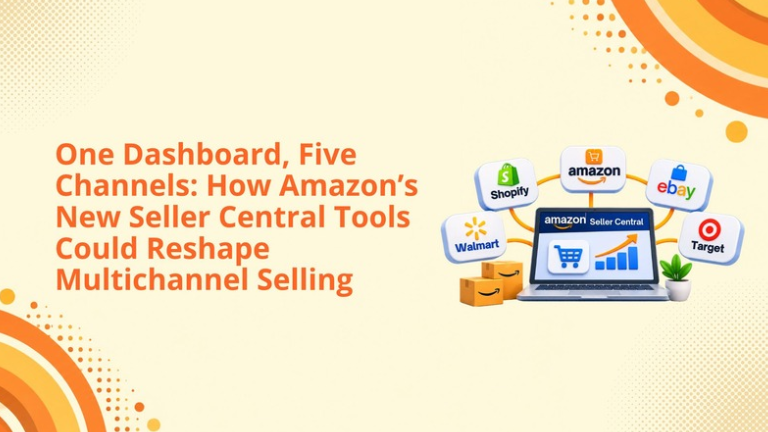
Selling on multiple ecommerce platforms can broaden a brand's exposure, minimize reliance on one channel and create new opportunities for revenue generation.
However, each new platform means keeping track of many additional listings, orders, inventories, reports and operational policies. For most merchants, the challenge is no longer about onboarding another online sales channel.
It is about ensuring that all the platforms work properly and profitably after the business goes live.
The new multi-channel selling tooling from Amazon’s Seller Central platform seeks to make that task easier. The toolbox allows qualified U.S. vendors to link their accounts on eBay, Shopify, TikTok and Walmart to their Seller Central account. Sellers can achieve management of all major listing, order and profit generating processes from a single location.
The new features are being rolled out gradually to the U.S. sellers without extra charge.
With the help of various tools for multichannel selling via Seller Central, sellers are capable of integrating their external sales accounts with their existing systems for managing their Amazon sales.
The connected channels currently highlighted by Amazon include:
Once available and connected, the tools can help sellers manage three major areas of multichannel commerce:
The objective is to minimize switching between various platforms in order to perform daily operational functions.
As an example, sellers may update their inventory in the Manage Products section and synchronize this data with all relevant sales channel accounts connected to the seller’s account. Each marketplace has its own requirements regarding content formatting which are taken care of automatically.
The most significant improvement is not merely the addition of yet another Seller Central function. Instead, it lies in the potential for more control over conducting ecommerce operations.
Historically, multichannel sellers have often relied on a combination of:
Such a dispersed approach could be feasible with a limited number of offerings. But as the number of orders, types of goods and marketplaces rises, more difficulties are encountered.
The new capabilities are supposed to combine several of the operations that had previously had to be performed separately.
Using a connected workspace could enable store owners to keep track of everything that happens on different platforms without having to seek for every piece of information manually. It could also minimize redundant operations.
Inconsistent catalogs in multichannel selling can engender great problems. For instance, if a brand changes its Amazon product listing, it may overlook making the same modification on Walmart; a new product image may appear on Shopify while an earlier version is reflected on eBay instead; a number of items in a package could also differ between different channels.
These inconsistencies can lead to:
The solution for product management offered by Seller Central helps sellers process their information efficiently through different medium.
According to Amazon, the AI tools it uses can make listing material suitable for different media. It could mitigate the need for content writing before product launches.
However, it does not mean that sellers should start posting AI-generated information without checking it for mistakes.
Before distributing an update, sellers should confirm:
Automation can speed up the process of content creation. However, the human check is vital for ensuring the material's correctness and effectiveness of conversion.
Management of orders gets more challenging when a seller needs to keep track of numerous dashboards during the day.
Separate order systems can create delays in:
Amazon provides sellers with tools that enable them to check their orders in one platform, no matter which channel the sale was done through.
For example, a Shopify order can be fulfilled through Amazon and after fulfillment is done Amazon sends tracking information back to Shopify, so customers can see what is happening with their package.
This saves a lot of time with administrative tasks and allows teams to adhere to an established order handling process.
Before using Amazon fulfillment for off-Amazon orders, sellers should still evaluate:
The centralised order view is important, but at the same time it is necessary to ensure that every fulfilment decision made is one that assures the customer experience and the product margin.
Some multichannel businesses may be aware of the revenue generated by each channel but have no idea about the amount of profit received via each channel.
A marketplace may produce strong sales while consuming margin through:
Its advanced system brings together sales, traffic and advertising data to enable sellers to evaluate performance across their channels.
This can help answer more useful questions:
Having a system that helps in evaluating every channel will not only lead you to equalize the contributions of different channels but will give each one of them their definite role in the business.
Updating the product information across several systems can require a whole lot of time. However, having an integrated workflow allows the time spent on various updates to be reduced.
Having one window for all orders can allow retailers process their orders faster, without needing to switch from one system to another.
Having integration between product data and order data provides sellers with better chances to see how demand is changing in different marketplaces.
However, in order to reap this benefit, sellers must have an unchanging SKU and stock-distribution rules put into place.
Integrating performance data may allow for decreased reliance on manually reconciled spreadsheets and accelerate the identification of critical trends.
Organizations may find it easier to plug in yet another online channel when they already have product data structures, order flow processes and fulfillment mechanisms in place.
Qualifying sellers may be able to rely on Amazon to fulfill more off-Amazon orders and use a better-organized inventory and logistics system to manage different marketplaces.
Prior to enabling broad synchronization, it is crucial to review the product information on Amazon, eBay, Shopify, TikTok, and Walmart.
Look for differences in:
If incorrect information already exists, connecting the systems may worsen the situation.
Each product should have a recognizable identity across the platforms.
For example, a medium red t-shirt should not have different SKUs for Amazon, Walmart, and Shopify if the integration process lacks proper mapping.
Poor SKU mapping can lead to:
Create a master SKU map before connecting large catalogs.
Sellers should know which platform is the source of truth for:
Without clear ownership, one update may overwrite another or create conflicting information.
Real-time and near-real-time synchronization is not devoid of any risks associated with overselling.
Establish safety-stock caps for fast-moving goods, and consider holding inventory back for those sales channels, which may have significant promotions, high-profit margins, or strict delivery requirements.
Every distribution channel has its specific rules and regulations, and categorization system.
A product description that does very well on an Amazon marketplace may not work well on a TikTok Shop. Likewise, Walmart's attributes may not match with Amazon's specifications. The product description in an eBay listing may differ as well.
Centralization must allow for channel-specific optimization, not eliminate it.
Begin with a controlled group of products.
Use ASINs or SKUs with:
Monitor the synchronization, fulfillment and reporting process before expanding the integration across the full catalog.
Before connecting accounts, sellers should confirm that:
This preparation reduces the chance that an integration error will affect the entire catalog.
Every channel facilitates a different shopping environment.
The TikTok Shop focuses on discovery shopping. Shopify gives the brands more control over their buyer's journey. Walmart captures shoppers keen on discounts. eBay treats its product categories, conditions, or buyer behaviors in a unique way opposed to Amazon.
Keep in mind that accurate product information is necessary, yet, selling strategies should vary.
Integration cannot be a replacement for catalog cleanup. Duplicated SKUs, wrong details and broken variations need to be corrected before synchronization.
More sales channels lead to faster movements of stock. Failure to have stock buffers and sufficient synchronization in place can cause escalated cancellations and delays.
High volume of sales does not mean high profits. Each sales channel must be considered in conjunction with marketing, marketplace, fulfillment costs, discounts and returns.
The new multichannel tools in Amazon Seller Central can alleviate streamlined operations; however, having the accounts connected do not make any decisions regarding what to sell, how to market and where to invest our efforts.
We assist brands to move from the technical connection to actual marketplace growth.
We offer a variety of tools which allow different internet shops to connect and share their product information and sales data.
Our team can help with:
Our goal should not be to market every item on all available marketplaces at once.
Rather, we are focused on finding the most appropriate products and the right channels and mechanisms for achieving profitability.
Actually, we help sellers figure out whether to start selling their ASINs via Walmart, whether TikTok Shop is the right option for product search, or whether they should concentrate on regular customers with Shopify, and also whether using Amazon fulfillment service makes any sense for off-Amazon sales.
We also help sellers determine what comprises operational processes which technology cannot implement businesswise, including content modifications, keywording strategy, advertising planning, promotion and results analysis.
The information received can be illustrated on a modern dashboard.
Amazon currently highlights eBay, Shopify, TikTok and Walmart as supported connections for the new multichannel tools.
No. Amazon says availability is rolling out gradually to U.S. sellers.
Amazon says the tools are being introduced to eligible U.S. sellers at no additional cost.
Eligible orders from connected channels may be fulfilled through Amazon, with tracking information returned to the original channel.
No. Core product facts should remain consistent, but titles, descriptions, keywords and offers should be adapted to each channel’s audience and requirements.
Amazon’s new solutions may make multichannel selling easier for US-based sellers by integrating listings, orders, and profitability data into Seller Central.
The real advantage will be not just in time savings but in gaining a better understanding of the business and making decisions about inventory, fulfillment, content, and investments quicker.
Sellers should approach the rollout carefully:
Multichannel business becomes scalable when all channels are connected through one operating model.
A multichannel readiness and growth consultation. Our team can help you integrate the right marketplaces, align your products and inventory, and develop an actionable growth plan around profitable sales—not added complexity.
Schedule a strategy call with our team.
Follow Big Internet Ecommerce (BIE) on Instagram & LinkedIn to stay updated with the latest trends in Amazon selling.
Fill out the form and our experts will get back
to you within 24 hours.


We respect your privacy. Your information is safe with us.