July 14, 2026
Amazon Business Pallet Delivery: How FBM Sellers Can Turn Bulk Orders Into Bigger B2B Growth
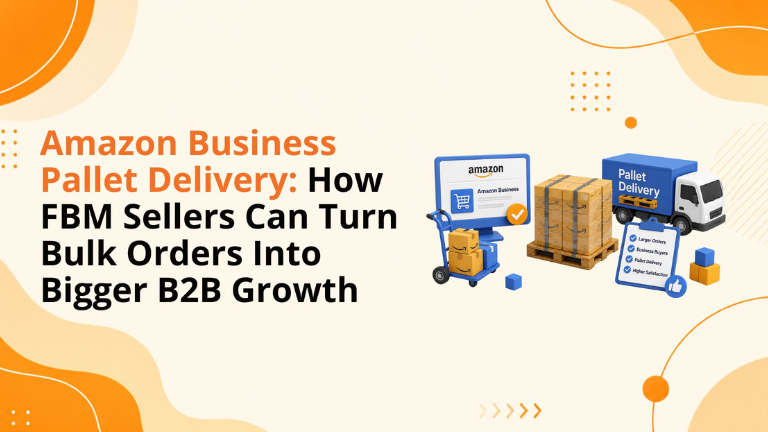
Amazon Business customers do not always buy one unit at a time.
Many businesses purchase in bulk for offices, warehouses, schools, clinics, restaurants, facilities, job sites, and commercial operations. For these buyers, standard parcel shipping may not be the most practical delivery method, especially when orders are heavy, bulky, or made up of multiple units.
That is why Amazon’s new pallet delivery option for eligible Fulfilled by Merchant Amazon Business orders matters.
Pallet delivery gives sellers a way to support larger B2B orders with a more suitable freight-style delivery experience. Instead of forcing bulk orders into a parcel shipping model, sellers can offer a delivery method that better matches how business customers receive inventory.
For FBM sellers, this update can create new opportunities to increase order value, improve fulfillment efficiency, and compete more effectively for Amazon Business demand.
Amazon Business buyers often care about more than speed.
They care about receiving accuracy, delivery planning, order consolidation, and whether the shipment can be handled properly at a commercial location. A large order arriving in multiple parcel boxes may be harder to manage than one palletized shipment.
Pallet delivery can make the buying experience more practical for customers ordering larger quantities.
For sellers, this can support bigger orders, cleaner operations, and better B2B positioning.
A strong Amazon Store Management strategy can help sellers identify which ASINs are best suited for Amazon Business growth and freight-style fulfillment.
Amazon Business pallet delivery is a shipping option for eligible seller-fulfilled Amazon Business orders.
It allows sellers to offer palletized delivery when the order meets certain requirements, such as commercial delivery, multiple units, and freight-level size or weight thresholds.
This option is especially relevant for sellers handling:
The main benefit is simple: the delivery method better matches the order type.
Business customers often have receiving areas, loading docks, warehouse teams, or specific delivery procedures.
For them, pallet delivery can be easier to receive than many separate parcels.
It can also reduce confusion when a large order is split across multiple packages. Businesses want shipments that are clear, consolidated, and easier to process.
This matters because delivery experience can influence repeat purchases.
If a business buyer has a smoother receiving process, they may be more likely to reorder from the same seller.
Bulk-friendly shipping can encourage larger orders.
If customers know a seller can support pallet delivery, they may feel more comfortable ordering higher quantities. This can help increase units per order and average order value for the right product categories.
However, sellers should not assume every ASIN is a good fit.
The best candidates are products with business demand, predictable replenishment patterns, strong margins, and shipping profiles that make sense for palletized delivery.
Sellers should review Amazon Business sales history, order quantity trends, freight costs, and contribution margin before enabling the option across products.
Pallet delivery can support larger orders, but freight costs must be managed carefully.
A bigger order does not automatically mean a better profit margin.
Sellers should calculate:
The goal is to use pallet delivery where it improves profitability and operational efficiency, not where it creates hidden fulfillment costs.
To enable pallet delivery, sellers need to configure the option inside Shipping Settings.
This includes selecting or creating a shipping template, enabling pallet delivery, and adding regions, transit times, and shipping fees.
This setup should not be rushed.
If regions are too broad, shipping costs may become difficult to control. If transit times are too aggressive, sellers may create delivery issues. If handling time is too short, warehouse teams may struggle to prepare pallet orders correctly.
A clean shipping template can help protect both customer experience and seller profitability.
Pallet orders often take longer to prepare than regular parcel shipments.
The product may need to be picked in larger quantities, packed securely, wrapped, labeled, staged, and scheduled with the right carrier.
If sellers use the same handling time as parcel orders, delivery promises may become unrealistic.
That can create late shipments, customer complaints, or account health risk.
Sellers should review warehouse capacity, staffing, pickup schedules, carrier availability, and preparation time before setting pallet-specific handling times.
Business customers need clear product information before placing larger orders.
If a buyer is ordering multiple units, they need confidence in dimensions, weight, case quantity, material, compatibility, specifications, packaging, and use case.
This is where Amazon Content Optimization becomes important.
Listings should clearly explain the product for both retail and business buyers. If the product is suitable for offices, warehouses, facilities, bulk use, or commercial environments, that value should be communicated clearly.
Strong Amazon Image Optimization can also help show product size, packaging, quantity, and business use cases more effectively.
Pallet delivery should not be viewed as only a shipping feature.
It can be part of a larger Amazon Business strategy.
Sellers can use it to support bulk buying behavior, improve operational efficiency, and serve commercial customers more professionally.
This is especially useful for brands that already receive larger B2B orders or want to grow in categories where customers buy in volume.
A complete strategy should connect product selection, pricing, shipping, inventory, listing content, and advertising.
If pallet delivery makes certain products more attractive to business customers, advertising strategy may also need to shift.
Sellers should review whether there are keywords, campaigns, or product targets that attract business-style buyers.
For example, bulk, case pack, commercial, wholesale, office, industrial, facility, and replenishment-related search behavior may be valuable depending on the category.
A smarter Amazon Advertising PPC Services strategy can help sellers connect ad spend with high-value order opportunities instead of only chasing single-unit retail conversions.
Large orders can move inventory quickly.
If pallet delivery encourages bigger orders, sellers need to make sure stock levels can support that demand. Running out of inventory can damage sales momentum, organic visibility, and customer trust.
Sellers should review replenishment cycles, warehouse stock, supplier lead times, FBM capacity, and FBA strategy.
For brands selling across Amazon, Shopify, Walmart, and other channels, a stronger Multi-Channel Integration strategy can help keep inventory planning more controlled across platforms.
Before enabling pallet delivery, sellers should review their catalog carefully.
Start with products that already receive multi-unit orders or have clear business use cases.
Then calculate whether pallet delivery improves margin after freight and handling costs.
Review warehouse readiness, packaging process, carrier capability, and regional shipping economics.
Update shipping templates and handling times carefully.
Finally, monitor order value, delivery performance, customer feedback, and profitability after enabling the option.
This helps sellers use pallet delivery as a growth tool instead of a fulfillment risk.
We helps Amazon sellers evaluate and implement marketplace growth opportunities like Amazon Business pallet delivery.
Our team reviews Amazon Business potential, SKU-level profitability, shipping settings, fulfillment readiness, inventory planning, listing content, PPC strategy, and multi-channel operations.
We help sellers identify which products are suitable for B2B growth and how to support larger orders without losing margin.
The goal is simple: help sellers grow smarter, serve business customers better, and turn operational improvements into profitable sales.
Amazon Business pallet delivery is a shipping option for eligible seller-fulfilled Amazon Business orders that allows sellers to offer palletized delivery for qualifying large or heavy business orders.
It applies to eligible Fulfilled by Merchant Amazon Business orders that meet Amazon’s quantity, size or weight, and commercial address requirements.
It can help support larger B2B orders, improve receiving convenience for business customers, and potentially increase units per order.
No. It works best for heavy, bulky, multi-unit, commercial, replenishment, or bulk-buy products where freight delivery makes operational and financial sense.
Sellers should review SKU profitability, shipping cost, handling time, warehouse readiness, carrier capability, regions, pricing, and inventory capacity.
Need help identifying Amazon Business growth opportunities?
Schedule a strategy call with our team.
Follow Big Internet Ecommerce (BIE) on Instagram & LinkedIn to stay updated with the latest trends in Amazon selling.
Fill out the form and our experts will get back
to you within 24 hours.
.webp)
.webp)
.webp)
We respect your privacy. Your information is safe with us.