July 27, 2026
Amazon FBA B2B Growth Strategy: How to Find High-Demand Products and Unlock More Business Sales
Most Amazon sellers decide which products to send to FBA by looking at overall sales volume.
They identify their best-selling consumer ASINs, send inventory into Amazon’s fulfillment network, and assume that high retail demand is enough to guide their FBA strategy.
That approach can miss an important opportunity.
Amazon Business customers shop differently from everyday consumers. They may buy larger quantities, purchase more frequently, prioritize dependable delivery, and search for products that solve practical business needs. A product that receives average consumer demand may have much stronger potential among offices, schools, facilities, contractors, procurement teams, resellers, and other business buyers.
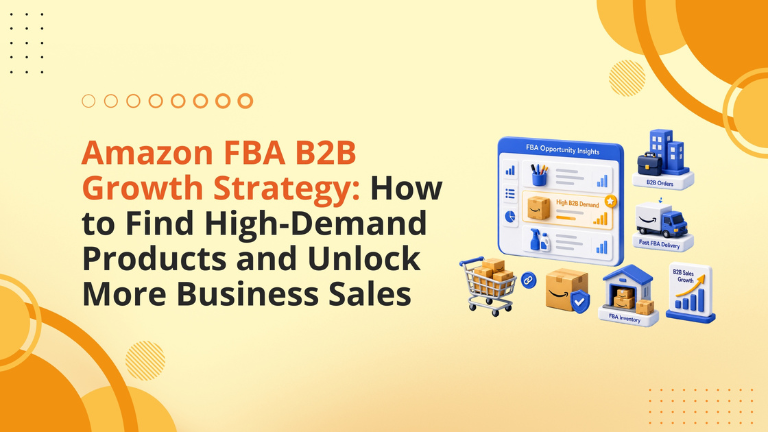
Amazon’s FBA Enrollment Opportunities page gives sellers a way to identify these products. By using the High B2B Demand filter, sellers can view ASINs that Amazon projects may perform better with business customers when fulfilled through FBA.
This is not simply an inventory tool. It is a catalog-growth opportunity.
In this blog, we will explain how the FBA Enrollment Opportunities page works, why Amazon Business customers matter, how FBA can improve B2B competitiveness, how to evaluate projected sales uplift, and how to combine FBA decisions with Amazon PPC and listing optimization.
Amazon Business is not just another sales channel. It represents a different type of buyer behavior.
Business customers often purchase products for teams, offices, worksites, institutions, hospitality operations, educational facilities, maintenance needs, and resale purposes. Their orders can be larger, more predictable, and more focused on practical value than impulse buying.
Amazon reports that Amazon Business customers purchase approximately 70%70\%70% more per order and return approximately 50%50\%50% less compared with other customers.
For sellers, this can create several advantages:
However, sellers cannot assume that the products winning with retail buyers will also win with business buyers.
B2B customers may prefer different sizes, configurations, materials, pack counts, or product features. That is why sellers need B2B-specific demand insights instead of relying only on total unit sales.
The FBA Enrollment Opportunities page is a Seller Central feature that helps sellers identify catalog products that may benefit from Fulfillment by Amazon.
Amazon analyzes product demand and identifies ASINs that could potentially perform better if they are fulfilled through FBA. For B2B-related opportunities, sellers can use the High B2B Demand filter to identify products with demand among Amazon Business customers.
The page may also show projected 909090-day B2B sales uplift for individual products.
This projected uplift helps sellers understand where Amazon sees potential incremental B2B sales if the product is enrolled in FBA.
It gives sellers a more data-informed starting point for answering an important question:
Which products in my catalog may generate more Amazon Business sales if they are available through FBA?
The recommendation should not replace a profitability analysis. It should help sellers prioritize which ASINs deserve a closer review.
Sellers can find these recommendations within Seller Central.
This process is simple, but the decision behind it requires more care.
A product may show high B2B demand potential, but it still needs to meet your profitability targets and fulfillment capabilities.
FBA does more than move boxes. It can improve the overall buying experience for Amazon Business customers.
When a product is fulfilled through FBA, Amazon handles storage, picking, packing, shipping, customer service, and returns. This gives sellers a scalable fulfillment solution while helping customers receive a faster and more reliable delivery experience.
For B2B buyers, fulfillment can influence the purchase decision significantly.
A business may need products for a project deadline, office supply replenishment, maintenance requirement, customer order, warehouse requirement, or operational need. If delivery is uncertain, the buyer may choose another listing even when your product is competitively priced.
FBA offers can become eligible for the Prime badge, subject to Amazon’s eligibility requirements.
Prime eligibility can increase buyer confidence because it signals fast and dependable delivery. For a business customer, this can reduce the risk of delayed supplies, missed deadlines, or unplanned inventory shortages.
A Prime-eligible offer may also help your listing compete more effectively against merchant-fulfilled sellers that cannot provide the same delivery promise.
FBA fulfillment may help your offer qualify for more Featured Offer opportunities, depending on Amazon’s rules and factors such as price, stock availability, seller performance, delivery speed, and customer experience.
The Featured Offer is important because it is often the default buying option customers see when they visit a product detail page.
If you sell in a competitive category, stronger fulfillment can help improve your ability to compete for this valuable placement.
Amazon states that FBA-shipped orders are exempt from the On-Time Delivery Rate and Business Hour Delivery Rate policy requirements.
For sellers managing fulfillment independently, delivery metrics can become difficult during carrier delays, peak sales periods, shipping disruptions, or unexpected order volume.
FBA shifts those fulfillment responsibilities to Amazon, allowing sellers to focus more on inventory planning, product availability, pricing, and growth strategy.
The projected 909090-day B2B sales uplift is useful, but sellers should treat it as an opportunity indicator, not a guarantee.
Amazon’s recommendation may show demand potential based on marketplace signals, but your actual sales performance will still depend on key factors such as pricing, reviews, listing quality, inventory availability, product competitiveness, fulfillment fees, and advertising support.
Before enrolling an ASIN in FBA, review the full business case.
High B2B demand does not automatically mean high profit.
A product may sell more units through FBA but still produce weak margins if storage fees, fulfillment fees, inbound shipping costs, returns, or advertising spend are too high.
Review the following before making an FBA enrollment decision:
The best FBA opportunity is not always the product with the biggest projected sales uplift. It is the product that can generate incremental sales while maintaining a healthy contribution margin.
Business customers can buy in larger quantities. That can be positive for sales growth, but it can also create stockout risk if inventory planning is weak.
Before you move a high-demand B2B product into FBA, confirm that your supply chain can handle higher demand.
Ask these questions:
A stockout can hurt sales velocity, reduce organic visibility, and disrupt repeat purchasing behavior. This is particularly important when business customers rely on your product for operational use.
Not every ASIN is equally suitable for an FBA-led B2B growth strategy.
Products that often have stronger business potential include practical, repeat-purchase, bulk-friendly, or operational-use items. Examples may include office supplies, cleaning products, food-service supplies, packaging materials, safety products, maintenance goods, industrial accessories, storage solutions, and professional-use items.
The product must still make financial sense for FBA.
Smaller, lighter products often have more favorable fulfillment economics than oversized, slow-moving, fragile, temperature-sensitive, or low-margin products. Sellers should evaluate each product based on its size tier, weight, price point, seasonality, demand consistency, and storage requirements.
For example, a compact multi-pack of labeling supplies may be a strong B2B FBA opportunity because it has repeat use, manageable FBA fees, and potential for larger business orders. An oversized product with low margins may require more caution, even if Amazon shows B2B demand.
Eligible sellers may be able to reduce the cost of trying new products in FBA through Amazon’s FBA New Selection Program.
For eligible new-to-FBA ASINs, program benefits may include:
Amazon may also offer additional new seller incentives, depending on eligibility and current program terms. These may include credits toward inventory shipping, fulfillment fees, Sponsored Products promotional clicks, or Coupons promotions.
Sellers can use the Promo eligible filter on the FBA Enrollment Opportunities page to identify products that may qualify.
Program benefits, qualification criteria, and incentives can change. Always verify the most current requirements inside Seller Central before making inventory and budget decisions.
FBA can improve delivery and customer experience, but it cannot fix a weak product detail page.
When you move a product into FBA, you may increase its visibility, delivery appeal, and ability to compete for the Featured Offer. If the listing does not convert, however, the product may still struggle to capture B2B sales.
Before scaling an ASIN through FBA, review the listing carefully.
Your listing should clearly communicate:
Strong Amazon Content Optimization can improve how clearly your product communicates value to both consumer and B2B buyers.
High-quality images also matter. Business buyers need confidence that the product meets their requirements, especially when they purchase multiple units. Effective Amazon Image Optimization can help customers understand product features, use cases, dimensions, pack size, and quality before purchasing.
FBA can make the offer more competitive, but it does not guarantee that customers will find your product.
Amazon PPC can help you capture demand, test B2B-oriented search behavior, and build visibility around relevant keywords.
The right PPC approach depends on your category, pricing, review count, conversion rate, and margin. However, sellers should avoid launching large, uncontrolled campaigns simply because they move an ASIN to FBA.
Start with a focused structure.
For example, identify the highest-intent keywords related to the product’s practical use, quantity, material, compatibility, or business use case. Build manual exact-match campaigns around proven terms, then use controlled phrase, broad, auto, and product-targeting campaigns to discover additional search opportunities.
Use Sponsored Products as the foundation, especially when the ASIN is still building sales history and conversion data.
A structured Amazon Advertising PPC Services strategy can help sellers increase product visibility while keeping bids, budgets, targeting, and profitability under control.
PPC and SEO should work together.
If you advertise for a keyword but the listing does not clearly support that term, conversion can suffer. Customers may click the ad, arrive on the product page, and decide the product does not match what they searched for.
That is wasted spend.
Before running campaigns, ensure that your most relevant customer search terms appear naturally in the title, bullet points, backend search terms, A+ Content, and image messaging where appropriate.
A strong Amazon SEO strategy supports better indexing, stronger relevance, and improved organic ranking potential over time.
When PPC, SEO, listing content, pricing, and FBA fulfillment work together, each conversion can contribute to a more sustainable growth system.
After sending inventory to FBA, monitor results closely.
Do not focus only on total sales. Look at the metrics that show whether the ASIN is generating profitable and sustainable growth.
Track:
Review these metrics consistently. A monthly review is useful for strategic planning, while weekly checks can help identify campaign, inventory, pricing, or conversion problems before they grow.
The first mistake is treating Amazon’s sales uplift projection as guaranteed profit.
The second mistake is sending too much inventory before checking fees, demand consistency, and replenishment capacity.
The third mistake is ignoring product margin after FBA fulfillment costs.
The fourth mistake is assuming that consumer best sellers are automatically the best B2B products.
The fifth mistake is launching PPC without improving the listing, images, pricing, and product offer.
The sixth mistake is allowing a high-demand product to go out of stock.
The seventh mistake is failing to review the FBA New Selection Program and Promo eligible opportunities before sending inventory.
Avoiding these mistakes can help sellers use FBA recommendations as a growth tool instead of an inventory risk.
Big Internet Ecommerce helps Amazon sellers make data-backed decisions across fulfillment, PPC, listing optimization, SEO, catalog strategy, and marketplace growth.
Our team helps sellers assess FBA enrollment opportunities, identify high-potential ASINs, review FBA profitability, improve listing conversion, build targeted PPC structures, and align advertising activity with organic ranking goals.
We do not believe in sending inventory to FBA without a plan.
We help sellers evaluate the product opportunity, understand the financial impact, strengthen the customer experience, and create a growth strategy that is built around real marketplace data.
The goal is simple: identify the right ASINs, make them more competitive, and turn B2B demand into profitable Amazon growth.
The FBA Enrollment Opportunities page is a Seller Central tool that identifies products that Amazon believes may perform better when enrolled in Fulfillment by Amazon.
The High B2B Demand filter highlights products that may have stronger sales potential among Amazon Business customers when fulfilled through FBA.
No. The projected uplift is an opportunity indicator, not a guarantee. Actual performance depends on price, listing quality, reviews, inventory availability, FBA fees, competition, and advertising support.
FBA can provide fast, dependable fulfillment, customer service, returns management, and potential Prime eligibility. These factors can be especially important to business buyers who value reliable delivery.
Eligible sellers and qualifying new-to-FBA ASINs may receive benefits through the FBA New Selection Program. Check Seller Central for current eligibility requirements, available incentives, and program terms.
Yes, if the product has sufficient margin and listing readiness. PPC can help increase visibility and capture relevant demand, but it should be structured carefully and monitored for profitability.
Want to find high-potential FBA opportunities hiding inside your Amazon catalog?
To review your FBA opportunities, B2B sales potential, product margins, listing conversion, and PPC growth strategy.
Schedule a strategy call with our team.
Follow Big Internet Ecommerce (BIE) on Instagram & LinkedIn to stay updated with the latest trends in Amazon selling.
Fill out the form and our experts will get back
to you within 24 hours.
.webp)
.webp)
.webp)
We respect your privacy. Your information is safe with us.