August 6, 2026
Amazon Is Automatically Translating Product Images: What Sellers Need to Know
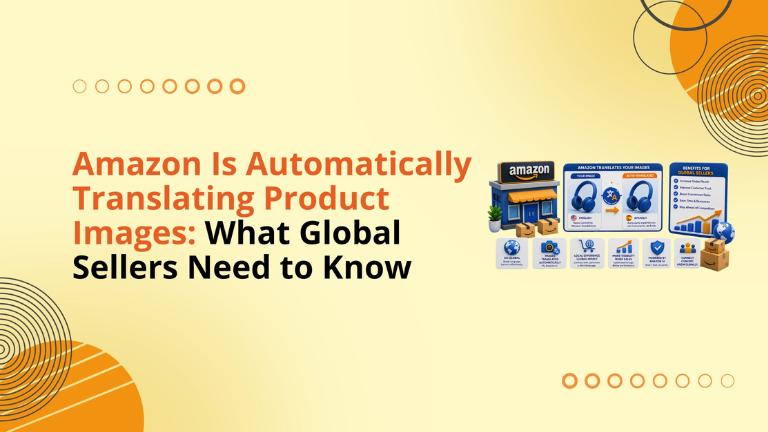
Amazon shoppers do not all read the same language, but they all make buying decisions quickly.
For sellers, that makes product images extremely important.
A good image stack does more than show the product. It explains the product, highlights benefits, answers objections, and helps customers compare options. When those visual selling points are written in a language the shopper understands, the listing becomes easier to trust.
Amazon is now expanding automatic translation for product images that contain text. This update can help sellers reach more customers across international marketplaces, but it also creates a new responsibility: your image content needs to be clear, accurate, and ready for localization.
Amazon will now automatically translate text that appears in product images into the customer’s preferred language across supported marketplaces.
This applies to non-media products in Amazon stores including: US, Canada, Mexico, Brazil, Germany, France, Italy, Spain, Netherlands, Belgium, Poland, Ireland, Sweden, UK.
Translated images may appear on the product detail page and inside Image Manager.
Your main product image will not be translated.
Product images often carry some of the most important selling information on the listing.
They may explain:
If shoppers cannot understand that information, they may hesitate, leave the listing, or purchase the wrong product.
Automatic image translation can help customers better understand what they are buying. That can support stronger purchase confidence and may help reduce avoidable returns caused by confusion.
This update is part of a larger shift toward better localized shopping experiences.
A customer in Germany may see translated image text in German. A customer in Canada who prefers French may see image text in French. A customer in the US who prefers Spanish may see translated image content in Spanish.
That matters because shoppers often scan images before reading bullets or A+ Content.
If the visual message is clear in their preferred language, they can understand the product faster.
Amazon has clarified that your original image in the store’s primary language will not change.
That means if your listing is active in the US store with English image text, the original English image remains available for that marketplace’s primary language experience.
The main product image will also not be translated.
This is important because Amazon’s main image requirements remain strict. Main images usually need to show the product clearly without added promotional text, badges, or extra graphics.
Sellers are still able to upload their own localized images.
If you upload an image in the correct language for a marketplace, Amazon will remove its automatically translated version from the product detail page.
This gives brands more control when they want custom localization instead of relying on AI-generated translation.
For important markets, this may be the better choice.
A manually localized image can account for:
Automatic translation is helpful only when the original image text is strong.
If the English image copy is unclear, too long, poorly structured, or filled with weak claims, the translated version may also be weak.
Before depending on Amazon’s AI translation, sellers should review every image that contains text.
Check whether your image copy is:
A messy image stack in one language can become a messy image stack in many languages.
Many sellers treat image localization as a translation task only.
That is a mistake.
Good localization is not just changing words from one language to another. It is making sure the customer understands the product in the right context.
Avoid these mistakes:
Image localization can directly influence how shoppers understand your product.
When image text is clear, customers can make decisions faster.
This can support:
For international sellers, this update can be especially useful because it reduces friction between the product page and the customer.
But translation alone does not fix weak creative.
The image still needs strong structure, clear benefit hierarchy, and professional design.
Sellers should treat this update as a listing audit opportunity.
Start with these steps:
This is not only a creative update.
It is a marketplace growth opportunity.
We help Amazon sellers improve listings across SEO, PPC, creative, catalog structure, A+ Content, Brand Story, Storefront, and marketplace growth strategy.
For image localization, our team can help sellers review:
The goal is not just to translate images.
The goal is to make every marketplace version of your listing clear, persuasive, and ready to convert.
Amazon image localization refers to translating text within product images so customers can view product information in their preferred language.
No. Amazon has stated that the main image will not be translated.
Translated images may appear on the product detail page and inside Image Manager.
Yes. Sellers can upload their own images in the correct language. When they do, Amazon’s translated versions are removed from the product detail page.
The update applies to sellers with non-media products in supported Amazon stores.
Not always. For important marketplaces, brands should review translated images and consider uploading custom localized images for stronger accuracy, compliance, and brand control.
Amazon’s automatic image translation update can help sellers reach more customers in their preferred language.
But brands should not leave everything to automation.
If your images include product claims, feature callouts, comparison points, usage instructions, or benefit messaging, now is the time to review them carefully.
A translated image can help customers understand your product.
A well-optimized image stack can help them choose your product.
Schedule a strategy call with our team.
Follow Big Internet Ecommerce (BIE) on Instagram & LinkedIn to stay updated with the latest trends in Amazon selling.
Fill out the form and our experts will get back
to you within 24 hours.
.webp)
.webp)
.webp)
We respect your privacy. Your information is safe with us.