August 21, 2026
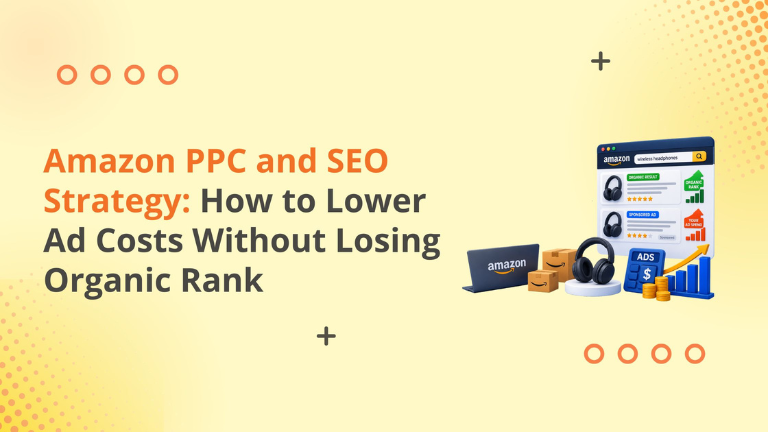
Amazon PPC and SEO Strategy: How to Lower Ad Costs Without Losing Organic Rank
Many Amazon sellers treat PPC and SEO as two separate jobs.
One team manages bids, budgets, ACoS, search terms, and campaign structure. Another team manages titles, bullet points, backend keywords, images, A+ Content, and organic ranking.
That sounds organized, but it creates a serious profit problem.
Amazon shoppers do not separate paid and organic results. They search for a keyword, compare the results, click the most relevant option, and buy the product that earns their trust. Amazon then reads those clicks, conversions, and sales as ranking signals.
This means your PPC and SEO are already connected, even if your reporting is not.
If your listing does not rank organically, PPC can help you buy visibility and build sales momentum. But if your product already ranks well, continuing to bid aggressively on the same keyword can make you pay for sales your organic placement may have earned naturally.
That is where ad waste begins.
The goal is not to cut PPC blindly. The goal is to use PPC and SEO together so every dollar has a clear job: build rank, protect rank, or scale profitable growth.
You combine Amazon PPC and SEO by managing both from one keyword strategy. Use PPC to support keywords where your product needs visibility, and use SEO to strengthen organic ranking, listing relevance, and conversion. As organic rank improves, reduce bids carefully on mature keywords while measuring total sales, TACoS, and organic rank.
Amazon PPC and SEO both influence the same customer journey.
PPC helps your product appear in paid placements when shoppers search for relevant keywords. SEO helps your product appear naturally in organic search results based on relevance, conversion history, sales velocity, content quality, and customer experience.
When PPC and SEO work together, your account becomes more efficient.
PPC can help new or under-ranked products gain traction. SEO can help reduce long-term dependence on paid clicks. Strong listing content can improve conversion from both paid and organic traffic. Better conversion can support stronger organic ranking. Stronger organic ranking can allow more controlled ad spend.
When PPC and SEO are managed separately, sellers often make two costly mistakes.
They overspend on keywords they already rank for.
They underinvest in listing improvements that would make ads convert better.
That is why Amazon growth should not be managed as “ads versus SEO.” It should be managed as one keyword growth system.
ACoS is useful, but it does not tell the full story.
ACoS measures ad spend compared with ad-attributed sales. It helps PPC managers understand whether a campaign is efficient.
But ACoS only looks at sales connected to ads. It does not show whether total business sales are becoming too dependent on advertising.
That is why TACoS matters.
TACoS measures ad spend compared with total sales. It helps sellers understand how much of the business is being supported by paid traffic.
A campaign can have a decent ACoS while the business becomes less profitable overall.
For example, your ACoS may stay stable, but if organic sales are not growing and total ad spend keeps rising, your Amazon account may be relying too heavily on PPC.
This is why serious Amazon sellers should review both numbers.
ACoS tells you how campaigns are performing.
TACoS tells you how the business is performing.
One of the biggest Amazon ad cost problems is keyword overlap.
This happens when your product ranks well organically for a keyword but still receives heavy PPC spend for the same search term.
Sometimes that spend is useful. Defensive PPC can help protect top placements from competitors.
But sometimes the spend becomes wasteful.
If your product already has strong organic rank, strong reviews, good conversion, and meaningful organic click share, you may not need the same aggressive bid level.
The problem is that many sellers never review this overlap.
A keyword starts as a PPC target.
The ads generate clicks and sales.
The product begins ranking organically.
Organic sales grow.
But the PPC bid stays the same.
Over time, the seller may be paying for clicks that organic rank could have captured.
That is why PPC and SEO data must be reviewed together.
To find overlap, compare your PPC data with organic performance data.
Start with your top keywords and search terms. Then review:
The key question is:
Is PPC still buying new visibility, or is it paying for demand the listing already wins organically?
If a keyword has high PPC spend and weak organic rank, the ad spend may still be necessary.
If a keyword has high PPC spend and strong organic rank, it may be ready for a controlled bid test.
Do not split your budget using one fixed percentage for every product.
A keyword with no organic visibility needs a different strategy from a keyword already ranking near the top of page one.
Use rank tiers to decide where the next dollar should go.
If your product is not indexed or does not appear for an important keyword, PPC alone will not fix the problem.
You need SEO work first.
Review the title, bullets, backend search terms, A+ Content, product attributes, and keyword relevance. Then use PPC to test whether the keyword can convert once the listing is properly aligned.
Best action: Fix indexing and run controlled PPC discovery.
If your product is ranking but still buried, PPC should support visibility while SEO improves relevance and conversion.
This is where Sponsored Products, exact match campaigns, and search term harvesting can help.
At the same time, improve your listing content so paid clicks have a better chance of converting.
Best action: Use PPC to build data and use SEO to improve conversion.
If your product is on page one but not in the top organic positions, do not cut aggressively.
This is a sensitive stage.
You may need PPC to support sales velocity while SEO and conversion work help push the product higher.
Review main image quality, pricing, reviews, A+ Content, and competitor positioning.
Best action: Hold PPC support while improving conversion assets.
If your product already ranks strongly for a keyword, shift from aggressive growth bidding to defensive and efficiency-focused bidding.
Do not automatically turn ads off. Competitors can still take sponsored placements above your organic result.
But you can begin testing lower bids carefully.
Best action: Reduce bids slowly while monitoring total units and organic rank.
You should reduce Amazon PPC bids only when the keyword has stable organic rank, healthy conversion, consistent total sales, and enough organic click share to support a test.
Do not reduce bids because one report looks good.
A safer bid reduction checklist includes:
Once these conditions are met, test gradually.
A 10% bid reduction is safer than a sudden cut. After the change, measure total units, not only ad-attributed units.
If ad sales drop but total sales hold steady, your organic placement may be absorbing the demand.
If total sales drop, the ad was still supporting visibility or conversion.
Many sellers panic when ad-attributed sales fall after a bid reduction.
But that is not always bad.
If total sales stay the same while ad-attributed sales fall, it may mean organic sales are replacing paid sales. That is a positive sign.
The real goal is not to protect ad sales. The goal is to protect profitable total sales.
After reducing bids, track:
If total sales hold and TACoS improves, the account is becoming more efficient.
If total sales fall, restore support and wait until organic strength improves.
A weak listing makes PPC more expensive.
If your title is unclear, images are weak, bullets are generic, A+ Content is missing, or reviews are not strong enough, paid traffic will struggle to convert.
That creates a cycle.
You spend more to get traffic.
The listing does not convert well.
ACoS rises.
Organic rank does not improve enough.
You continue paying for visibility.
Better SEO and listing optimization can break that cycle.
Strong listing optimization can improve:
Amazon PPC brings traffic. Listing quality decides how much of that traffic turns into sales.
Before increasing PPC spend, review the full product detail page.
Start with these areas:
If these areas are weak, PPC may only amplify the problem.
A better listing makes every ad click work harder.
Search Query Performance is useful because it helps brands understand how shoppers interact with their products for specific queries.
It can show how your brand and ASINs perform across search impressions, clicks, cart adds, and purchases.
For PPC and SEO planning, this helps answer important questions:
Which queries are driving organic clicks?
Which queries have strong ad spend but weak organic share?
Which keywords are moving from paid discovery to organic strength?
Which keywords need listing improvements?
Which terms deserve more PPC support?
Which terms may be ready for bid reduction?
This is especially useful for mature accounts where surface-level campaign reporting no longer explains the full cost problem.
Many sellers increase ad costs without realizing it.
The most common mistakes include:
The biggest mistake is trying to solve every problem inside the ad account.
Sometimes the PPC account is not the real problem.
Sometimes the listing, content, pricing, reviews, or SEO structure is what makes advertising expensive.
Use this process to connect PPC and SEO properly.
This gives your team a clear structure.
It also makes it easier to explain decisions to leadership, finance, and clients.
Finance teams do not need every campaign detail.
They need to know whether advertising is creating profitable growth or simply replacing organic sales.
A stronger Amazon performance report should include:
This changes the conversation from “Can we lower ACoS?” to “Where is ad spend actually helping the business grow?”
That is a better question.
Amazon shopping is becoming more guided, more conversational, and more dependent on product clarity.
That means sellers need listings that answer real customer questions, not just listings filled with keywords.
Your product content should clearly explain:
This helps both traditional search and answer-style shopping experiences.
AEO-friendly Amazon content is clear, specific, and useful.
If your product page does not answer buyer questions, your listing may lose opportunities even if your keyword research is strong.
We help Amazon sellers and D2C brands grow through PPC management, Amazon SEO, listing optimization, A+ Content, catalog health, Store Management, creative strategy, and full-service marketplace support.
With 14+ years of Amazon experience and work across hundreds of seller and vendor accounts, we know that Amazon growth is not created by one lever.
PPC needs SEO.
SEO needs conversion.
Conversion needs strong creativity.
Creative needs customer insight.
Rank needs sales velocity.
Profit needs controlled ad spend.
When these pieces are managed separately, sellers often overspend.
When they are managed together, the account becomes easier to scale.
We help sellers identify where PPC is still needed, where organic rank is strong enough to defend, where listings need improvement, and where ad spend is leaking margin.
The best way is to manage both from one keyword strategy. Use PPC for keywords that need visibility and SEO to improve organic ranking, listing relevance, and conversion.
Yes. Strong SEO and listing optimization can improve organic visibility and conversion, which can reduce long-term dependence on paid clicks.
Not always. If the keyword is important, defensive PPC may still protect visibility. Reduce bids slowly and monitor total sales before making bigger cuts.
ACoS measures ad spend against ad-attributed sales. TACoS measures ad spend against total sales and shows how dependent the business is on advertising.
Compare PPC spend, organic rank, organic click share, and total sales. High PPC spend on a keyword with strong organic rank may indicate overlap worth testing.
Start with small reductions, such as 10%, only after organic rank and total sales are stable. Avoid large sudden cuts.
Measure total units, organic rank, TACoS, conversion rate, and profit after ad spend. Do not rely only on ad-attributed sales.
A better listing can improve conversion from paid clicks. Weak images, unclear bullets, poor A+ Content, or weak reviews can make PPC more expensive.
We can audit your PPC, SEO, keyword rankings, listing quality, A+ Content, catalog structure, and TACoS to find where ad spend is helping and where it is leaking margin.
Amazon PPC and SEO should work from one keyword plan.
PPC helps you buy visibility where your product still needs traction.
SEO helps you earn visibility without paying for every click.
Listing optimization helps both paid and organic traffic convert better.
Search Query Performance helps identify overlap.
TACoS shows whether your business is becoming too dependent on ads.
The goal is not to reduce ad spend blindly.
The goal is to spend where PPC is still needed and stop overpaying where organic rank is already doing the work.
If your Amazon ad spend is rising but profit is not improving, the issue may not be only inside your campaigns. It may be in the gap between PPC, SEO, listing quality, and organic rank.
We can help you review PPC performance, keyword overlap, listing optimization, A+ Content, TACoS, organic rank, and catalog growth opportunities.
Schedule a strategy call with our team.
Follow Big Internet Ecommerce (BIE) on Instagram & LinkedIn to stay updated with the latest trends in Amazon selling.
Fill out the form and our experts will get back
to you within 24 hours.
.webp)
.webp)
.webp)
We respect your privacy. Your information is safe with us.