July 22, 2026
Amazon TIC Compliance: How Sellers Can Protect Listings Before Testing Issues Stop Sales
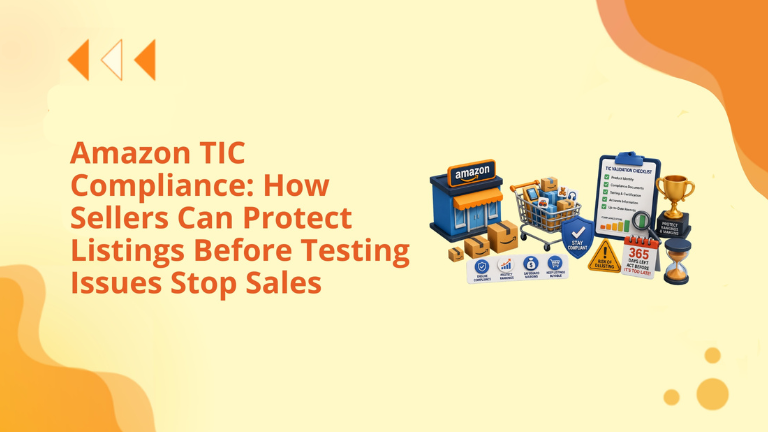
Amazon product compliance has become one of the most important parts of protecting listing health, especially for sellers in safety-sensitive categories.
In the past, many sellers treated compliance as a document upload task. They collected test reports, certificates, supplier files, or safety documents and submitted them when Amazon asked. That approach is no longer enough for certain product categories.
Amazon’s testing, inspection, and certification process now requires notified ASINs to be verified through approved third-party TIC service providers. These providers review existing documents or test product samples, then submit results directly to Amazon. Sellers are still responsible for compliance, but the validation process is now more controlled.
This matters because compliance issues can quickly affect buyability, product visibility, sales, PPC performance, and overall Account Health.
Amazon’s direct product validation process changes how sellers handle certain compliance requests.
Instead of uploading documents directly and waiting for Amazon to review them, sellers must work with an authorized third-party testing, inspection, and certification provider.
The TIC provider reviews existing documentation or conducts new testing based on the required standards. Once the review or testing is complete, the provider submits the results directly to Amazon.
This creates a more controlled compliance process.
For sellers, it also means timelines, provider selection, product samples, existing documentation, and Account Health deadlines must be managed carefully.
Compliance is not just about satisfying a policy requirement.
It protects product safety, customer trust, listing visibility, and account stability.
If a product fails testing, if documents fail validation, or if the seller does not act before the required deadline, the listing may be deactivated or lose buyability.
That can create a chain reaction.
Sales stop. Ads lose efficiency. Organic rank may weaken. Inventory can become stranded or harder to move. Account Health may be affected. Launch plans, seasonal sales, and ranking momentum can all suffer.
A strong Amazon Store Management process should include compliance monitoring, not just sales and advertising management.
Amazon’s TIC requirements can apply to products where safety, health, or regulatory risk is higher.
This includes categories such as dietary supplements, children’s toys, children’s jewelry, e-mobility products, lithium-ion batteries, portable power supplies, OTC pain relievers, mattresses, smoke and carbon monoxide alarms, water delivery products, and other sensitive categories.
The exact requirement can vary by product type, Amazon store, and policy.
Sellers should not assume that a product is safe from compliance review just because it has been live for a long time.
Amazon may request testing, inspection, or certification at launch, during ongoing surveillance, or after a policy review.
When Amazon sends a compliance notification, sellers should act immediately.
The request usually appears in Account Health under Policy Compliance and Food and Product Safety Issues. Sellers can select the affected ASIN, choose the submission option, and begin the product verification process.
From there, sellers must choose a TIC provider and submit a Test Request Form.
The selected provider will guide the seller on whether existing documents can be reviewed or whether product samples need to be tested.
The important point is timing.
Testing may take weeks, especially if physical samples are required. Waiting until the deadline is close can create unnecessary listing risk.
The Test Request Form, often called a TRF, connects the seller’s compliance request to the TIC provider and Amazon’s workflow.
If the request is not submitted correctly, the provider may not be able to validate the product properly.
Once the TIC provider receives the required materials and updates the status, Amazon can see that the process is in progress.
This matters because sellers need to show movement before the address issue deadline.
A missing or delayed TRF can create avoidable enforcement risk.
Some sellers may already have testing reports, certifications, supplier documents, or lab results.
That is helpful, but it does not always mean the requirement is complete.
For notified ASINs, existing documents may still need to be submitted to an approved TIC provider for review. The provider determines whether those documents meet Amazon’s policy guidelines.
If the documents are outdated, incomplete, mismatched, or not aligned with the correct standard, additional testing may be required.
Sellers should review document quality before assuming they are covered.
If the seller does not have acceptable documentation, product samples may need to be sent to a TIC provider for testing.
This can take time.
The seller may need to coordinate product samples, supplier information, labels, packaging, batch details, component information, and technical documents.
For products with variants, bundles, multipacks, or component parts, the process may become more complex.
This is why compliance should be planned before launch, not after a listing is already at risk.
Amazon’s compliance process applies to selling partners individually.
Even if another seller has already submitted documents for a product, you may still need to complete your own requirement if Amazon notifies your account.
This is especially important for resellers, distributors, wholesalers, and brands with multiple sellers on the same ASIN.
Do not assume another party’s documents automatically protect your offer.
If your Account Health shows a request, your team needs to address it.
Compliance can become more complicated when products are sold as variations, bundles, or multipacks.
A supplement with multiple flavors, a toy with multiple colors, or an e-mobility accessory with different models may require careful review.
Sellers should work with the TIC provider to understand whether one report covers multiple variants or whether separate validation is needed.
For bundles and component products, the provider may need to review individual parts as well as the final sold unit.
This is where strong catalog structure becomes important.
Clean product data, accurate variation relationships, and complete listing details can reduce confusion during compliance review.
Many sellers think compliance is separate from marketing.
It is not.
If a listing is deactivated, SEO momentum can stop. PPC campaigns may become inefficient or unable to run. Organic ranking may decline. Inventory may sit without sales. Customers may lose confidence if the listing disappears or changes suddenly.
This is why compliance readiness should be connected to broader marketplace operations.
A strong Amazon Advertising PPC Services strategy cannot protect sales if the listing itself is not buyable.
A strong Amazon SEO strategy cannot create growth if compliance issues block the ASIN.
Amazon compliance issues can also be triggered or worsened by unclear or unsupported listing content.
For example, products in health, supplement, beauty, safety, children’s, or electrical categories must be careful with claims, ingredients, specifications, intended use, warnings, and certifications.
If a listing makes claims that are not supported by documentation, it can create additional review risk.
Strong Amazon Content Optimization helps sellers create listings that are persuasive but still aligned with product documentation and marketplace requirements.
The goal is to sell clearly without creating compliance exposure.
Images can create compliance problems when they show unsupported claims, incorrect certifications, missing warnings, inaccurate packaging, or mismatched product details.
This is especially important for supplements, toys, batteries, electronics, and safety-related products.
Product images should match the actual product, label, packaging, and use instructions.
Strong Amazon Image Optimization should balance conversion with accuracy. A high-converting image stack should never create policy risk.
Sellers should not wait for a notification to organize compliance files.
A proactive compliance folder should include product specifications, supplier details, test reports, certificates, packaging files, label artwork, ingredient panels, safety warnings, batch information, invoices, and any category-specific documents.
Brands should also review whether documents are current, complete, and tied to the correct product, SKU, variant, or batch.
This preparation can reduce delays when Amazon sends a request.
It can also make provider communication faster and cleaner.
Sometimes sellers may believe the compliance request does not apply to their product.
In that case, sellers can submit an appeal through Account Health or Manage Your Compliance.
The appeal should include a clear reason, supporting details, and any relevant documentation.
However, sellers should be careful not to ignore the request while waiting.
If the ASIN has a deadline, the safest approach is to take action quickly and keep records of all submissions and communication.
The first mistake is waiting too long after receiving a notification.
The second mistake is assuming old documents will automatically pass validation.
The third mistake is using a non-authorized lab without understanding whether results need additional validation.
The fourth mistake is ignoring variant, bundle, or multipack complexity.
The fifth mistake is allowing listing claims to exceed what documents can support.
The sixth mistake is treating compliance as separate from catalog management.
These mistakes can create delays, enforcement action, and lost revenue.
Sellers in sensitive categories should immediately review Account Health and Manage Your Compliance.
They should identify any ASINs with active policy issues, check deadlines, gather product documents, and understand which provider options are available.
They should also audit high-risk listings for unsupported claims, outdated labels, missing product details, and inconsistent variation data.
If testing may be required, start early.
A 30-day testing window can quickly become a sales risk if the seller waits until the last week.
Big Internet Ecommerce helps Amazon sellers manage compliance-sensitive catalog issues before they interrupt sales.
Our team reviews Account Health, product documentation readiness, listing content, image claims, category risks, variation structure, suppressed ASINs, and catalog accuracy.
We also help sellers connect compliance with broader marketplace strategy, including SEO, PPC, content optimization, inventory planning, and account health recovery.
The goal is simple: protect listings, reduce enforcement risk, and help sellers stay buyable while continuing to grow.
Amazon TIC compliance refers to testing, inspection, and certification validation through approved third-party providers for certain notified ASINs.
For certain notified products, sellers must work with an authorized TIC provider, and the provider submits the results directly to Amazon.
Testing can take several weeks and may take around 30 days after the provider receives product samples, so sellers should start early.
If a product fails testing or documents fail validation, the listing may be deactivated until compliant documents are provided and accepted.
Yes. Sellers can submit an appeal through Account Health or Manage Your Compliance with a clear reason and supporting details.
Need help reviewing your Amazon compliance risk before it affects sales?
Schedule a strategy call with our team.
Follow Big Internet Ecommerce (BIE) on Instagram & LinkedIn to stay updated with the latest trends in Amazon selling.
Fill out the form and our experts will get back
to you within 24 hours.
.webp)
.webp)
.webp)
We respect your privacy. Your information is safe with us.