October 26, 2026
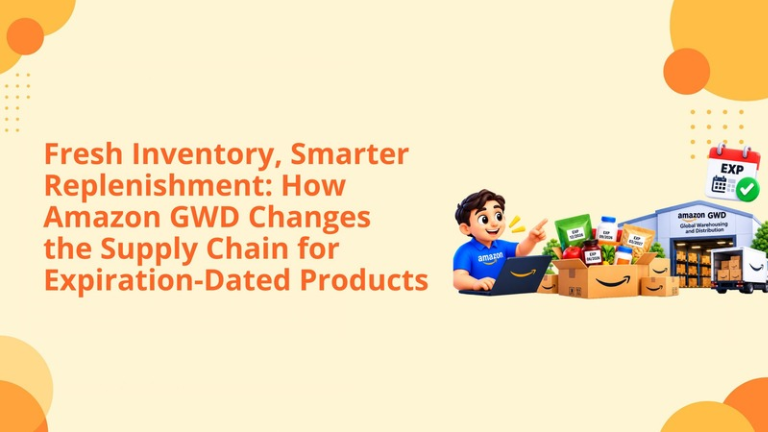
Fresh Inventory, Smarter Replenishment: How Amazon GWD Changes the Supply Chain for Expiration-Dated Products
Expiration Dates Just Became Part of Amazon’s Origin-Storage Strategy
The presence of perishable products makes inventory management a challenge for Amazon sellers. If sellers send too much of this type of inventory to FBA too soon, goods will go bad while accumulating storage expenses. On the other hand, sending too little inventory will result in running out of stock before the next delivery reaches the US. Order too much from the manufacturer, and working capital becomes trapped in products that have a limited selling window.
Amazon’s latest Global Warehousing and Distribution expansion gives eligible sellers another option.
Now, qualifying expiration-dated products can be stored at GWD facilities in Shenzhen, Shanghai, or Ningbo and later replenished to U.S. FBA fulfillment centers.
The mentioned updates seem significant mainly for the qualified items under Beauty, Baby Products, Health and Personal Care, etc. However, the program comes along with strict policies about specific products, their packages, regulatory aspects, and shelf life.
The two numbers every seller needs to remember are:
Amazon Global Warehousing and Distribution is an origin-storage and cross-border inventory program.
It allows eligible sellers to store inventory closer to manufacturing origin, use consolidated Amazon Global Logistics transportation, and replenish Amazon’s Prime-ready US fulfillment network when needed.
Amazon describes GWD as offering:
Sellers must onboard Amazon Global Logistics for cross-border transportation before using GWD. Once onboarding is complete, shipments can be created through Amazon Warehousing and Distribution in Seller Central.
GWD is not a replacement for FBA. It functions as an upstream inventory reserve that can replenish FBA.
A simplified workflow is:
Manufacturer or supplier in China → GWD facility in China → Amazon Global Logistics → US FBA network → Customer
Eligible expiration-dated products can now enter the GWD network.
Sellers can send qualifying products to GWD distribution centers in:
Inventory can remain in GWD until the seller, or Amazon’s automated replenishment system, creates a replenishment order to move units to US FBA fulfillment centers.
This could allow sellers to place more of their eligible China-sourced catalog in a single upstream storage system. But there are two different eligibility checks that matter.
When the seller creates a shipment to GWD, the expiration date must be at least 365 days away.
A product with only 364 days of remaining shelf life would not satisfy this requirement, even if it might otherwise be accepted by FBA.
The product must have at least 180 days of shelf life remaining at the time the seller creates a replenishment order from GWD to FBA. Amazon says sellers will be notified by email when GWD inventory approaches the 180-day threshold. That notification should let the seller know it’s time to send eligible inventory to FBA, or arrange for its removal before it can no longer be replenished.
Amazon’s definition can be broader than the date printed on a package.
Amazon may consider a product expiration-dated when it:
A product may still be classified as expiration-dated even if its packaging shows no expiration date. Check your ASIN classification and marketplace requirements to confirm.
Amazon’s GWD eligibility list includes many categories, such as:
However, appearing in an eligible category does not guarantee that every ASIN within that category qualifies.
A Beauty product may be ineligible because it is meltable. A Health and Personal Care product can sometimes be limited based on the fact that it is considered a dietary supplement or a medical apparatus. With regard to Baby products, they can be disqualified due to regulatory, product-size, and dangerous-material issues. On the bright side, Amazon checks whether an ASIN can be accepted when creating a shipment.
Sellers must distinguish between category eligibility and product eligibility.
Products currently listed as ineligible include:
Amazon’s dangerous-goods exclusion includes lithium-ion and lithium-metal batteries, whether shipped separately or with equipment.
This is particularly important for sellers reading only the broad category list. “Health and Personal Care” may be eligible, while a vitamin, supplement, medical device, or medication within that category remains prohibited.
GWD facilities are not positioned as temperature-controlled storage for heat-sensitive inventory.
Amazon’s meltable classification can include:
This means some beauty, personal-care, baby, or wellness products may remain ineligible even when their standard category is accepted.
Before building a GWD plan, sellers should confirm the physical storage requirements of the product and Amazon’s classification.
Eligible shipments must remain within GWD’s conveyable size and weight requirements.
According to Amazon’s current eligibility guidance:
Oversize, heavy, bulky, or non-conveyable products are not currently eligible.
These limits should be considered before production is packed. A product may qualify at the ASIN level but become difficult to send if its master-carton configuration exceeds GWD limits.
Sellers can store products in China instead of sending the entire order to the United States right away.
This gives them extra stock that they can send to FBA when needed.
Sellers can send smaller amounts of products to FBA based on sales, upcoming offers, seasonal demand, and warehouse space available rather than sending all products to FBA at once.
This can help reduce the risk of keeping too many products in FBA.
Sellers can store eligible products with expiration dates alongside other products that qualify for GWD.
As a result, this can make it easier to manage products stored in China without needing separate storage plans for different products.
Sellers can also now create orders to send products to FBA themselves or use automatic restocking when available.
Manual restocking gives sellers more control, while automatic restocking can help save time.
The rule of 180 days enables vendors to complete the inspection of goods before shipping them to FBA.
Nevertheless, that doesn’t mean that every item will be sold before its use-by date. It is still up to sellers to do their analytics and manage their inventory appropriately.
Sellers can make products before a busy shopping season and store eligible stock in GWD.
When customer demand increases, they can send products to FBA as needed.
This can help them prepare for busy periods without sending all their stock to FBA too early.
When extra stock is already stored in GWD, sellers can plan their next shipments more easily as compared.
They may not need to arrange a new pickup from the manufacturer every time FBA needs more products.
GWD gives sellers more flexibility, but products with expiration dates still need careful management.
Products do not stop getting older while they are stored in GWD.
For example, a product that arrives with just over 365 days of shelf life remaining will have less time left after a few months.
Sellers must plan when to send these products to FBA before they get too close to the 180-day limit.
If customers do not buy products as quickly as expected, some stock may remain in GWD for too long.
Sellers may not be able to send all these products to FBA before they reach the required shelf-life limit.
They may need to remove the remaining products, which can lead to extra costs.
If sellers expect more sales than they actually get, they may end up with too many products sitting in storage.
If they expect fewer sales than they actually get, they may run out of stock in FBA.
GWD gives sellers another storage option, but it cannot fix incorrect sales estimates.
Manufacturers verify as to when the items were produced, when they are due to expire and how long the product will remain on the shelf before it is shipped to the customer.
Delay in production can lead to early expiration of the product.
Automatic restocking can save time, but sellers should not depend on it fully.
They should check for sales, offers, returns, product listings, and expiry dates regularly.
Before using GWD, sellers are required to register with Amazon Global Logistics (AGL).
They are also required to provide payment information and the person who will pay for importing the product, along with customs information.
Expiration-dated sellers must forecast two connected inventory layers:
A strong replenishment plan should include:
For example, a product may have sufficient total inventory but still face an FBA stockout if the next replenishment order is created too late.
Alternatively, the seller may replenish too much, leaving excess units aging inside FBA.
The objective is not simply to keep inventory available. It is to maintain the right amount of sellable inventory in the right location with enough remaining shelf life.
GWD requires sellers to onboard to AGL for cross-border transportation to the United States.
Do not merely depend on product categories. Validate the ASIN when preparing shipments and check any surprise ineligibility cases.
Make sure that every box has at least 365 days of shelf life left on the date of shipment preparation.
Review meltable, temperature-sensitive, hazardous, medical, nutritional, food, and other restricted products.
Check dimensions and weight of carton and individual products.
Destination listing for the US should be correct. Correct inactive listings, stranded inventory, missing attributes, and catalog errors before shipment.
Estimate the time needed for the inventory to reach the 180-day limit.
Select the method that matches your sales predictability, internal controls, and account-management capacity.
Decide what will happen if inventory approaches the threshold but cannot be sent to FBA.
Someone should monitor GWD inventory age, FBA stock, sales speed, incoming orders, and notifications from Amazon.
The process outlined by Amazon is described below:
The process is complete once Amazon has confirmed receipt of inventory and distribution at the GWD center.
A GWD strategy should be measured at the SKU and batch level.
Track:
Sellers should also compare actual sales against the forecast regularly. When velocity changes, replenishment quantities and timing should change with it.
The operational value of GWD depends on how well inventory planning connects with sales.
We help Amazon sellers coordinate:
For example, increasing advertising without checking FBA supply could accelerate a stockout. Reducing advertising too early could leave expiration-dated inventory aging in GWD. Sending a large replenishment before demand is validated could simply move overstock from one warehouse to another.
The strongest plan connects inventory, marketing, catalog health, and profitability.
Yes. Eligible products can be stored at participating GWD facilities in China and replenished to US FBA.
Products need at least 365 days remaining when the GWD shipment is created and 180 days when the FBA replenishment order is created.
No. Amazon currently lists vitamins and supplements among GWD’s restricted and prohibited products.
Amazon identifies GWD facilities in Shenzhen, Shanghai, and Ningbo for this workflow.
Yes. Sellers must onboard to AGL for cross-border transportation before using GWD.
Amazon’s decision to accept eligible expiration-dated products in GWD gives qualifying sellers a valuable new supply-chain option.
Brands sourcing from China may now be able to store more inventory near the manufacturing origin, consolidate eligible products within GWD, and replenish US FBA based on demand.
But the opportunity comes with firm limits:
GWD can help create a more controlled replenishment pipeline. It cannot replace accurate forecasting, inventory-age monitoring, and product-level decision-making.
If your brand sells eligible expiration-dated products sourced from China, to evaluate whether GWD fits your inventory and growth strategy.
Schedule a strategy call with our team.
Follow Big Internet Ecommerce (BIE) on Instagram & LinkedIn to stay updated with the latest trends in Amazon selling.
Fill out the form and our experts will get back
to you within 24 hours.


We respect your privacy. Your information is safe with us.