November 16, 2026
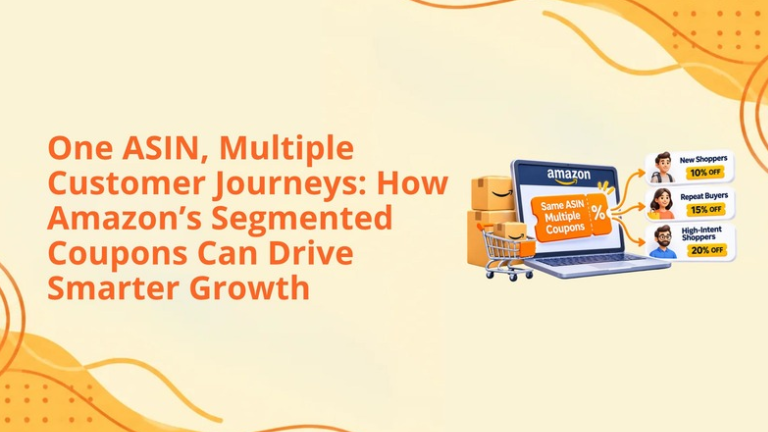
One ASIN, Multiple Customer Journeys: How Amazon’s Segmented Coupons Can Drive Smarter Growth
Not everyone who shops on Amazon requires the same motivation to make a purchase.
For instance, a new customer might need an introductory incentive to get them to buy. Someone who abandons their cart might need an incentive and reassurance. A repeat customer may be familiar with the product but require a nudge to re-order. A loyal customer may be ready for Subscribe & Save while a customer who is on the edge may need a stronger incentive.
Until now, sellers have often used a blanket offer for different segments. This practice allows them to get orders but comes at the cost of marginal profits.
Amazon's new coupon functionality enables sellers to improve the offer. They can make use of multiple coupons for one ASIN.
The benefits are not limited to creating and issuing different types of discount coupons, as this might help sellers improve their understanding of buyer motivation, buying behavior, margins, and inventory levels.
Coupons from Amazon audience segments are promos that are only made available to customers that meet certain eligibility requirements.
So, in case of a qualifying brand, instead of coming up with a single coupon for every single customer, the brand should create specific offers meant for groups of consumers like repeat buyers, cart abandoners, high-spenders, potential buyers, and customers on the verge of devoting their loyalty to another brand.
Amazon now allows sellers to run the following coupon types on an ASIN at the same time:
This structure allows a single ASIN to support several customer objectives simultaneously.
For example, a seller could use:
When a customer is eligible for several coupons, Amazon applies the coupon which yields the most savings at the checkout stage. While coupons cannot be cumulated, they can be combined with any other promotions. This difference means that companies have to plan their promotions and analyze their margins.
Before the revision, a thing can be noted that the update converts the Amazon coupons from a generally extensive instrument for promotional purposes into a more adaptive approach for customer lifecycle management. Before the conversion, a business player would provide a 20 percent discount to gain the attraction of the customers as a means of boosting the market demand. However, it would be true that different clients may have made a purchase with a 10 percent discount or needed another communication or buying solution instead.
Segmented coupons give sellers more control over three important decisions:
Since brands will not worry about their spending on the same incentives for clients with different purchase intentions, they will save. What matters is not how many coupons the company has but the possibility of relating each coupon with a precise goal.
Available audiences vary by marketplace, account eligibility, and brand access. Common audience options include the following.
Repeat customers are those who have made purchases from the brand more than once within the last 12 months.
These customers already belong to the brand family, hence they may not need the biggest discount. A strategically planned Reorder coupon can serve as a reminder for these customers to buy a product that they regularly consume.
This segment may work especially well for:
The objective is to increase repeat-purchase frequency without giving away more margin than necessary.
Brand cart abandoners have been ones to make an addition of a brand's product to their cart within the past three months without making any purchases.
Such customers have already shown a considerable amount of interest. A special coupon may come in handy to address the issues related to the price, time, alternatives, or hesitation to buy.
Let sellers ensure that the listing is as perfected as possible before giving a coupon to the client. If consumers abandon their carts due to the unappealing product listings (drawings, reviews, delivery promises, or product specifications), there is a risk that they will continue to be unsatisfied even after receiving a coupon.
High-spend customers are the customers of a brand who contributes the most to the brand’s revenue in the relevant period.
Although these customers might require extra care, merchants shouldn’t take it for granted that every customer should be given great deals.
A high-spend coupon could be used for:
The offer should reinforce the customer’s value without training loyal buyers to wait for discounts.
The brand has recently gained customers who have bought from it, but they are still new to the repeating-buying practice. The targeted offer may help the customer make the second purchase while he/she has enough positive impressions about the product, making it easier for brands to obtain loyal customers later.
This newly acquired audience can be used by companies in terms of cross-selling, making offers with bundles of products, and proposer virtual home checkups at the appropriate stages of product usage.
Individuals who have signed up as followers of a product have illustrated interest in it. Even though followers have shown interest in the product, they might be engaged in the purchasing process at different stages. The coupon that is made specifically for followers can help launch products or provide seasonal collections etc. But followers are not as easily available through marketplaces as are some of the other groups.
High-status customers have made a purchase in the recent past, purchased more products, or purchased more times than most of the audience.
Such customers are of great significance because they have proven their high level of engagement.
Merchants should focus on preserving one’s customer base rather than using the biggest discount.
For instance, a good promotion is to present customers with a new high-priced article or a complementary item.
Top-tier customers who are experiencing a decline used to be some of the strongest buyers of the brand, but they will start spending less in the future. This group might be among the most important customers. The seller does not only want to complete another sale; rather, the seller wants to avoid losing the established relationship with the customer.
A coupon may help, but the brand should also investigate whether declining engagement could reflect:
The group of customers who are identified as promising consists of those who have made purchases in the recent past, who buy sporadically, and whose spending exceeds the average individual’s expenditure when doing so. This group of customers might respond positively to any offers that aim at increasing their frequency of purchases or introducing a second product offer to them.
A customer is considered at risk if he or she has not made a purchase for some time and his or her purchasing behavior differs. If the estimated profit from the reactivation of the customer exceeds the cost of providing him or her the discount, the seller may consider giving a larger discount. Nevertheless, sellers should not assume that every inactive customer is just as valuable.
The former buying behavior of the customer, the length of the time between purchases of the consumer, the profits from selling, and the estimated buying behavior of the customer may help choose the discount.
Potential new consumers have recently engaged with the brand's products by either clicking on or adding them to the cart but did not purchase from the brand in the last one year.
An introductory offer as a coupon will help close the deal with prospective customers who have shown intent without automatically giving discounts to regular customers.
This audience can help in the acquisition of customers, and but sellers must calculate the expenses for acquiring the initial order and the possibility of further purchases.
If a customer qualifies for more than one coupon on an ASIN, Amazon automatically applies the highest-value eligible coupon.
For example, suppose a shopper qualifies for:
The customer is fully entitled to the use of the 20% coupon because it provides the greatest value.
Coupons cannot be combined with each other. The customer cannot combine all of them and receive a total discount of 45%.
Nevertheless, coupons can be combined with other forms of discounting like promotions, sales, business pricing, and offers. Vendors should watch out for potential overlap in discounts in order to avoid problems.
This is important because one company should not apply different percentages of coupons to one customer without checking for overlaps between different groups of customers.
Sellers can tailor the promotion to the shopper’s current relationship with the brand instead of using one broad incentive.
A brand can reserve deeper offers for customers who are harder to convert or reactivate, while providing smaller incentives to high-intent or loyal shoppers.
Reorder, recent-customer, top-tier, and at-risk coupons can support repeat purchasing and improve customer lifetime value.
Sellers can run a separate Subscribe & Save coupon alongside other eligible offers, giving customers an incentive to choose recurring delivery.
Potential new customer and cart-abandoner offers can focus acquisition spending on shoppers who have already demonstrated interest.
Brands can introduce new products to followers, recent customers, high-spend shoppers, and loyal audiences without discounting for every Amazon shopper.
Segmented coupons create new opportunities, but they also introduce important operational considerations.
When an offer is narrowed down to a customer group, the orange coupon icon will not appear in any search results.
Qualifying customers may find the deal on the product page or in their shopping cart, but vendors must not exploit the segmented coupon’s presumed visibility on the web as though it were the same as that of a general Standard coupon.
In case the goal is to generate additional searches, then the effort should be supplemented with advertising.
Brand Tailored Audiences are accessible to eligible sellers assigned with the role of a Brand Representative for brands enlisted in the Amazon Brand Registry.
Sellers managing various brands must select a brand of choice and make different tailored coupon coupons for the brand through its products.
Audience size corresponds to those who meet a given set of criteria. This size is subject to change anywhere between coupon creation and coupon activation because customers may enter or exit that segment.
So the size of the audience presented should be treated as an estimation, rather than a definitive number of impressions or redemptions.
Brand Tailored Audience coupons must be created at least 48 hours before their scheduled start.
Sellers should not wait until the morning of an event to build a segmented campaign.
A coupon may fail to appear if it has not activated, has been deactivated, the offer is not buyable, or the seller does not hold the Featured Offer.
A discount cannot fix a suppressed, unavailable, or uncompetitive offer.
Do not create eight coupons simply because the system permits them.
Assign one clear purpose to each offer:
If the objective cannot be defined, the coupon probably does not need to exist.
The discount must be assessed alongside:
The relevant question is not, “How much discount will increase conversion?” It is, “What discount can increase incremental contribution profit?”
Strong candidates may include:
Low-margin, low-stock, suppressed, or operationally unstable ASINs may not be suitable.
Review coupons against:
Model the worst-case checkout price before launch. A campaign should never depend on the assumption that another discount will not combine.
Track:
A coupon with fewer redemptions may be more successful if it produces higher-margin or higher-lifetime-value customers.
The tools are offered to users by Amazon but the system does not define the campaign that is best for your company.
It involves the underlying knowledge regarding product economics, customer behavior, stock capability, advertising, and brand objectives in the long run.
We help Amazon sellers develop coupon strategies with the help of segmentation in order to link promotion activities to profitable growth.
Our support can include:
We identify which products are suitable for acquisition, reorder, retention, reactivation, and subscription campaigns.
We calculate how different coupon percentages affect contribution margin after Amazon fees, fulfillment, advertising, returns, and other promotions.
We create a structured promotion plan so each audience receives an offer aligned with a specific customer-lifecycle objective.
We review active and scheduled offers to reduce the risk of accidental over-discounting.
We align coupons with Sponsored Products, Sponsored Brands, Sponsored Display, and retargeting strategies where appropriate.
We evaluate available stock, sales velocity, and replenishment timing before increasing promotional demand.
We measure campaign results using conversion, redemptions, customer behavior, contribution profit, and longer-term value—not revenue alone.
We do not recommend discounting simply to create a temporary sales spike. We help sellers build a controlled promotional system that acquires valuable customers, improves retention, and protects margins.
Sellers can run one Standard coupon, one Subscribe & Save coupon, and up to eight eligible segmented coupons on the same ASIN.
No. If a customer qualifies for several coupons, Amazon applies the highest-value eligible coupon.
Yes. Coupons may combine with other promotion types, so sellers should audit overlapping offers before launch.
They are available to eligible Brand Representatives managing brands enrolled in Amazon Brand Registry.
No. Audience-targeted coupons do not display the orange coupon badge in search results, although eligible shoppers may see them on the detail page or in their cart.
Amazon's introduction of multiple coupons can bring flexibility to sellers but could also lead to big expenses in case of lack of proper strategy.
Strongest brands do not tend to use every possible audience and offer the biggest coupon possible. Instead, they track the effectiveness of the coupon and offer the lowest price to reach the goal.
Now a single ASIN can assist different customer journeys. It is time to plan them carefully.
Our team will assist in selecting appropriate ASINs and audiences, deciding on discount size, advertising support and performance metrics to ensure that the coupons will serve their purpose.
Schedule a strategy call with our team.
Follow Big Internet Ecommerce (BIE) on Instagram & LinkedIn to stay updated with the latest trends in Amazon selling.
Fill out the form and our experts will get back
to you within 24 hours.


We respect your privacy. Your information is safe with us.