September 10, 2026
Prime Big Deal Days Deadline Extended: How Amazon Sellers Should Use the Extra Time Before Q4
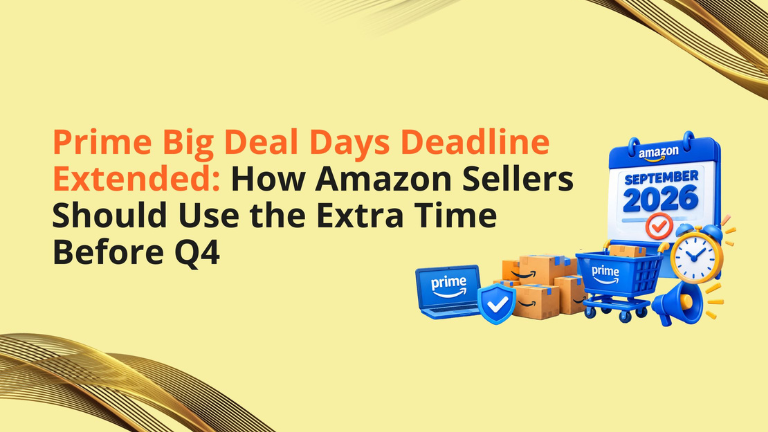
Amazon has extended the deal sourcing window for Prime Big Deal Days to September 22, 2026.
For sellers, this is good news.
But it is not a reason to delay.
Prime Big Deal Days is more than a short promotional event. It is one of the key entry points into Q4 shopping behavior, holiday buying, inventory movement, and year-end sales planning. Sellers who use the extended deadline only to submit a last-minute discount may miss the bigger opportunity.
The real goal is not just to run a deal.
The goal is to choose the right ASINs, ship enough inventory, clean up aged stock, improve listing conversion, and start advertising early enough that the deal has momentum when shoppers arrive.
Amazon customers are value-driven during major shopping events. They compare prices, scan badges, read reviews, check delivery speed, and move fast when they see a strong offer. If your product page is weak, your inventory is late, or your PPC campaigns are cold, a deal may bring traffic without enough sales.
Explains what Amazon sellers should do before the September 22 deadline, which promotion types to consider, how to use Amazon Outlet for excess inventory, and how Big Internet Commerce can help sellers prepare for Prime Big Deal Days and the larger Q4 sales season.
Amazon has extended the Prime Big Deal Days deal sourcing window to September 22, 2026. This gives eligible sellers more time to submit promotions such as Best Deals, Lightning Deals, Prime Exclusive Discounts, and coupons.
The extension also gives sellers time to review inventory health, move aged FBA stock, prepare advertising, and ensure deal ASINs are ready before the event.
Important point: Prime Big Deal Days promotional prices are excluded from the 30-day and 60-day lookback window and will not affect the maximum deal price required for Black Friday Week and Cyber Monday deals. This means sellers may be able to price more aggressively for Prime Big Deal Days without hurting Black Friday and Cyber Monday deal eligibility.
The September 22 extension matters because Q4 planning has several moving parts.
Sellers need to think about inventory, pricing, ads, listing readiness, fees, and promotion type at the same time.
A product may be eligible for a deal, but that does not automatically mean it should run one. A strong event ASIN should usually have enough inventory, stable pricing history, healthy reviews, strong main images, clear listing copy, competitive pricing, and enough margin to support the discount.
The extra time allows sellers to make smarter decisions.
Instead of asking, “Which ASINs can I discount?” sellers should ask:
Prime Big Deal Days can support revenue, but only when the deal is connected to a clear marketplace strategy.
Before submitting any promotion, sellers should review inventory readiness.
Amazon’s Q4 readiness guidance highlights the importance of getting FBA inventory into fulfillment centers ahead of event cutoff dates. For Prime Big Deal Days, the provided timeline includes September 2 for Amazon Warehousing and Distribution shipments, September 9 for FBA minimal shipment splits, and September 16 for FBA Amazon-optimized shipment splits.
For Black Friday Week and Cyber Monday, the provided timeline includes October 14 for AWD shipments, October 21 for FBA minimal shipment splits, and October 28 for FBA Amazon-optimized shipment splits.
These dates matter because Amazon fulfillment centers shift operational focus as Q4 progresses. In September and October, receiving inventory is a priority. In November and December, fulfillment centers focus more heavily on processing customer orders and delivery speed.
If inventory arrives late, sellers may lose the Prime badge, miss deal demand, or run out of stock during the exact window they worked to create.
Sellers should also remember that holiday peak fulfillment fees apply from October 15, 2026, to January 14, 2027, for FBA, Remote Fulfillment with FBA, Multi-Channel Fulfillment, and Buy with Prime. That makes unit economics especially important before discounting.
Prime Big Deal Days are not only for best sellers.
It can also be used strategically to improve inventory health.
If a seller has products with more than 90 days of supply or inventory aged over 180 days, the high-traffic window around Prime Big Deal Days can help move slow stock before Q4 fees and storage pressure become heavier.
Amazon Outlet is especially useful for this type of situation.
Amazon Outlet is designed for overstock and clearance products. It can help sellers increase sell-through, improve cash flow, reduce excess inventory, and lower storage fee exposure. Outlet deals generally run for a fixed two-week period and may be available for eligible FBA inventory that has been in fulfillment centers for at least 90 days.
Outlet can be a strong option when a product is not the best candidate for a Lightning Deal or Best Deal but still needs a structured clearance push.
However, sellers should be careful. Outlet does not allow a quantity limit in the same way some deal types do. If you do not want to sell through all available inventory at the Outlet deal price, you should not submit that ASIN.
The attached Amazon promotion guide makes one thing clear: the right promotion depends on the seller’s goal.
Different promotions solve different problems.
Best Deals can run for a longer period and may be useful for products with enough inventory to support sustained discounting. These are often better for strong products that can benefit from event visibility, not just quick clearance.
Best Deals may be useful when:
For Prime Big Deal Days, Best Deals typically require a stronger discount than simple coupons, so sellers should check margin carefully.
Lightning Deals are time-limited and built for urgency. They can be useful when sellers want fast sales volume during a short window.
Lightning Deals may work well when:
Lightning Deals can generate traffic, but they are not magic. If the listing has weak images, poor reviews, unclear copy, or a high price after discount, performance may disappoint.
Prime Exclusive Discounts can give sellers event badging and a stronger offer for Prime members. Since Prime members are highly active during deal events, this can be useful for eligible products with Prime-ready fulfillment.
Prime Exclusive Discounts may be useful when:
For many sellers, this can be a practical middle path between a major deal and a simple coupon.
Coupons are flexible and easy for shoppers to understand. They can appear across search results, product pages, and event merchandising depending on eligibility.
Coupons may be useful when:
But sellers need to watch discount stacking. Coupons may combine with other promotions, which can create deeper discounts than expected and affect profitability.
Price Discounts can be useful for store-wide or category-wide promotional planning. They can support multiple SKUs and may receive event badging when the seller selects the specific event during setup.
This is important: if sellers choose “No Event” and manually select event dates, they may not receive event badging. For event visibility, the event must be selected from the correct drop-down when available.
One of the biggest Prime Big Deal Days mistakes is starting advertising too late.
If sellers wait until the event begins, campaigns may not have enough time to gather data, build relevance, or identify which keywords are converting.
Amazon recommends starting advertising early so deal ASINs can gain momentum before each event.
This matters because Amazon PPC is not only about traffic. It also helps sellers test keyword relevance, identify converting search terms, support ranking signals, and prepare budgets before competition rises.
Before Prime Big Deal Days, sellers should review:
A strong PPC plan should warm up traffic before the event, scale carefully during the event, and continue retargeting after the event.
Discounts can increase traffic, but listings convert that traffic.
Before submitting a deal, sellers should review the product page as if they are a customer seeing it for the first time.
Check the main image. Is it clear, compliant, and competitive?
Review secondary images. Do they explain product benefits, size, usage, comparison, lifestyle context, and key purchase objections?
Review the title. Is it readable and keyword-relevant without looking stuffed?
Review bullets. Do they communicate benefits clearly?
Review A+ Content. Does it strengthen trust and help the customer understand why this product is better?
Review reviews and ratings. Is the product strong enough for event traffic?
Review variations. Are colors, sizes, styles, or multipacks cleanly organized?
A deal on a weak listing can waste margin. A deal on a strong listing can amplify momentum.
Not every promotion is profitable.
Some deal types include upfront fees and sales-based fees. Coupons also carry fees. Holiday peak fulfillment fees may affect costs. Discount stacking can reduce margins further.
Before creating a promotion, sellers should calculate:
This is where many sellers make mistakes. They focus on revenue and ignore profit.
Prime Big Deal Days should be used to support business goals, not just create a temporary sales spike.
Many sellers lose event value because they prepare too late or choose the wrong ASINs.
Avoid these mistakes:
A smart Q4 strategy connects every event instead of treating each one separately.
Big Internet Commerce helps Amazon sellers and D2C brands grow through PPC management, Amazon SEO, listing optimization, A+ Content, Store Management, creative strategy, catalog health, and marketplace growth planning.
For Prime Big Deal Days, that matters because sellers need more than a promotion.
They need to know which ASINs are ready, which listings need improvement, which campaigns should be scaled, which inventory should be cleared, and which products should be protected for Black Friday and Cyber Monday.
A strong Amazon event plan should include:
We can help sellers turn Prime Big Deal Days from a discount event into a structured growth opportunity.
Amazon extended the Prime Big Deal Days deal sourcing deadline to September 22, 2026.
Sellers may consider Best Deals, Lightning Deals, Prime Exclusive Discounts, coupons, Price Discounts, and Amazon Outlet depending on eligibility and business goals.
Yes. Starting PPC early helps deal with ASINs build keyword relevance, traffic, and performance data before event traffic increases.
Amazon states that Prime Big Deal Days promotional prices are excluded from the 30-day and 60-day lookback window and will not affect maximum deal price requirements for Black Friday Week and Cyber Monday deals.
Amazon Outlet is useful for eligible overstock or aged FBA inventory, especially products stored in fulfillment centers for at least 90 days.
Sellers should check inventory, margin, listing quality, PPC readiness, reviews, pricing history, deal fees, promotion stacking, and event eligibility.
We can help Amazon sellers prepare deal strategy, PPC campaigns, listing optimization, A+ Content, inventory review, and Q4 growth planning.
The Prime Big Deal Days deadline extension gives Amazon sellers more time, but the sellers who benefit most will use that time carefully.
Do not only submit a deal.
Review your inventory.
Choose the right promotion type.
Clean up aged stock.
Prepare PPC early.
Improve listing conversion.
Check profitability.
Plan for Black Friday and Cyber Monday now.
Prime Big Deal Days can help create sales momentum, but only when the offer is supported by inventory, content, ads, and operational readiness.
If your Amazon business needs a stronger Prime Big Deal Days or Q4 strategy, Big Internet Commerce can help review your listings, PPC campaigns, inventory risks, and marketplace growth opportunities.
Schedule a strategy call with our team.
Follow Big Internet Ecommerce (BIE) on Instagram & LinkedIn to stay updated with the latest trends in Amazon selling.
Fill out the form and our experts will get back
to you within 24 hours.
.webp)
.webp)
.webp)
We respect your privacy. Your information is safe with us.