July 24, 2026
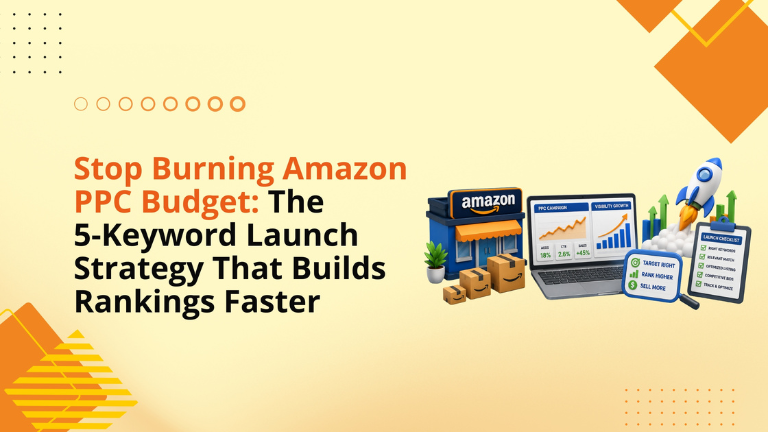
Stop Burning Amazon PPC Budget: The 5-Keyword Launch Strategy That Builds Rankings Faster
Launching a new product on Amazon has become more competitive than ever. With rising CPC costs, aggressive competitors, and limited advertising budgets, sellers can no longer afford to rely on a “target everything and hope something works” approach.
Many brands launch their first PPC campaigns with dozens of keywords, multiple match types, and large budgets from day one. However, without conversion history and performance data, this approach often creates more confusion than growth.
A new Amazon product does not need hundreds of keywords. It needs a focused strategy built around the keywords most likely to convert.
A carefully planned five-keyword PPC launch strategy allows sellers to concentrate advertising spend, collect meaningful data faster, and build stronger ranking signals with Amazon’s algorithm.
We help brands create performance-driven Amazon PPC strategies that connect advertising, SEO, and listing optimization to build sustainable marketplace growth.
One of the biggest mistakes sellers make during an Amazon launch is assuming that more keywords automatically create more sales.
They create large campaigns with:
The problem is not the number of keywords.
The problem is that your advertising data becomes diluted.
When a new ASIN receives traffic, Amazon is trying to understand:
If your budget is divided across 50 keywords, each keyword receives fewer clicks and fewer opportunities to prove its value.
A focused campaign gives Amazon clearer signals and gives sellers better control.
The five-keyword strategy is based on one principle: Focus on your budget where purchase intent is highest.
Instead of targeting every possible search term, sellers identify five keywords that best represent their product and create individual campaigns around each one.
This approach provides: Better Budget Allocation
Each important keyword receives enough attention instead of competing with dozens of unrelated terms.
You can easily identify:
When performance data is clear, sellers can make smarter PPC adjustments.
A common mistake is selecting keywords only because they have high search volume.
A keyword with thousands of searches does not matter if those shoppers are not ready to purchase.
Your launch keywords should answer three important questions:
The search term should describe what you sell, not just your general category.
Purchase-focused keywords usually perform better than informational searches.
Highly competitive keywords may require a significant budget and strong review history.
During launch, relevance is more valuable than popularity.
When launching a new ASIN, control matters.
Manual exact match campaigns allow sellers to tell Amazon: This is the search term where we want to compete.
Unlike broad targeting, exact match helps you:
Auto campaigns are useful for discovery, but they should not replace a strategic launch structure.
A simple launch structure looks like this:
Campaign 1: Primary Keyword → Exact Match
Campaign 2: Secondary Keyword → Exact Match
Campaign 3: High Purchase Intent Keyword → Exact Match
Campaign 4: Customer Search Keyword → Exact Match
Campaign 5: Competitive Opportunity Keyword → Exact Match
Each campaign should have:
A clean account structure creates better decision-making.
Many sellers expect profitability immediately after launching PPC.
However, the early stage has a different purpose.
Your first goal is to collect enough information to understand:
A successful launch does not mean achieving the lowest ACoS immediately.
It means creating the foundation for long-term ranking.
A strong PPC campaign can bring visitors to your product page.
But the listing determines whether those visitors become buyers.
Before launching ads, sellers should optimize:
PPC amplifies what already exists. It cannot compensate for a poor customer experience.
During a product launch, sellers often focus only on advertising costs.
But successful launches require a bigger view.
Track:
The right metrics show whether your advertising is building future growth.
The five-keyword strategy is not designed to remain limited forever.
It creates the foundation for expansion.
Once your keywords generate consistent conversions, you can expand into:
The goal is not more keywords.
The goal is better keywords.
Successful Amazon advertisers do not guess forever.
They use PPC data to discover new opportunities.
Keyword harvesting involves:
Over time, your PPC structure becomes stronger because every campaign is built on real customer behavior.
Creates scattered data and weak optimization.
Traffic without conversion wastes advertising money.
Early data requires patience.
High initial ACoS can be normal during ranking campaigns.
The budget should follow proven performance.
Successful Amazon growth requires more than creating campaigns.
It requires alignment between:
We help sellers build Amazon strategies designed for measurable growth.
Our approach focuses on:
The biggest mistake sellers make is believing that bigger campaigns create faster growth. They do not.
Successful Amazon launches come from precision.
Five highly relevant keywords, structured campaigns, strong listings, and continuous optimization can outperform large campaigns built without strategy.
Start focused. Learn from data. And scale what works.
That is how Amazon PPC becomes a growth engine instead of just another expense.
It is a focused launch method where sellers choose five highly relevant keywords and place each keyword in its own manual exact-match campaign.
Starting with fewer keywords helps concentrate budget, collect cleaner data, and understand which search terms are most likely to convert.
Auto campaigns can be useful later for discovery, but manual exact-match campaigns give more control during the early launch phase.
Yes. Launch ACoS can be higher than mature campaign targets because the seller is collecting data, building visibility, and testing keyword relevance.
Add more keywords after the first five have collected enough data and shown clear performance signals such as conversions, rank movement, and useful search term insights.
Need help launching your next Amazon product without wasting PPC budget?
Schedule a strategy call with our team.
Follow Big Internet Ecommerce (BIE) on Instagram & LinkedIn to stay updated with the latest trends in Amazon selling.
Fill out the form and our experts will get back
to you within 24 hours.
.webp)
.webp)
.webp)
We respect your privacy. Your information is safe with us.