July 13, 2026
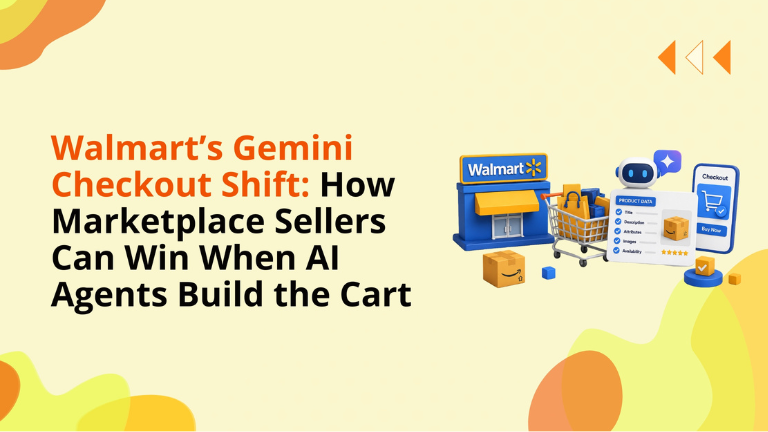
Walmart’s Gemini Checkout Shift: How Marketplace Sellers Can Win When AI Agents Build the Cart
Ecommerce is moving into a new stage where customers may not always browse, compare, and checkout the way they used to.
With Walmart connecting Google Gemini and Universal Commerce Protocol into shopping experiences, AI agents are becoming more involved in product discovery, cart building, and checkout. Instead of manually scrolling through pages of search results, shoppers can describe what they want, set conditions like budget or rating, and let an AI assistant narrow the options.
For marketplace sellers, this changes the rules of visibility.
Winning in ecommerce is no longer only about having an attractive product page. Sellers now need product data that AI systems can read, compare, and trust. Attributes, price, inventory, reviews, delivery promise, product details, and structured content all become part of whether an agent chooses to surface your product.
This is not just a Walmart update. It is a signal for the future of marketplace selling across Amazon, Walmart, Shopify, and other ecommerce channels.
For years, sellers optimized listings for search results pages.
The goal was simple: rank high, get clicks, convert shoppers, and scale sales.
AI shopping changes that journey.
Now, the customer may ask an assistant for a product recommendation before ever visiting a marketplace page. The agent may filter products based on structured data, compare options, assemble a cart, and guide the shopper closer to purchase.
This means sellers need to think beyond traditional keyword ranking.
Your product must be understandable to the system before it can be shown to the shopper.
Walmart’s integration with Google Gemini and UCP matters because it brings agent-led commerce closer to a major retail marketplace environment.
For Walmart Marketplace sellers, this can influence how products are discovered and selected. For Amazon sellers, it is another sign that AI shopping behavior is becoming a broader ecommerce trend, not a platform-specific experiment.
Amazon has its own AI shopping tools. Shopify is building AI commerce infrastructure. Google is building AI checkout rails. Walmart is now moving deeper into agent-led product discovery.
The direction is clear: marketplaces are preparing for a future where AI agents help decide which products get attention.
A strong Multi-Channel Integration strategy can help brands keep product data, pricing, inventory, and content consistent across Amazon, Walmart, Shopify, and other sales channels.
In agentic commerce, the product page is not always the first thing the shopper sees.
The AI agent may read your product data before the customer does.
That means vague product information can make your item less visible. Missing attributes can remove your product from filtered results. Weak descriptions can make it harder for AI systems to understand the use case.
Sellers should review details such as:
The better your product data, the easier it becomes for AI shopping systems to understand where your product fits.
A human shopper may be willing to scroll through images and read between the lines.
An AI agent needs structured clarity.
If a customer asks for “a dishwasher-safe glass water bottle under $25,” the agent needs direct product data to match that request. If your listing only says “premium bottle” without clear material, capacity, dishwasher status, and price accuracy, your product may be ignored.
This is why Amazon Content Optimization is becoming more important for marketplace sellers.
Strong product content should clearly explain what the product is, who it is for, what problem it solves, and why it is the right choice.
AI agents can compare offers faster than shoppers.
If your product is priced differently across Walmart, Amazon, Shopify, and other marketplaces, the agent may guide shoppers toward the lowest total-cost option.
That means price parity and margin planning need more attention.
Sellers should review:
The goal is not always to match every price exactly. The goal is to understand how pricing differences affect shopper trust, channel performance, and profitability.
AI agents are built to satisfy customer intent.
If a shopper asks for a product that can arrive quickly, the agent may prioritize items with stronger availability and delivery promises.
This means stockouts, weak inventory feeds, unclear fulfillment timelines, or inconsistent delivery promises can reduce product visibility.
Sellers should connect inventory planning with marketplace growth.
A product cannot win if it is unavailable, delayed, or poorly represented in the data layer.
A full Amazon Store Management approach can help sellers align inventory, pricing, listing quality, and marketplace performance.
AI-led commerce does not remove the need for strong visuals.
Images still help shoppers trust and understand the product once it is surfaced. But in this new environment, images need to work alongside structured product data.
Your visuals should clearly show:
Strong Amazon Image Optimization helps products communicate faster, especially when shoppers are comparing multiple options quickly.
As AI agents influence discovery, marketplace advertising will also need to evolve.
Sellers should monitor whether traffic patterns, conversion rates, and channel attribution begin changing as agent-driven shopping expands.
On Walmart, sellers may need to watch for future reporting around agent-assisted orders. On Amazon, sellers should continue tracking AI-driven search behavior, branded search, organic rank movement, PPC performance, and session quality.
A strong Amazon Advertising PPC Services strategy should connect ad spend with SEO, listing quality, pricing, and channel profitability.
Paid traffic cannot fix poor product data.
Walmart sellers should start by auditing product data.
Check whether every important field is complete, accurate, and easy to understand. Review product titles, attributes, category placement, descriptions, images, pricing, shipping promises, and review signals.
Next, review competitor products through the lens of an AI filter.
Ask whether your product would be selected if a shopper searched by budget, rating, use case, delivery speed, material, size, or compatibility.
Then update product content and attributes to remove confusion.
The goal is to make your product easier for both AI systems and human shoppers to choose.
Amazon sellers should not treat this as a Walmart-only development.
The same shift is happening across ecommerce. Amazon’s AI shopping tools are already changing how customers ask questions, compare products, and discover alternatives.
That means Amazon listings need to become more agent-readable.
Sellers should review backend attributes, title clarity, bullet structure, A+ Content, Q&A, images, product details, and customer review themes.
If an AI assistant had to explain your product in one answer, would your listing provide enough clear information?
We help marketplace sellers prepare for AI-driven commerce across Amazon, Walmart, Shopify, and other ecommerce channels.
Our team reviews product data, marketplace listings, SEO, content structure, image quality, pricing, inventory, PPC strategy, and multi-channel consistency.
We help sellers build product pages and data systems that are easier for shoppers, search engines, and AI agents to understand.
The goal is simple: improve visibility, protect margins, and prepare your brand for the next stage of marketplace growth.
Agentic commerce is a shopping experience where an AI agent helps customers discover products, compare options, build carts, and move toward checkout based on customer intent.
It shows that large marketplaces are moving toward AI-assisted shopping experiences where agents can influence product discovery and checkout.
Start with structured product data, product attributes, pricing accuracy, inventory availability, listing content, and images.
Yes. Even though the update is tied to Walmart and Google, the broader shift toward AI-led shopping applies to Amazon, Shopify, and other ecommerce platforms.
Sellers should make product data complete, improve listing clarity, maintain price consistency, strengthen images, monitor competitor positioning, and track channel-level profitability.
Need help preparing your marketplace listings for AI-led commerce?
Schedule a strategy call with our team.
Follow Big Internet Ecommerce (BIE) on Instagram & LinkedIn to stay updated with the latest trends in Amazon selling.
Fill out the form and our experts will get back
to you within 24 hours.
.webp)
.webp)
.webp)
We respect your privacy. Your information is safe with us.