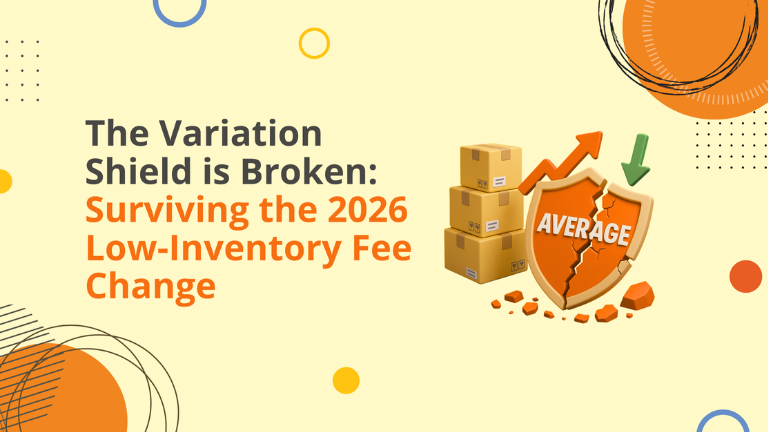
If you sell products with variations (size, color, style), you have been benefiting from an implicit benefit. For the past year, Amazon calculated its Low-Inventory-Level Fee at the Parent ASIN level. This meant that your overstocked slow-movers often “shielded” your understocked fast-movers from penalties.
That subsidy ends on January 15, 2026.
Amazon has confirmed that the fee calculation is moving to the Seller-FNSKU level. This is a fundamental shift in how you must manage your supply chain.
Contents
The New Math: Granularity = Liability
Amazon’s goal is distribution efficiency. They cannot distribute a “Parent ASIN.” They can only distribute a physical SKU (FNSKU). If you are out of stock on Medium, having plenty of Large helps no one.
- The Trigger: If an individual FNSKU’s historical days of supply (short-term AND long-term) drops below 28 days, the fee applies to that specific SKU.
- The Cost: Fees range from $0.32 to over $1.11 per unit for standard items. For a low-margin variation, this fee can easily turn a net profit into a net loss. *
- The Expansion: This now applies to Small Bulky and Large Bulky items as well. Furniture and appliance sellers are no longer exempt.
* actual fee depends on the size/weight of the unit and how far below the 28-day threshold the supply is.
The “Runner” Problem
The cruel irony of this fee is that it punishes your winners. Your “Hero SKUs”—the ones with the highest velocity—are the hardest to keep in stock. They are the ones most likely to dip below the 28-day threshold. In 2026, if you let your Hero SKU run lean to manage cash flow, Amazon will tax every unit you sell during that lean period. You are effectively paying a penalty for being too successful at selling, if your logistics can’t keep up.
Your Playbook: Precision Supply Chain
You need to move from “Aggregate Forecasting” to “Granular Forecasting.”
FNSKU-Level “Min/Max” Logic
You can no longer restock based on the “product line.” You should set individual Reorder Points for every FNSKU.
- Old Way: “Order 5,000 shirts, mixed sizes.”
- New Way: “Order 1,200 Mediums (Air Freight), 800 Smalls (Ocean), 3,000 Larges (Hold at 3PL).”
The AWD Buffer
Amazon Warehousing & Distribution (AWD) is your best defense. By keeping a bulk reserve in AWD and enabling Auto-Replenishment, you ensure a steady drip-feed of inventory into FBA. This helps smooth out the “Days of Supply” metric and protects you from the volatility that triggers fees.
Prune the Dead Weight
Variations that don’t pull their own weight are now liabilities. They can no longer “boost the average” of the parent. If a variation has low margin and high supply chain complexity, kill it. Focus your capital on keeping the Hero FNSKUs above 28 days.
Where Big Internet Ecommerce Fits In
We build supply chains that are “Fee-Proof.”
- FNSKU Forecasting Models: We implement advanced forecasting tools that track velocity at the child level, not the parent level.
- Unit Economics Lab: We calculate the impact of the new fee on your margins. We tell you exactly how much “Safety Stock” you can afford to hold versus the cost of the fee.
- AWD Integration: We set up your AWD upstream storage to act as the perfect buffer, automating your compliance with the 28-day rule.
The average is almost gone. Precision is the only path forward.
Book a call to get your migration roadmap today.
Follow Big Internet Ecommerce (BIE) on Instagram & LinkedIn to stay updated with the latest trends in Amazon selling.