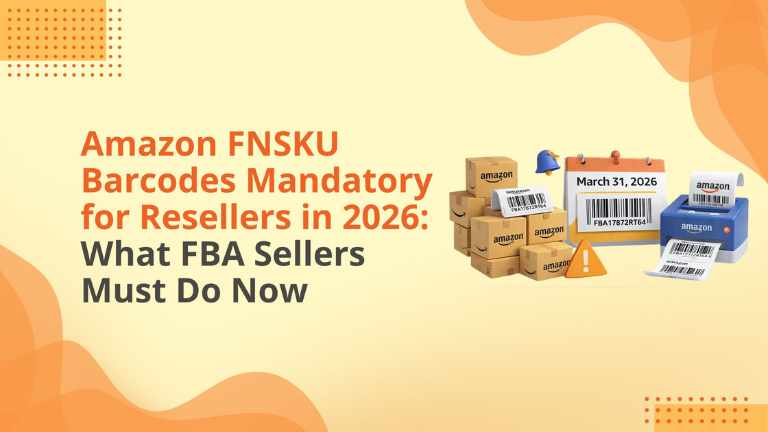
Amazon has announced a major Fulfillment by Amazon (FBA) update that directly impacts resellers.
Beginning March 31, 2026, Amazon FNSKU barcodes will be mandatory for sellers who are not enrolled in Brand Registry — even if products already carry manufacturer UPC codes.
This update eliminates stickerless commingled inventory for non-brand sellers and fundamentally changes how inventory must be prepared before reaching fulfillment centers.
For wholesale sellers, drop shippers, and hybrid FBA models, this shift introduces operational and cost considerations that require immediate planning.
Contents
Why Amazon Is Mandating FNSKU Label
Previously, Amazon allowed:
- Manufacturer barcode usage (UPC/EAN)
- Pooled inventory across sellers
- Stickerless commingling
However, commingled inventory created:
- Counterfeit risk
- Inventory tracking challenges
- Attribution issues between sellers
By requiring Amazon FNSKU barcodes, Amazon ensures:
- Unit-level seller attribution
- Improved traceability
- Stronger compliance control
- Reduced fraud risk
This aligns with Amazon’s broader compliance tightening seen in labeling, transparency, and brand protection programs.
What Changes on March 31, 2026
Non-Brand Registered Sellers:
- Must apply FNSKU label per unit
- Cannot rely solely on UPC
- Must update barcode preferences in Seller Central
- Must revise prep workflows
Brand Registered Sellers:
- May still use manufacturer barcodes (if eligible)
- Maintain stickerless commingling option
This creates a competitive structural advantage for brand owners.
Operational & Financial Impact
1. Labeling Costs
Third-party prep centers may charge:
- $0.20–$0.50 per unit
- Handling fees
- Additional storage
For high-volume wholesale sellers, this can significantly impact margins.
2. Drop Shipping Complexity
If suppliers ship directly to FBA:
- Factory-level FNSKU application becomes mandatory
OR - Inventory must route through prep centers
This adds:
- Lead time
- Operational friction
- Working capital exposure
3. Inventory Rejection Risk
Failure to comply may result in:
- Receiving delays
- Inventory defects
- Increased fees
- Account performance risk
How Sellers Should Prepare
- Audit all SKUs not enrolled in Brand Registry
- Update barcode preference in Seller Central
- Negotiate factory-level FNSKU printing
- Calculate new per-unit cost impact
- Evaluate transition toward private label
If you are running hybrid wholesale models, consider whether brand ownership reduces long-term cost risk.
Strategic Perspective
This update reinforces a trend:
Amazon increasingly favors structured, brand-controlled ecosystems over anonymous wholesale reselling.
Brand Registry continues to offer:
- Listing control
- Manufacturer barcode eligibility
- IP protection
- Enhanced advertising tools
Learn more about building and protecting your brand through strategic Amazon growth.
The Amazon FNSKU barcode requirement is not just a labeling change.
It is a structural shift in how inventory ownership is enforced within FBA.
Resellers who prepare now will:
- Avoid disruption
- Protect margins
- Maintain inbound efficiency
- Reduce compliance risk
Those who wait may face shipment delays, unexpected costs, and operational stress.
If you need help restructuring your FBA labeling and supply chain before enforcement:
Follow Big Internet Ecommerce (BIE) on Instagram & LinkedIn to stay updated with the latest trends in Amazon selling.