Amazon has quietly introduced one of the most impactful changes to its advertising ecosystem in years — and most sellers haven’t fully understood the consequences yet.
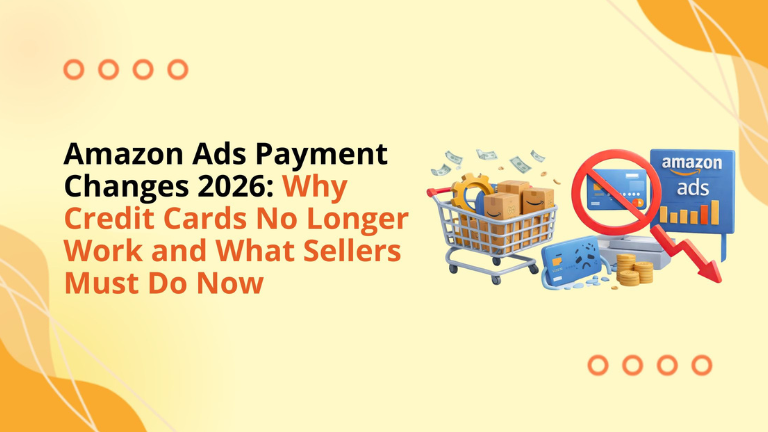
Starting April 15, 2026, Amazon Ads will no longer rely on credit cards as the primary payment method. Instead, ad spend will be automatically deducted from seller payouts.
At first glance, this may seem like a simple operational update.
In reality, it fundamentally changes:
- Cash flow management
- Scaling strategies
- Profitability models
What’s changing, why it matters, and how you should adapt immediately.
Contents
What Exactly Changed?
Amazon Ads will now:
- Deduct ad spend directly from seller revenue
- Remove credit card billing cycles
- Use credit cards only as backup
- Automate all payments
No manual payments required
No billing cycle advantage
No reward-based benefits
This aligns ad spend directly with sales performance — but at a cost to sellers
The Hidden Impact: Cash Flow Collapse
Previously, sellers benefited from:
- Amazon payout delay (~30 days)
- Credit card billing cycle (~30 days)
Total: ~60 days of working capital
Now?
That buffer is completely gone
Why This Matters
This impacts:
- Inventory reinvestment cycles
- Ad scaling decisions
- Supplier payments
- Business liquidity
Even profitable sellers may struggle if cash flow isn’t managed tightly.
The Real Cost: Lost Rewards & Profit Leakage
Let’s quantify it:
| Monthly Ad Spend | Annual Cashback Lost (2%) |
| $10,000 | $2,400 |
| $50,000 | $12,000 |
| $100,000 | $24,000 |
This is pure margin erosion.
Why Amazon Made This Move
Amazon Ads generated billions in revenue.
By removing credit card payments:
- They eliminate 1.5–2.5% interchange fees
- They get paid immediately
- They improve internal margins
This is a business optimization for Amazon — not for sellers
How Sellers Should Adapt
1. Shift to Profit-Based PPC
Stop scaling based on spend — start scaling based on:
- TACOS
- Contribution margin
- Net profitability
2. Tighten Keyword & Campaign Structure
Eliminate:
- Wasted spend
- Irrelevant traffic
- Low CVR keywords
3. Forecast Cash Flow Weekly
Track:
- Ad spend vs revenue
- Payout timing
- Inventory needs
4. Reduce Dependency on Broad Campaigns
Focus on:
- High intent keywords
- Branded defense
- Product targeting
5. Optimize CTR & CVR
Better creatives = lower CPC pressure
Better listings = higher conversion
This is where most sellers win or lose.
How Big Internet Ecommerce Helps
At Big Internet Ecommerce, we:
- Rebuild PPC systems for profitability
- Align ads with cash flow cycles
- Improve CTR → CVR → ranking loop
- Reduce wasted spend drastically
We don’t just manage ads.
We build scalable systems.
This isn’t just a payment update.
It’s a fundamental shift in how Amazon businesses operate.
Sellers who adapt will:
- Scale profitably
- Control cash flow
- Dominate rankings
Sellers who don’t… will feel it in margins very quickly.
Want help restructuring your Amazon Ads strategy before this impacts your business?
Schedule a strategy call with our team.
Follow Big Internet Ecommerce (BIE) on Instagram & LinkedIn to stay updated with the latest trends in Amazon selling.