The structure of online retail is rapidly consolidating around a few dominant platforms.
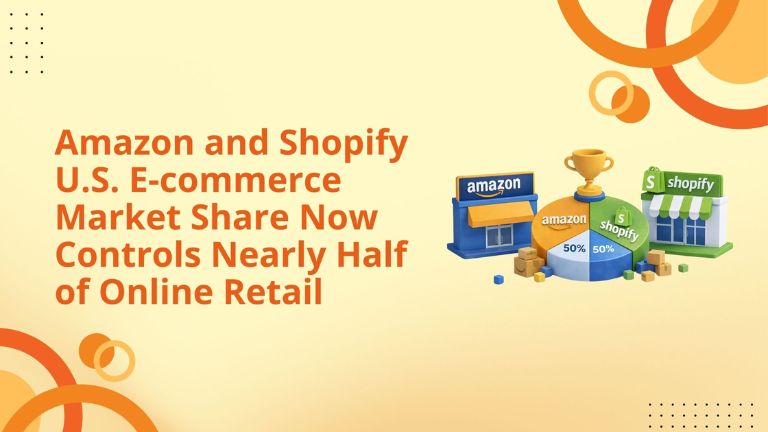
Recent industry data shows that Amazon and Shopify U.S. e-commerce market share now accounts for 49.7% of all online retail sales in the United States, representing nearly half of the $1.2 trillion e-commerce economy.
Amazon alone generated approximately $440 billion in revenue in 2025, while Shopify merchants collectively represent 14% of the market through millions of storefronts.
This dramatic rise signals a major shift in how digital commerce is structured. Sellers must now think strategically about where they build their business and how they distribute operations across platforms.
Understanding the roles of both Amazon and Shopify is essential for brands aiming to scale in the modern e-commerce ecosystem.
Contents
- 1 Amazon and Shopify U.S. E-commerce Market Share Dominance
- 2 U.S. E-commerce Market Share Breakdown
- 3 Amazon’s Role in the E-commerce Ecosystem
- 4 Shopify’s Growth in the Direct-to-Consumer Market
- 5 Why Sellers Must Understand This Market Structure
- 6 Strategic Opportunities for Sellers
- 7 The Future of E-commerce Platforms
Amazon and Shopify U.S. E-commerce Market Share Dominance
According to research from Marketplace Pulse, the combined market share of Amazon and Shopify has grown significantly in recent years.
In 2021, these platforms accounted for approximately 43% of U.S. e-commerce sales.
By 2025–2026, that number has increased to 49.7%.
This means nearly half of all online retail purchases in the United States now happen either:
- On Amazon
- On Shopify-powered stores
Amazon dominates marketplace commerce, while Shopify powers the infrastructure behind millions of independent brands.
U.S. E-commerce Market Share Breakdown
Current estimates place the market distribution as follows:
- Amazon – 35.7%
- Shopify – 14%
- Walmart – 6.4%
- Apple – 3.6%
- eBay – 3%
Amazon remains the largest single platform in the e-commerce ecosystem.
The company receives over 2.8 billion visits annually, making it one of the most visited retail websites in the world.
This massive traffic volume reinforces Amazon’s role as the primary discovery platform for online shoppers.
Amazon’s Role in the E-commerce Ecosystem
Amazon operates a centralized marketplace where customers search for products directly on the platform.
Key advantages include:
- Massive buyer traffic
- Integrated fulfillment infrastructure (FBA)
- Built-in trust and credibility
- Advanced advertising systems
For many brands, Amazon represents the fastest way to reach high-intent shoppers.
Sellers interested in improving their marketplace strategy can explore our Amazon growth services.
Shopify’s Growth in the Direct-to-Consumer Market
While Amazon dominates marketplace commerce, Shopify powers the infrastructure behind direct-to-consumer brands.
Key Shopify statistics include:
- Nearly 7 million active stores globally
- Merchants operating across 235 countries
- Over $490 billion in economic activity
The Shopify ecosystem enables brands to control:
- Customer relationships
- Branding and design
- Marketing campaigns
- First-party data
The Shopify App Store also plays a major role in the platform’s growth, with more than 25 million installed apps enhancing merchant capabilities.
According to Shopify statistics compiled by Josh Howarth, the platform controls approximately 20% of the e-commerce platform market.
Why Sellers Must Understand This Market Structure
The increasing dominance of Amazon and Shopify changes how sellers should approach growth.
Platform strategy is now critical.
Many brands mistakenly view the decision as:
Amazon vs Shopify.
However, the most successful companies leverage both platforms.
Amazon provides customer acquisition through marketplace discovery, while Shopify builds long-term brand value and customer retention.
Strategic Opportunities for Sellers
Sellers can leverage the strengths of both platforms through a structured strategy.
Amazon
Best for:
- Product discovery
- High-intent search traffic
- Marketplace scale
Shopify
Best for:
- Brand building
- Customer ownership
- Repeat purchases
By integrating both channels, brands can create a balanced growth model that combines marketplace exposure with direct-to-consumer control.
The Future of E-commerce Platforms
Industry projections suggest that online retail will continue expanding rapidly.
Global e-commerce sales are expected to reach:
- $6.3 trillion in 2024
- $7.9 trillion by 2027
As this growth continues, Amazon’s massive infrastructure and Shopify’s merchant ecosystem will likely remain dominant forces shaping the future of online commerce.
Sellers who understand how these platforms interact will be better positioned to scale their brands in an increasingly competitive market.
The rise of Amazon and Shopify U.S. e-commerce market share to nearly 50% signals a major shift in the structure of online retail.
Amazon leads product discovery through marketplace traffic, while Shopify empowers brands with direct-to-consumer control.
Rather than choosing one platform over the other, successful sellers increasingly build strategies that leverage the strengths of both ecosystems.
For brands seeking long-term growth, understanding how to navigate these platforms effectively is becoming a critical competitive advantage.
If you want help building a scalable Amazon growth strategy or integrating your marketplace and DTC channels:
Follow Big Internet Ecommerce (BIE) on Instagram & LinkedIn to stay updated with the latest trends in Amazon selling.