Amazon has long operated as a closed ecosystem, where sellers compete for visibility, drive traffic to their listings, and complete transactions entirely within the platform.
That model is now evolving.
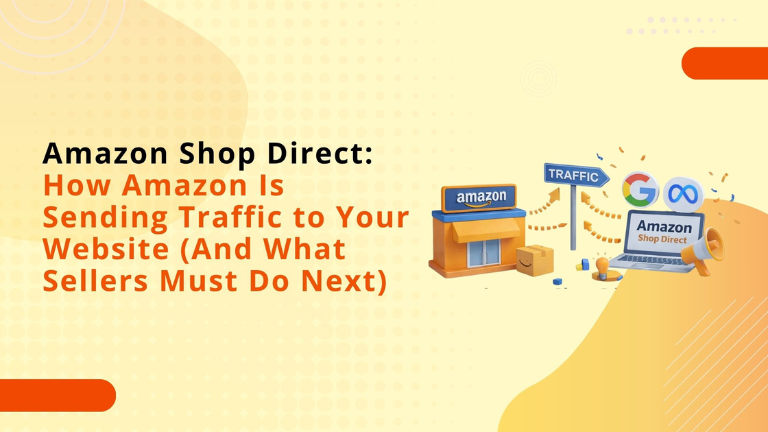
With the rollout of Amazon Shop Direct, Amazon is introducing a new system where products can appear in search results without traditional listings, and in many cases, customers are redirected to merchant websites to complete purchases.
This marks a significant shift in how sellers acquire traffic, control customer relationships, and optimize conversions.
For Amazon sellers, this is not just an update — it is a fundamental change in the e-commerce model.
Contents
What is Amazon Shop Direct?
Amazon Shop Direct is a system that allows:
- Product discovery on Amazon
- Product data pulled via third-party feeds
- Checkout happening either:
- On the merchant website
- Or through Amazon’s AI-assisted checkout
This is powered by:
- AI-driven product discovery
- Real-time product feed integrations
- External merchant catalogs
How Amazon Shop Direct Changes the Seller Model
1. From Listing-Based to Data-Based Visibility
Previously:
→ Rankings determined visibility
Now:
→ Structured data + feeds determine visibility
This means:
- Attributes matter more
- Backend data matters more
- Feed quality matters more
2. Amazon Becomes a Discovery Engine
Amazon is no longer just:
→ A transaction platform
It is becoming:
→ A product discovery engine
Similar to:
- Google Shopping
- Meta ads
- TikTok Shop
3. Dual Funnel Commerce (Amazon + Website)
Sellers now operate in two funnels:
Funnel 1:
Amazon → Amazon checkout
Funnel 2:
Amazon → Website → Checkout
This creates a hybrid commerce model.
Why This is a Huge Opportunity for Amazon Sellers
1. Customer Ownership
Selling off Amazon means:
- You capture emails
- You control retargeting
- You build brand equity
2. Lower Dependency on Rankings
New sellers can now:
- Bypass ranking barriers
- Gain visibility faster
3. Higher Lifetime Value (LTV)
DTC customers = repeat purchases
Amazon customers = one-time transactions
4. Diversified Risk
You are no longer 100% dependent on:
- Amazon algorithm
- Account health
- Listing suppression
The Hidden Challenge Most Sellers Will Face
1. Website Conversion Rate
Amazon converts at ~10–20%
Most Shopify stores convert at ~1–3%
Without optimization:
→ You lose the advantage
2. Feed Optimization Complexity
Tools like:
- Feedonomics
- Salsify
Require:
- Clean data
- Structured catalogs
- Real-time sync
3. Tracking & Attribution Gaps
You must now track:
- Cross-platform conversions
- External attribution
- Funnel performance
Strategic Framework for Sellers (What You Should Do Now)
Step 1: Build Hybrid Strategy
Amazon = trust + volume
Website = ownership + LTV
Step 2: Optimize Product Data
Focus on:
- Titles
- Attributes
- Structured data
Step 3: Upgrade Website Funnel
Improve:
- Landing pages
- Checkout
- Speed
Step 4: Implement Tracking Systems
Use:
- Attribution tools
- Analytics dashboards
Step 5: Prepare for AI Discovery
Optimize for:
- Machine-readable data
- Context relevance
How Big Internet Ecommerce Can Help
At Big Internet Ecommerce, we help sellers transition into this next phase of Amazon commerce:
Amazon + DTC Strategy
We design hybrid growth systems combining both channels.
Feed & Data Optimization
We structure your catalog for AI discovery.
Conversion Optimization
We turn traffic into revenue across platforms.
Advanced Tracking
We build attribution systems for cross-channel visibility.
Amazon Shop Direct is not just a feature.
It is a shift in how e-commerce works.
Sellers who:
- Adapt early
- Build hybrid strategies
- Optimize for AI
Will dominate the next phase of Amazon growth.
Others will struggle to keep visibility.
If you want to future-proof your Amazon business and build a hybrid growth system.
Follow Big Internet Ecommerce (BIE) on Instagram & LinkedIn to stay updated with the latest trends in Amazon selling.