September 21, 2026
Amazon MCF for Shopify and TikTok Shop Orders: 2026 Guide to Fees, Discounts, and Fulfillment Strategy
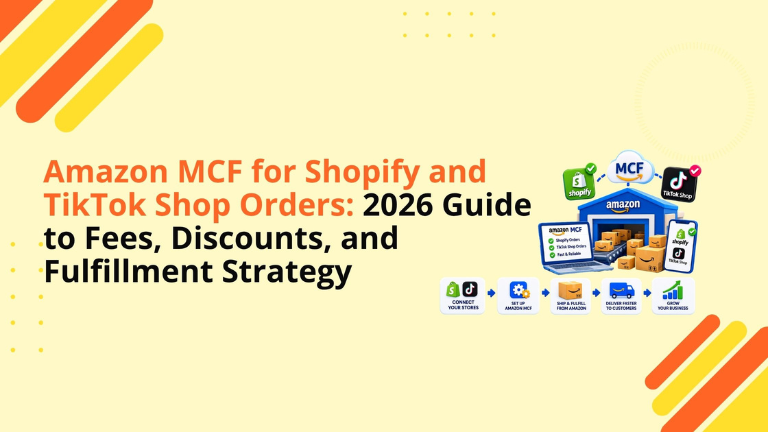
Selling on Amazon is no longer just about winning the Buy Box or improving PPC performance. Many sellers now run multi-channel ecommerce businesses across Amazon, Shopify, TikTok Shop, Walmart, and other marketplaces. That creates one major question: how should orders be fulfilled without increasing cost, delaying delivery, or splitting inventory across too many locations?
Amazon Multi-Channel Fulfillment, commonly called Amazon MCF, gives sellers a way to fulfill off-Amazon orders using inventory already stored in Amazon’s fulfillment network. Sellers can use Amazon’s fulfillment capabilities for orders from their own websites and other ecommerce channels.
For Shopify and TikTok Shop sellers, this can be a powerful option. But in 2026, the real opportunity is not just “using MCF.” It is using MCF correctly. Routing, attribution, fees, app setup, and product size can decide whether MCF protects your margin or quietly drains it.
Amazon MCF allows sellers to ship off-Amazon orders from the same inventory pool they use for FBA. If your products are already stored in Amazon fulfillment centers, MCF can fulfill eligible orders from channels like Shopify and TikTok Shop without requiring a separate warehouse.
Here is the simplest way to understand it:
Your Amazon orders are fulfilled through FBA.
Your Shopify and TikTok Shop orders can be fulfilled through MCF.
Both can draw from the same Amazon inventory pool.
That means sellers can avoid duplicating stock across multiple warehouses. Instead of sending one batch to FBA, another to a 3PL, and another to a marketplace-specific provider, sellers may be able to centralize fulfillment through Amazon’s network.
However, MCF is not identical to FBA. FBA is built for Amazon orders. MCF is built for off-Amazon orders. With MCF, you manage the customer relationship, returns process, and channel experience. Amazon handles picking, packing, shipping, and tracking through its fulfillment network.
The appeal of Amazon MCF is straightforward: sellers want speed, scale, and simpler inventory control.
If you sell through Shopify, MCF can help you fulfill orders without building your own warehouse process. If you sell through TikTok Shop, MCF can help you move social commerce orders through a fulfillment network that is already tied to your FBA inventory.
This matters because multi-channel sellers often face three common problems:
When those problems happen, margin becomes difficult to measure. A seller may think Shopify is more profitable because there is no Amazon referral fee, but fulfillment cost may still be higher than expected. A seller may think TikTok Shop orders are receiving Amazon’s MCF discount, but the connector may not be passing the correct channel attribution.
The result is simple: sellers may be leaving money on the table without realizing it.
Most sellers start by asking, “What does Amazon MCF cost?”
That is the right question, but it is not the full question.
MCF pricing depends on product size tier, shipping weight, units per order, and delivery speed. Amazon’s MCF pricing also reflects additional cost factors such as surcharges and peak fulfillment windows.
But the most important cost factor may be routing. A properly attributed TikTok Shop order may qualify for a discount. A manually entered order may not. A Shopify order passed through the wrong app may miss the channel data needed to qualify for certain benefits.
Using the provided rate scenario, a 6 oz small standard item shipped through Shopify may cost around $7.61 after surcharge assumptions, while the same item sold through TikTok Shop and attributed correctly may cost around $4.95 after the 35% discount. At 2,000 orders per month, that difference can add up quickly.
Actual fees should always be verified inside Seller Central and Amazon’s current pricing tools, but the lesson is clear: configuration can change profitability.
Amazon has promoted a 35% discount on eligible Standard and Expedited MCF rates for qualifying US TikTok Shop orders.
The key word is “eligible.”
The discount is not simply applied because an order came from a TikTok Shop in theory. The order must be attributed correctly when it reaches Amazon MCF. That usually requires a supported integration that passes the required channel information.
Common reasons sellers may miss the discount include:
This is why sellers should not assume their discount is working. They should confirm it through actual order data and MCF reporting.
For Shopify sellers, Amazon’s MCF and Buy with Prime app can connect Shopify orders to Amazon fulfillment. In many cases, this removes the need for separate middleware.
Still, the setup needs careful attention.
Sellers should review:
A major issue in 2026 is the legacy Shopify MCF app. If a seller is still using an older app or outdated fulfillment connection, they may risk missed discounts, routing errors, or future disruption. Sellers should review their app setup before peak season instead of waiting until orders spike.
TikTok Shop sellers need to pay special attention to attribution and returns.
A TikTok Shop order may look simple from the customer side, but behind the scenes the integration must pass the correct order source into Amazon MCF. Sellers using supported integration partners are more likely to preserve the order data needed for discount eligibility.
Sellers should also confirm whether their TikTok Shop has Seller Shipping access. If not, the setup may require a central fulfillment address and additional configuration.
Returns are another important detail. Sellers should not point returns to an Amazon fulfillment center. Because Amazon dynamically routes inventory across its network, there is no single Amazon warehouse address that should be treated as the seller’s returns destination. Sellers need a return address they control.
Before going live at scale, run at least one test order and one test return. That small step can prevent a much larger customer service problem later.
The best fulfillment choice is not always Amazon MCF, and it is not always a 3PL. The right answer depends on the SKU.
Amazon MCF may be a strong option when:
A 3PL may be better when:
Many growing brands need both. Amazon MCF can support standard-size, fast-moving SKUs, while a 3PL can handle bulky items, custom unboxing, wholesale orders, or high-return categories.
The key is to evaluate fulfillment at the SKU level, not the brand level.
MCF becomes more sensitive during Q4 because holiday peak fulfillment fees can apply. In the user-provided source, the peak window begins October 15 and continues into January.
That means sellers should not judge MCF only by September costs. A channel that looks profitable before Q4 may look different after peak fees, surcharges, and faster delivery promises are included.
Before Q4, sellers should review:
If all channels pull from one inventory pool, stockouts can happen faster. The benefit of one pool is simplicity. The risk is that one fast-growing channel can drain stock needed for another.
Amazon MCF is powerful, but it is not a complete logistics strategy.
MCF does not replace every part of your supply chain. Sellers may still need help with inbound freight, customs, prep, labeling, long-term storage planning, branded packaging, reverse logistics, and returns inspection.
Amazon Warehousing and Distribution may help with upstream storage and replenishment into fulfillment centers, but sellers still need a broader operating plan.
This is where many sellers make the wrong assumption. They treat MCF as a plug-and-play solution for every channel. It is better to treat MCF as one fulfillment option inside a larger ecommerce growth system.
After Amazon MCF is live, sellers should measure performance with real numbers, not assumptions.
Track these metrics:
During peak season, review these numbers weekly. Outside peak season, a monthly review may be enough.
The goal is not just to reduce fulfillment cost. The goal is to understand which channels are truly profitable after advertising, fulfillment, returns, discounts, and customer service.
At Big Internet Commerce, the focus is not only on launching campaigns or optimizing listings. The bigger goal is profitable marketplace growth.
For Amazon sellers expanding into Shopify and TikTok Shop, fulfillment strategy is now part of growth strategy. PPC may bring traffic, SEO may improve discoverability, and A+ Content may improve conversion, but weak fulfillment economics can reduce the value of every sale.
We helps Amazon sellers and D2C brands with Amazon SEO, PPC management, listing optimization, catalog health, Store Management, compliance support, and marketplace strategy. For sellers using Amazon MCF, that support can include reviewing SKU economics, identifying fulfillment gaps, improving channel readiness, and aligning advertising with inventory availability.
If your fulfillment setup is costing more than expected, the answer may not be to stop using MCF. The answer may be to fix the routing, review the SKUs, and build a clearer multi-channel fulfillment strategy.
Yes. Amazon MCF can fulfill Shopify orders using inventory stored in Amazon fulfillment centers. Sellers should connect Shopify through the correct app, map SKUs accurately, and test orders before going live.
Yes, but sellers must use the correct workflow and supported integrations. To qualify for certain TikTok Shop MCF discounts, the order must be attributed correctly.
Sometimes. MCF can be competitive for standard-size domestic products, especially when the seller already uses FBA. A 3PL may be better for bulky items, branded packaging, international shipping, or high-return products.
No. Off-Amazon orders fulfilled through MCF do not carry the standard Amazon referral fee because the sale did not happen on Amazon. However, MCF fulfillment fees still apply.
Start with a fulfillment audit. Check Shopify routing, TikTok Shop attribution, SKU mapping, MCF fees, discount capture, and Q4 peak impact. Then decide which SKUs belong on MCF and which may need a 3PL.
Amazon MCF can be a smart fulfillment option for Shopify and TikTok Shop orders in 2026, but it needs to be managed carefully. The sellers who benefit most are not just the ones who turn it on. They are the ones who understand routing, attribution, fee timing, SKU economics, and channel-specific profitability.
If you are fulfilling Shopify and TikTok Shop orders from FBA inventory without knowing your true per-unit cost, now is the time to review the setup.
We can help you evaluate Amazon MCF readiness, marketplace growth opportunities, PPC performance, catalog health, and operational gaps that may affect profitability.
Schedule a strategy call with our team.
Follow Big Internet Ecommerce (BIE) on Instagram & LinkedIn to stay updated with the latest trends in Amazon selling.
Fill out the form and our experts will get back
to you within 24 hours.
.webp)
.webp)
.webp)
We respect your privacy. Your information is safe with us.