October 13, 2026
Amazon Selling Partner Plugin: Setup, Uses, and Risks for Sellers

Amazon sellers no longer have to keep every AI workflow separate from Seller Central.
At Amazon Accelerate 2026, Amazon introduced the Amazon Selling Partner plugin, a new way to connect Amazon seller data with external AI assistants. The plugin launched in Amazon Quick and in beta with Anthropic's Claude, and it is currently a beta for sellers in Amazon's US stores, allowing sellers to ask questions about sales, inventory, traffic, listings, and other business data from an AI interface.
But there’s an important question sellers should ask: What happens when AI gets access to your Amazon business data?
In this guide, we’ll break down the Amazon Selling Partner plugin, how the connection works, where the Amazon MCP server fits in, what sellers can use it for, and the key things to check before turning it on.
The Amazon Selling Partner plugin connects an Amazon selling account with a supported AI assistant.
Instead of repeatedly switching between Seller Central and an AI tool, sellers can ask questions about their Amazon business directly through the connected assistant.
Amazon's Seller Central documentation says the plugin brings two things into supported AI tools:
● Live Amazon selling data
● Amazon selling skills that can interpret sales trends, manage inventory, and optimize listings
In practical terms, this means you can ask questions based on your own seller data rather than relying only on general AI knowledge.
For example, instead of asking: "How should I manage Amazon inventory?"
you can ask something much more specific: "Which of my products are at risk of running out of stock?"
The plugin is also designed around human approval. Amazon says actions require approval by default, sellers control what data the assistant can access, and the connection can be limited to answers only.
In short, the flow looks like this: Amazon data → AI analysis → recommendation or drafted action → seller approval
Amazon says the goal is to bring its selling intelligence into the AI tools sellers already use. Amazon says about 90% of its selling partners already use third-party AI tools to run their businesses.
Amazon has also described its broader AI direction as a way to help sellers identify opportunities faster and automate routine tasks.
That is important because sellers often spend significant time collecting information before they can even make a decision.
The decision still belongs to the seller, but getting to the decision can become faster.
The initial rollout includes two supported AI environments.
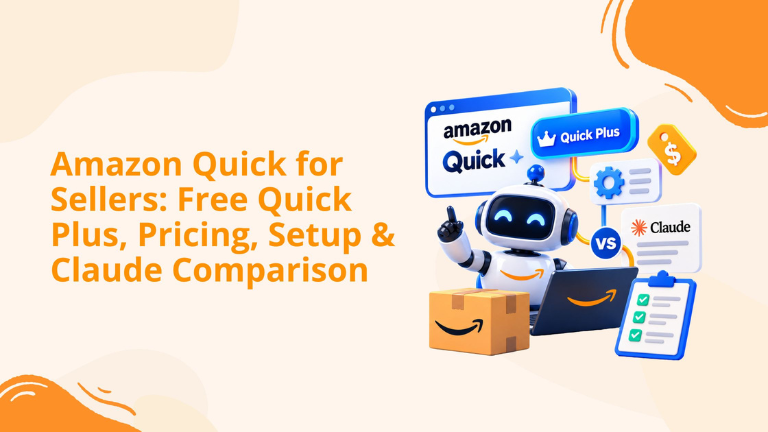
● Amazon Quick. Launched September 23, 2026. Quick is Amazon's AI workspace, and it can work with business information and other connected resources.
● Claude by Anthropic. In beta. It lets sellers connect their Amazon selling account to Claude.
● Other assistants. Future integrations. Amazon says the plugin is designed to support additional integrations.
Amazon's current Seller Central documentation explicitly says the plugin works with Amazon Quick and Claude, with access rolling out to sellers over time. Before you try to connect, check three conditions reported from Amazon's help pages: the plugin is a beta for sellers in Amazon's US stores, it needs a Professional selling plan, and after you connect, you either get access right away or join a waitlist and receive an email when access opens. Amazon has not stated a plugin fee or Claude plan requirements.
So when people search for terms such as "Claude Amazon plugin," "connect Amazon seller account to Claude," or "Amazon Quick plugin," they are generally referring to this new connection between an Amazon selling account and an AI assistant.
The plugin becomes more useful when you look at specific seller tasks.
Amazon's documentation gives examples around sales, inventory, traffic, and listings.
Instead of opening multiple Seller Central reports, you can ask the connected assistant about your business performance.
For example: "What were sales last week?"
Inventory management is another major use case.
Amazon's open-source Selling Partner agentic toolkit includes a stockout-prevention skill that analyzes days of supply and sales velocity and can recommend how much to reorder and when.
The Amazon toolkit includes skills for listing troubleshooting, listing issues, buyability, searchability, and compliance.
That means an AI workflow can help identify why a listing may not be performing or appearing as expected and suggest possible next steps.
For example, if a listing needs better bullet points, an AI assistant can help draft the proposed update.
Amazon's documentation says the assistant proposes changes and waits for approval before proceeding.
Amazon's Selling Partner agentic toolkit also includes an FBA inbound management skill.
The toolkit describes a workflow covering inbound steps such as creating the plan, packing, placement, transportation, and confirmation, with approval gates.
MCP stands for Model Context Protocol. It provides a way for compatible AI assistants to interact with external tools and data.
Amazon's public Selling Partner agentic toolkit includes an Amazon Selling Partner Connector, which is implemented as an MCP server. Amazon's toolkit documentation says the connector is authorized through the normal Seller Central OAuth consent flow, with access limited by the seller's Amazon roles.
The MCP server is part of the technical bridge that allows the AI assistant to interact with Amazon's authorized selling tools.
You do not need to build an MCP server yourself just to use the official plugin. The toolkit also works through SP-API, Amazon's developer interface for selling data, so you do not need to build an SP-API integration either.
Amazon says connecting Claude takes about 60 seconds and needs no coding.
Open Claude and go to its plugin directory.
Search for the Selling Partner plugin and select Install. The listing may appear as "Amazon Selling Partner MCP." Confirm it is Amazon's official listing before you install.
When prompted, sign in using your Amazon selling account.
This is important because the connection is for your Amazon business data, not your normal Amazon shopping activity.
Before authorizing the connection, check what the plugin can access.
Amazon says sellers control the data the assistant can use and can limit the assistant to answers only.
Review the permissions and authorize the plugin.
Ask a simple question about your Amazon business.
The Amazon Quick setup follows a similar process.
According to Amazon's current help documentation:
Amazon is also currently offering a Quick Plus promotion tied to the connection. The current Seller Central documentation says primary sellers can receive one year free, while other sellers receive 30 days free, with the offer available through December 31, 2026.
Because offers and eligibility can change, sellers should check the current Amazon terms before relying on the promotion.
One of the simplest ways to reduce risk is to avoid starting with action-taking permissions.
Begin by asking questions such as which products have declining sales and which ASINs have low inventory.
Amazon specifically allows sellers to limit the assistant to answers only.
The biggest mistake would be to look only at the convenience.
Connecting an external AI assistant to your Amazon business also means thinking about data access, permissions, privacy, and operational responsibility.
The plugin connects your Amazon business information with an AI assistant.
Amazon's official toolkit documentation explains that Amazon business data returned by the connector is processed through the Amazon connection, while your prompt text is processed by the AI assistant according to that assistant's own terms and privacy policy.
That means sellers should understand both sides of the connection:
Amazon's privacy terms + the AI assistant's privacy terms.
Amazon's help pages, as summarized by Seller Essentials, add that once you authorize an outside assistant, your account data is sent to and processed on systems outside Amazon's control, under that assistant's terms.
The plugin works according to the permissions you grant.
Giving an AI assistant unnecessary access creates unnecessary exposure.
Give the assistant the minimum access required for the job.
An AI assistant can identify a potential problem, but the recommendation may not contain every piece of business context.
Imagine an AI tells you that a product is running low on inventory.
Before placing a large replenishment order, you may also need to consider supplier lead time, purchase cost, seasonal demand, cash flow and upcoming launches.
The AI can help identify the issue faster. It does not remove the need for business judgment.
Amazon's human-approval system is one of the most important safeguards in the plugin.
The official documentation says actions require approval by default and that the assistant proposes changes rather than making them automatically.
Before approving a price, listing, inventory, or FBA-related action, check what exactly is changing, which ASIN or SKU is affected, why the change is recommended and whether it fits your strategy and margin.
Connecting an AI assistant does not remove the seller's responsibility for the account. Amazon's terms, as reported by Seller Essentials, make the seller responsible for every action the agent takes on the account. Disconnecting stops data access immediately, but it does not undo changes already made.
That means businesses should establish a clear approval process before allowing employees, VAs, or agencies to use connected AI tools.
Amazon's Selling Partner Toolkit includes an invite-secondary-users capability that guides account administrators through granting AI-agent access to secondary users through Seller Central's Manage Agents area.
For a team, create a simple permission policy: analysts view data, account managers prepare recommendations, and only senior managers or the account owner approve sensitive actions.
The important principle is to avoid giving every team member the same level of access.
Agencies can use the plugin as an analysis layer rather than a replacement for account managers.
A practical workflow could look like this:
The assistant identifies:
● Sales changes
● Inventory risks
● Listing problems
● Traffic changes
● Other account opportunities
An Amazon specialist checks whether the finding makes sense in the wider business context.
The assistant drafts the appropriate action where supported.
The account manager or authorized client reviews the proposed change.
The agency monitors what happened after the action.
This is a more controlled version of automation.
AI → specialist → approval → action → measurement
The Amazon Selling Partner plugin does not mean that every Amazon task can now be fully automated through Claude.
Because the plugin is new, supported skills and workflows can change, so Amazon's published documentation is the better source for the exact capabilities available to your account at the time you connect.
The official plugin documentation focuses on areas such as sales, inventory, traffic, listings, and related seller workflows.
So sellers should not assume that connecting Claude or Amazon Quick automatically gives the assistant unrestricted access to Amazon PPC campaigns.
If advertising functionality becomes available through a particular integration, verify the exact permissions and supported tasks in Amazon's current documentation before using it.
Seller Assistant is Amazon's AI experience within Seller Central.
The Amazon Selling Partner plugin brings Amazon selling data and capabilities into supported external AI assistants.
A seller who already spends most of their time in Seller Central may prefer the native Seller Assistant experience.
A seller or agency that already works heavily in an external AI environment may find the plugin more useful because Amazon data can become part of that workflow.
Amazon provides several controls:
● You choose what data the assistant can access.
● Actions require approval by default.
● You can restrict the assistant to answers only.
● You can disconnect the plugin.
● The official toolkit uses Seller Central authorization and role-based access.
But sellers should still review the AI assistant's own privacy settings and terms.
Amazon recommends opting out of allowing AI assistant interactions to be used for training or improving AI models when that setting is available.
The safest practical approach is therefore not to trust the AI blindly, but to start with answers-only access, grant the minimum permissions, and approve every change yourself.
Before setting it up, keep these limitations in mind: the plugin is in beta, documented for the US marketplace, needs a Professional selling plan and may put you on a waitlist. Access is limited to what you authorize and what your Amazon roles allow, supported skills can change, and the seller remains responsible for reviewing every proposed action.
Before installing the Amazon Selling Partner plugin, go through this checklist:
1. Check eligibility
Confirm that the plugin is available for your marketplace and account.
2. Review permissions
Understand exactly what the AI assistant will be allowed to access.
3. Start with answers only
Use read-only analysis before enabling action-oriented workflows.
4. Check privacy settings
Review both Amazon's policies and your AI assistant's privacy settings.
5. Disable training where appropriate
If the AI assistant provides an option to prevent your interactions from being used to train or improve models, review that setting before connecting.
6. Create an approval policy
Decide who can approve changes.
7. Review team access
Do not give every employee or VA identical permissions.
8. Monitor the integration
Review connected agents periodically and disconnect anything you no longer need.
The Amazon Selling Partner plugin connects Amazon seller data and selling capabilities with supported external AI assistants such as Amazon Quick and Claude. It can answer questions using business data and prepare supported actions for seller approval.
Yes. Amazon's current Seller Central documentation provides a setup flow for connecting a selling account to Claude through the Selling Partner plugin.
Amazon says actions require approval by default. The assistant proposes changes and waits for approval before proceeding.
An Amazon MCP server is part of the technical infrastructure that lets an MCP-compatible AI assistant interact with authorized Amazon tools. Amazon's official Selling Partner agentic toolkit includes an Amazon Selling Partner Connector implemented as an MCP server.
Is the Amazon Selling Partner plugin free?
Amazon has not stated a plugin fee or Claude plan requirements, so check the terms of the assistant you connect. Separately, Amazon is offering eligible primary account holders a free year of Amazon Quick Plus.
The plugin's rollout is still developing. Amazon's current Seller Central help page identifies the United States marketplace for the documented plugin experience, so sellers outside the US should check their own account for availability. It also requires a Professional selling plan, and access may begin on a waitlist.
The Amazon Selling Partner plugin changes the way sellers can interact with their Amazon business data.
Instead of constantly moving between Seller Central and an AI assistant, sellers can connect their Amazon business information to supported tools such as Amazon Quick and Claude.
But the biggest lesson for sellers is simple:
AI should make the workflow faster, not remove responsible oversight.
Start with read-only analysis. Give the assistant only the permissions it needs. Understand how your AI provider handles your prompts and data. Review proposed changes carefully. Then expand automation as your team becomes comfortable with the workflow.
The real opportunity isn't letting AI run an Amazon account without supervision.
It's giving your team a faster way to find problems, understand the data, prepare actions, and make better-informed decisions.
And for Amazon sellers, that may be the most useful way to think about the Selling Partner plugin: not as a replacement for Seller Central, but as a new AI layer around the Amazon business you already operate.
Fill out the form and our experts will get back
to you within 24 hours.
.webp)
.webp)
.webp)
We respect your privacy. Your information is safe with us.