November 19, 2026
Amazon Haul Is Now in Main Search: What Cross-Listing Means for FBA Sellers
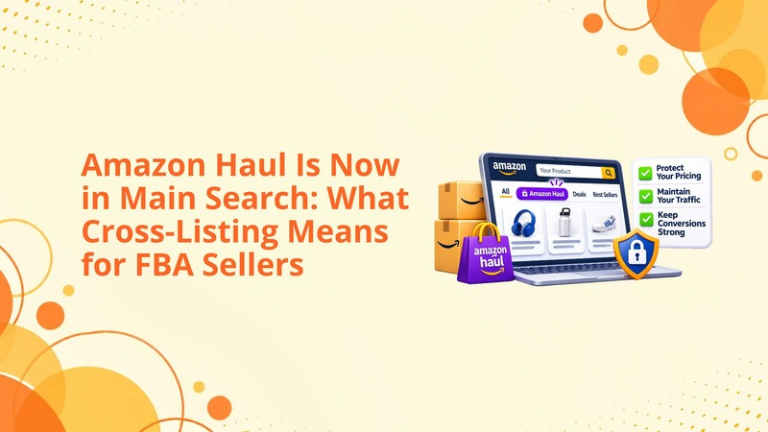
Haul was a side store. Cheap goods, its own tab, and a shopper had to go there on purpose. For most FBA sellers, it was somebody else's concern.
That has changed in two ways. Amazon has confirmed that relevant Haul products may now be shown in standard search results. And under Haul Distributed Fulfillment, Amazon can take selected FBA offers held in local fulfillment centers and list them on Haul as well.
Some of your products may be on Haul already. You need not have accepted an invitation, which was the original route for Haul-specific inventory.
Marketplace Pulse has tried to count the sellers involved. Its figure is nearly 184,000, which it reckons to be about 40% of active Amazon.com sellers; it calls a seller active if the account got at least one piece of feedback in the previous year. Amazon has not confirmed the number. Still, nobody could now describe Haul as a few direct-from-China sellers and nothing more.
None of which tells you much about your own account. For that you have to check three things. First, whether your offers were cross-listed at all. Second, whether Haul products now appear on the search terms you rely on. Third, whether the extra orders make money and are orders you would not have had anyway.
Haul is Amazon's store for low-priced products. Fashion, home, beauty, electronics, toys and seasonal goods are all there.
In November 2026, Amazon said Haul had passed 10 million products. Most cost under $10; over a million cost under $5, and more than 500,000 under $3. It also said selection had grown more than 25-fold in two years and that buying customers were up nearly 350% on a year earlier.
Two fulfillment models sit behind it.
This route generally uses fulfillment infrastructure dedicated to Haul. Goods ship from the country of origin. Amazon describes it at present as invitation-only.
Here Amazon uses selected FBA products already stored in its fulfillment network in the customer's own country, and makes them available in the local Haul store. They may remain on sale in the core Amazon marketplace at the same time.
This is worth keeping in mind when you read about the growth in Haul sellers. Thousands of businesses did not necessarily apply. A good share of the growth may simply be Amazon cross-listing suitable products that were already in FBA.
Put simply, an eligible FBA offer is given a second shop window inside Haul. You do not have to set aside separate local inventory for it. The one product can be bought from its normal detail page, from Haul, and from whatever Amazon search results it qualifies for, and the same FBA stock fills orders from either side.
That is more visibility without a second fulfillment operation, which is good. It also raises questions you did not have before: how your price is shown, how fast stock goes, which customers you are reaching, and what the brand looks like sitting in a bargain store.
It appears so. Amazon's documentation for Distributed Fulfillment says Amazon evaluates which products will be made available through Haul. So do not assume it all begins with an application from you. Where needed, Amazon may also ask for compliance documents or updated packaging.
Your Seller Central account is the place to check. Look for whether Distributed Fulfillment is available to you, which products were selected, whether Haul orders have come in, what controls you have, and what opting out would mean for the account. These things can differ by marketplace and by account, so go by what your own account shows.
Amazon has announced that Haul products may surface in standard search results when they closely match a customer's query. Until now, a seller could think of Haul as a separate cheap store that people entered deliberately. With this change, qualifying Haul offers can appear in the middle of ordinary shopping.
Somebody typing "phone stand", "hair accessories", "kitchen organizer" or "stocking stuffer" may now find a very cheap Haul item near the regular offers. Amazon has not said publicly how all the ranking, labeling, and advertising works for these listings. Better, then, to watch the real search results than to guess how Haul offers will be shown or ranked.
It would be a mistake to treat Haul as harmful by default. For the right products, it can add reach you would not otherwise get.
The stock is already in the local FBA network, so you gain another place to sell without building a separate domestic inventory operation. Some shoppers go to Haul only for low prices. An accessory, a trial size, a refill, or an entry-level item may reach people there who would pass it by in the main store, and if they really are new customers, the units are extra.
There may be a money angle too. Marketplace Pulse reports that Amazon pays for Haul promotional discounts on cross-listed offers, while sellers go on paying their usual referral and FBA fees. Check that against your own transactions and the current Seller Central terms before you count on it.
Haul can also move low-priced stock, provided it has enough margin, healthy inventory and some natural appeal to bargain hunters. The case is strongest where Haul orders are truly additional and do no damage to the product's main-store performance or to the wider brand plan.
Haul holds millions of products sold on price. Once they appear in main search, an established ASIN can find itself next to alternatives costing a good deal less.
A premium product need not match the cheapest price. It does have to show why it costs more. Good images help, as do clear benefits, believable reviews, better materials or features, a trusted brand, a faster delivery promise, useful A+ Content, and a difference the shopper can actually see.
Suppose a shopper clicks your listing and then buys a cheaper Haul item. Traffic stays the same, but conversion falls. That fall works its way into organic sales, ad efficiency, ACOS, TACOS, and keyword rank, and after that into your inventory forecasts and replenishment plans.
Haul should not take the blame for every slump, though. Seasonality, pricing, competitors, reviews, content, and stock levels can all do the same. Treat Haul as one possible cause and look into it.
A premium or carefully run brand may not want its goods seen in an ultra-cheap store. The concern is sharper if you have Minimum Advertised Price policies, retail distribution agreements, wholesale partners, premium positioning, a fixed promotional calendar or pricing commitments tied to a marketplace.
Even when Amazon funds the discount, the shopper may see only a lower price. A brand should check whether that causes commercial or contractual trouble.
More Haul orders can empty FBA stock sooner. With excess stock on hand, that is welcome. With stock already short, or long replenishment lead times, it can lead to a stockout. Work out what the added demand would do to days of supply before you let exposure grow.
Marketplace Pulse and Amazon's Distributed Fulfillment documentation both suggest the controls may work at account level. You may not be able to pull out a single cross-listed ASIN.
With a mixed catalog, this is awkward. You might be glad to have an $8 accessory on Haul and not want every other eligible product in the account to follow it there.
Before you opt out, put these questions to Seller Support: does the control apply to the whole account; which marketplaces does it affect; how long does the change take; can you opt back in; what happens to current Haul orders; and can individual products be excluded?
According to Marketplace Pulse, cross-listed sellers pay the same referral and FBA fees, and Amazon funds the applicable Haul promotional discounts.
Check this in your own records rather than assume every Haul order comes out the same. Take a sample of Haul transactions and look at the product price, any discount funded by Amazon or by you, the referral fee, the FBA fee, other fulfillment charges, refunds, returns, and net proceeds.
The Haul price shown to shoppers is not the figure to judge by. What you keep after every charge is.
Begin in Seller Central. Find the Haul or Distributed Fulfillment pages, if your account has them, and note the cross-listed products, Haul order activity, product eligibility, program notices, account-level controls, and the marketplaces involved.
Then look as a customer would. Search for your product and main keywords in the Amazon app or site where Haul runs. Note whether your product shows in Haul and in ordinary search, the price and wording displayed, the Haul offers competing with it, any badges or labels, delivery expectations, ratings and reviews, and the organic and sponsored placements around it.
Search results are personalized, so repeat the checks signed out or in a separate shopping context where you can.
Compare performance before and after Haul exposure. We group the numbers like this.
Search and traffic: Search Query Performance, impressions, clicks, click-through rate, sessions, share of voice, organic keyword position.
Conversion and sales: Unit Session Percentage, ordered units, revenue, average selling price, new-to-brand customers where available, repeat purchases, and Haul orders set against core-store orders.
Advertising: CPC, conversion rate, ACOS, ROAS, TACOS, advertising sales, placement performance, search-term performance.
Inventory: available FBA units, days of supply, inbound inventory, sell-through rate, stockout risk, reorder timing.
Profitability: net proceeds per order, contribution margin, Amazon fees, advertising cost, return costs, cost of goods, incremental profit.
Gross sales on their own will not tell you whether Haul is paying its way.
No one answer suits everyone.
Staying in makes sense if Haul orders are incremental, margins hold, stock can cope with the extra volume, the products suit a bargain channel, Amazon-funded promotions do not clash with the brand, Haul brings new customers, and search performance stays steady.
Opting out deserves thought if the price presentation clashes with your brand strategy, MAP or retail relationships are at risk, Haul seems to be taking full-price sales, stock is going too fast, margins are thinner than expected, conversion on key search terms has dropped, the account holds products unsuited to Haul, or taking part causes operational trouble.
Because the opt-out may cover the whole account, the decision has to weigh the entire eligible catalog and not just one ASIN.
Record the SKU, ASIN, core-store price, Haul price, inventory, margin, and product role for each.
Premium hero products, core products, entry-level products, accessories, refills, trial items, clearance candidates, low-margin products. Haul will fit some of these groups better than others.
Take the 20 to 30 most important branded and non-branded terms for your priority products. Note which Haul items appear and how their offers compare with yours.
Keep the date ranges consistent, and allow for promotions, seasonality, price changes, stock levels, and advertising changes.
Find out whether Haul adds profitable orders or merely diverts customers who would have bought in the core store anyway. Amazon may not supply all the attribution you would need for a clean comparison, so part of this is inference. Say so in the analysis, and do not mistake correlation for proof.
Read your MAP, wholesale, reseller, distributor, and retail-partner terms before accepting visible discounting.
Program details change. Get current information from Seller Central or Seller Support before you choose an account-wide opt-out.
Haul adds one more layer to a marketplace that was complicated enough already. Cross-listing now bears on organic search, PPC, pricing, inventory, and brand positioning together. Our work is to turn those questions into a plan you can measure.
Cross-listed catalog audit: We find which of your products appear on Haul and sort them by margin, inventory, pricing, and strategic importance.
Search-results monitoring: We watch how Haul products show up on your priority search terms and whether the competition there has shifted.
PPC performance analysis: We compare CPC, conversion, ACOS, ROAS, TACOS, and search-term performance to see where campaigns need adjusting.
Product-level profitability review: We work out what Haul orders really earn after Amazon fees, advertising, fulfillment, returns, and product costs.
Brand and pricing assessment: We help spot conflicts between Haul exposure and premium positioning, MAP commitments, or retail partnerships. Legal and contractual questions should still go to qualified counsel.
Inventory planning: We judge whether the extra Haul demand helps sell-through or puts important ASINs at risk of a stockout.
Opt-out decision modeling: Where participation is controlled at account level, BIE looks at the catalog as a whole rather than reacting to one product.
Listing and conversion optimization: If cheaper Haul offers are moving into your search results, we sharpen your differentiation through listing copy, images, A+ Content, Brand Story, storefront strategy, and advertising.
We are not out to push every seller into Haul, or out of it. We want the decision that gives you profitable growth you can keep up.
Amazon takes selected FBA offers stored locally and makes them available in Amazon Haul. They stay on sale in the core Amazon store as well.
Yes. Amazon says relevant Haul products can appear in standard search results when they closely match a shopper's query.
Look at the Haul or Distributed Fulfillment information in Seller Central, go through the relevant orders, and browse the live Haul store yourself.
Reports so far suggest the Distributed Fulfillment opt-out may apply to the whole account. Check what controls your own account has before you act.
No. For suitable products, it may bring incremental sales. Weigh margins, inventory, pricing, conversion, and brand positioning before you decide whether taking part is worth it.
Haul started as a separate cheap store and has become a source of selection for the wider marketplace. Relevant Haul items can now appear in normal Amazon search, and Distributed Fulfillment can put selected FBA products into Haul.
Some sellers will gain reach they did not have. Others will meet more price pressure, inventory risk, or brand conflict. Ignoring the change would be the worst course; an account-wide decision made without data would be nearly as bad.
We can identify your cross-listed ASINs, look at what Haul is doing to your search and PPC results, assess product-level profitability, and build a response that fits your brand and growth goals.
Schedule a strategy call with our team.
Follow Big Internet Ecommerce (BIE) on Instagram & LinkedIn to stay updated with the latest trends in Amazon selling.
Fill out the form and our experts will get back
to you within 24 hours.


We respect your privacy. Your information is safe with us.