November 17, 2026
New U.S. Importer of Record Rules for 2027: What Amazon Sellers Must Verify Before January 5
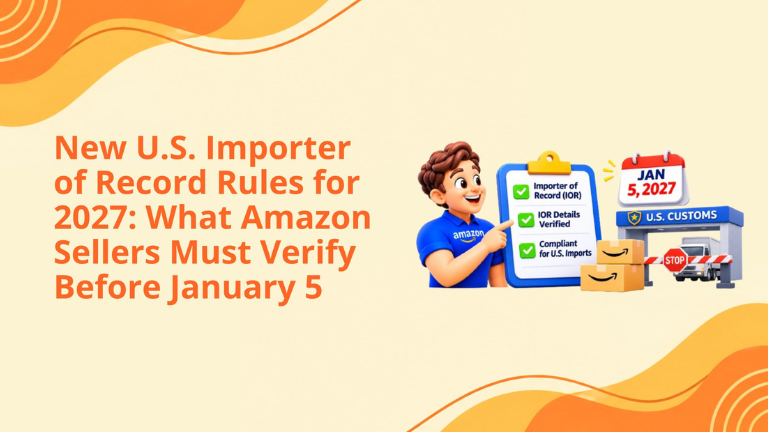
International sellers on Amazon devote months to product development, supplier negotiations, freight logistics, and FBA stock setup, yet one misidentified name on a customs document can jeopardize all that investment.
On January 5, 2027, U.S. Customs and Border Protection will introduce stricter requirements for importers not qualifying as U.S. IORs. A foreign IOR is required to either be CTPAT confirmed or hire a licensed customs broker confirmed by CTPAT.
This is particularly critical for foreign brands, non-U.S.-based sellers, private label manufacturers, aggregators, and companies that rely on freight forwarders to arrange imports.
The regulation is effective for commodities reaching U.S. Customs on or after January 5, regardless of when they are shipped from their home country. Thus, even cargoes in transit, waiting at sea, or moving through the supply chain will be impacted.
Businesses cannot take for granted that their freight forwarder has solved the issue for them. They have to find out who the Importer of Record is, ascertain the status of this IOR, gather documents, and ensure that the customs broker is compliant with the new rules.
An Importer of Record (IOR) refers to an individual or business entity that is accountable for introducing imported goods into the United States.
The Importer of Record has a key role and is expected to make sure that the merchandise is imported properly with all the necessary customs formalities. At the same time, the IOR provides payment for the goods imported into the U.S. and is obliged to observe U.S. customs rules and issues regarding tax and duty payment.
Depending on the shipping structure, the IOR may be:
A large number of online sellers fail to think about the importer of record since they do not undertake customs operations themselves. In fact, the customs process cannot be handled without establishing the identity of the IOR.
The IOR is stated in various documents associated with the process, including the document produced by the customs authorities known as the customs entry summary or CBP Form 7501, shipping contract, customs power of attorney and other broker documentation.
There are new requirements for IORs that are not U.S. importers of record as per the latest CBP framework. A foreign IOR is required to fulfill either of the below conditions:
The regulations also cast responsibilities on customs brokers to check and provide their declaration regarding their clients being U.S. IORs.
In this regard, for the sellers on Amazon, immediate concern is identifying the category of their current IOR and whether the broker who is filing their entries qualifies.
An entity has to fulfill specific prerequisites to be eligible for qualification as U.S. IOR, rather than simply having a U.S. address, receiving mail in the country, or renting warehouses in the U.S. In accordance with the updated policy framework, U.S. eligibility criteria must be fulfilled.
CBP may consider factors such as whether the company:
The determination can depend on the circumstances of the individual entity. That is why sellers should request evidence instead of accepting a simple “yes” from a logistics provider.
A U.S. address alone is not reliable proof of U.S. IOR status.
A foreign IOR is generally an importer that does not satisfy the requirements to qualify as a U.S. IOR.
Examples may include:
The designation of being a foreign importer of record does not mean that the entity is totally barred from importing. It rather means that specific conditions must be followed in order for foreign importers to conduct imports.
To become a foreign importer, the concerned business has to secure the correct CTPAT validation or hire a licensed customs brokerage that is already certified by CTPAT.
CTPAT stands for Customs-Trade Partnership Against Terrorism. It is a voluntary supply-chain security initiative operated by the U.S. Customs and Border Protection agency. Participants must collaborate with CBP in spotting weaknesses in their supply chains and establishing proper security measures. Some benefits of being in the program are fewer inspections, priority in inspections, shorter waiting time at borders, and more benefits in special customs programs.
CTPAT certification and verification are not the same thing as simply hiring a customs broker or registering online. In order to be accepted into the program, companies must meet eligibility criteria, provide necessary information, create a security profile for their supply chains, and pass through the necessary verification.
Most Amazon sellers will not qualify for the CTPAT program in a short time. Therefore, choosing an appropriate licensed customs broker that is already CTPAT verified may be a better solution for foreign merchandisers.
Sellers need to check whether the broker that they want to use has registered company name, license, CTPAT verification, information about filing code, capacity, and ability to process their entries.
A customs problem can quickly affect several parts of an Amazon business.
When goods are rejected or delayed in Customs process of customs clearance, they may not arrive at the Amazon fulfillment centers according to their original re-supplying time.
Such a situation may create difficulties during product launches, during seasonal sales or promotions period, or even any time of high sales.
When an FBA product runs out of stock, the business can lose:
The financial effect may continue after the shipment finally arrives because the seller must rebuild sales velocity.
Campaigns that have been planned ahead of incoming inventory may still continue creating demand, even when the stock left is less than before.
Sellers may thus have to turn off campaigns, adjust budgets, switch ASINs, or divert traffic to products that have more available inventory.
The problem with clearance can lead to costs associated with demurrage, detention, storage, inspections, handling and administration.
The costs vary according to the carrier, port, and warehouse and can quickly reduce profits.
An unclear arrangement with the IOR does not only apply to one container. If the problem is not resolved, it can happen again with the next shipment.
The relevant point is when the merchandise clears U.S. Customs.
If goods are expected to clear Customs on or after January 5, 2027, the new requirements may apply even if the shipment:
Sellers should therefore review all open purchase orders, bookings, shipments, and estimated clearance dates—not only freight scheduled to depart after January 5.
Contact the freight forwarder or customs broker responsible for each U.S. import lane and request written answers.
Ask:
Requesting answers in writing creates a clear record of the information provided and makes it easier to identify gaps.
Review the following records where available:
Confirm all shipments, suppliers, marketplaces, and freight service providers use identical IOR. Some companies may vary their import arrangements for airfreight, ocean freight, sample shipments, and full container shipments.
In case the entity is eligible for being a U.S. IOR, obtain the confirmation in writing along with the supporting documents.
Ensure that the documentation is available as the customs broker may require validating the eligibility of the entity.
Don’t think that the successful clearance of an earlier shipment means that there will be no issues with future shipments.
Confirm the broker’s status using current CBP information and obtain its registered name and filer code.
Also confirm that the broker:
The seller may be required to utilize a broker approved by CTPAT, vary the customs arrangement, or switch freight forwarders.
Actions should be initiated right away. Changing brokers may require the creation of new agreements, legal documents, bonds, importing records, payments, and review of documents.
This is a clear indication of trouble.
The entry summary and shipping agreement should be examined. Any confusion should be removed by asking the forwarder and broker for clarification. There must be a clear understanding by the business as to the party responsible for the importer's functions prior to the shipment leaving for the next destination.
Request supporting evidence.
A statement such as We have a U.S. office does not establish that the entity satisfies the complete U.S. IOR test.
Before the deadline, sellers should:
Customs classification should be managed by Customs and Border Protection, authorized brokers, or skilled legal professionals. However, the financial ramifications of delayed inventory should be managed within the Amazon ecosystem as well.
Having said that, we can solve the problem of import readiness and other operations within Amazon.
We determine the ASINs affected by shipments that should arrive after January 5 and project how much longer the available FBA stock will last.
We analyze sales velocity, remaining stock, inflows, delays and seasonal needs to evaluate the risk of certain products.
We will help organize all the necessary operational information for sellers to request from their forwarders, suppliers and brokers. The customs decisions are still in the hands of qualified people, but the process becomes more understandable and easier.
If a shipment might be delayed we can adjust campaigns to reduce any pressure on low stock items, ensuring your spend has been shifted to ASINs that will be available to advertise.
We can advise sellers if they should proceed, delay or stop planned launches, coupons, deals or seasonal promotions based on expected stock availability.
Where applicable, we could help understand the best options for you to use (FBM, 3PL, split stock or other) to reduce full reliance on one inbound shipment.
We can support your integrated business needs relating to catalog health, FBA, forecasting, PPC, profitability and performance reports.
The goal is not just to get one shipment out but to avoid causing any issues to your growth on Amazon due to the customs change.
The announced effective date is January 5, 2027, for goods clearing U.S. Customs on or after that date.
No. The entity must satisfy the complete U.S. organization, presence, ownership, control, asset, or real-property requirements.
A foreign IOR must be CTPAT validated or use a CTPAT-validated, licensed customs broker to make entry.
They may. The relevant date is when the goods clear U.S. Customs, not necessarily when they were shipped.
Ask the freight forwarder or broker to identify the IOR, confirm its classification in writing, provide proof, and explain who will file the entry after January 5.
The regulatory framework and compliance concepts above were checked against CBP and Federal Register materials. Because implementation guidance can evolve, sellers should verify their exact arrangement with CBP or a licensed customs professional before relying on it.
The new U.S. Importer of Record rules clearly outline a cut-off point but you still have plenty of time to prepare.
Ensure you know who is responsible, ask for evidence, ensure your broker is correct, check on stock in transit and put together an action plan by January 5th.
The most vulnerable businesses will not necessarily be those using a foreign IOR, but those that do not know who they are using or cannot confirm how they will be entering their future consignments.
Request our Amazon Import and Inventory Readiness Review.
We can support you to understand what stock is at risk, manage operational actions, and implement changes to your reordering and advertising strategy whilst qualified customs experts deal with the compliance element.
Schedule a strategy call with our team.
Follow Big Internet Ecommerce (BIE) on Instagram & LinkedIn to stay updated with the latest trends in Amazon selling.
Fill out the form and our experts will get back
to you within 24 hours.


We respect your privacy. Your information is safe with us.