September 15, 2026
Amazon Premium Shipping Manual Enrollment: What Newly Eligible Sellers Need to Do Now
Amazon shoppers often compare prices before they buy. Delivery speed, trust, seller reliability, and the expected arrival date can all influence whether a customer clicks “Buy Now” or moves to another offer. For Fulfilled by Merchant sellers, this makes Premium Shipping an important growth opportunity.
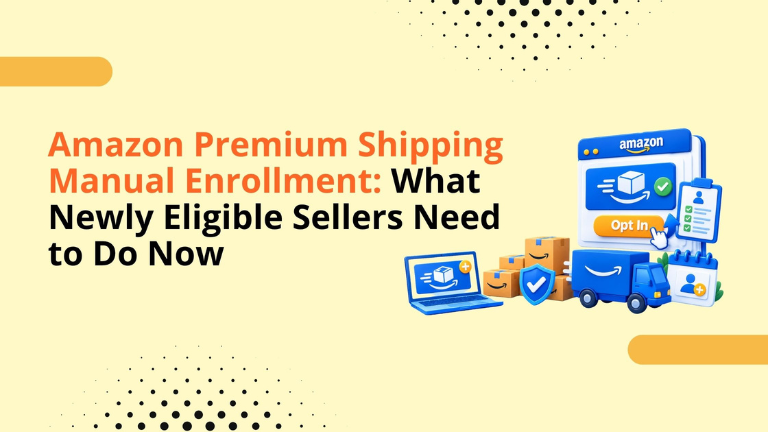
Amazon has updated how newly eligible sellers access Premium Shipping. Sellers who become eligible now need to manually enroll before they can offer one-day and two-day delivery options. Previously, eligible sellers could be enrolled automatically. Now, eligibility alone is not enough.
For Amazon sellers, this update is small in process but big in impact. If you qualify and forget to enroll, you may miss the chance to display faster delivery options to customers. That can affect offer competitiveness, conversion potential, and sales momentum.
According to Amazon Seller Central, Premium Shipping helps eligible sellers offer faster regional delivery options, including one-day and two-day shipping promises. Sellers should review their eligibility and enrollment status directly inside Seller Central.
What Is the New Premium Shipping Update?
Amazon now requires newly eligible sellers to manually enroll in Premium Shipping.
If you qualify based on your seller-fulfilled performance metrics, you must opt in through Seller Central, accept the program requirements, and enable Premium Shipping on your shipping templates. If you do not enroll, you will not be able to offer one-day or two-day Premium Shipping options.
Sellers who are already enrolled do not need to take action.
Premium Shipping gives qualified seller-fulfilled merchants the ability to offer faster delivery promises to Amazon customers. This can be especially useful for sellers who manage their own warehouse, use a third-party logistics provider, or fulfill certain ASINs outside of FBA.
In competitive Amazon categories, delivery speed can influence buying decisions. A customer comparing two similar products may choose the offer that arrives faster, even when the price is slightly higher. This is why Premium Shipping should be viewed as more than a logistics feature. It can support conversion, customer satisfaction, and stronger marketplace positioning.
For brands running Amazon Ads, the impact can be even more important. PPC traffic is expensive. If a seller is paying for clicks but the offer shows slower delivery than competitors, the listing may lose buyers at the final decision stage. Faster shipping options can help reduce friction and support better performance from paid traffic.
Premium Shipping eligibility depends on seller-fulfilled performance. Amazon expects sellers to maintain strong operational standards before giving access to faster delivery promises.
The key performance requirements include:
These metrics show whether a seller can reliably handle fast delivery expectations. Premium Shipping is not simply about offering speed. It is about consistently delivering on the promise shown to customers.
If your fulfillment process has delays, inaccurate tracking, stock mismatches, or frequent cancellations, activating Premium Shipping too early can create customer dissatisfaction and future account risk.
The most important part of this update is that newly eligible sellers must now opt in manually.
In the past, eligible sellers could be enrolled automatically. That made the process easier, but it also meant sellers had less control over when they started using faster shipping options. Now, Amazon is placing that decision in the seller’s hands.
This creates both responsibility and opportunity.
The responsibility is clear: sellers must check eligibility, complete enrollment, and configure shipping templates correctly. The opportunity is also clear: sellers who act quickly can start using faster delivery options while competitors may overlook the change.
For Amazon agencies, account managers, and in-house marketplace teams, this should become part of the regular Seller Central checklist.
If you are newly eligible, the enrollment process starts inside Seller Central.
First, go to the Premium Shipping eligibility area and confirm whether your account qualifies. If you are eligible, click “Enroll” and review the program requirements. After acknowledging the requirements, you can begin setting up Premium Shipping options on your shipping templates.
The next step is operational setup. Sellers need to select the right shipping templates, enable one-day and/or two-day delivery, choose eligible regions, set shipping fees, configure handling times, and confirm carrier methods.
Amazon sellers should also decide whether to use Shipping Settings Automation or manual transit times. Shipping Settings Automation can help align delivery promises with supported carrier performance and shipping locations. Manual transit times give sellers more control, but they also require careful maintenance.
To enable One-Day Shipping, go to Seller Central and open Shipping Settings from the Settings menu. Select an existing shipping template or create a new one for eligible products.
Then choose the One-Day Delivery option, select the regions where your business can confidently meet one-day delivery, enter the shipping fee, and save the template.
Do not enable one-day delivery nationwide unless your fulfillment setup can support it. A better approach is to start with regions close to your warehouse or fulfillment partner, then expand after reviewing performance.
Two-Day Shipping follows a similar process.
From Seller Central, open Shipping Settings, choose the shipping template you want to update, and enable Two-Day Delivery. Add the regions where two-day shipping is realistic, enter the appropriate shipping fee, and save your changes.
For Two-Day Delivery Prime templates, sellers may also need to add the shipping fee for regular customers.
Two-day delivery can be a strong option for sellers who want faster shipping visibility without taking on the pressure of one-day delivery across too many regions.
Premium Shipping can help increase competitiveness, but it should not be enabled casually.
If your warehouse team cannot process orders quickly, if your carrier pickup schedule is inconsistent, or if inventory data is not accurate, faster shipping promises can create problems. Late deliveries, missed tracking updates, and cancellations can damage customer trust and seller performance.
Before activating Premium Shipping, sellers should review:
A fast promise only works when operations are built to support it.
Amazon customers want clarity. When a listing shows a faster delivery estimate, it can reduce hesitation and make the buying decision easier.
This matters for products with urgent use cases, replacement needs, seasonal demand, gifting behavior, office supply demand, repair needs, and replenishment purchases. Customers often do not want to wait when the need is immediate.
Premium Shipping may help FBM sellers compete more effectively with FBA offers, especially when the seller has strong regional fulfillment coverage. It can also improve the customer experience for products that are better suited to merchant fulfillment because of size, prep requirements, storage needs, or operational control.
Amazon PPC performance is not only controlled by bids and keywords. Conversion rate plays a major role in whether campaigns become profitable.
If ads are sending traffic to an offer with slow delivery, weak inventory availability, or unclear shipping promises, customers may click but not buy. That can increase ad spend without generating enough sales.
Premium Shipping can help improve the post-click experience. When paired with optimized listings, strong pricing, high-quality images, and clear product messaging, faster delivery can support better conversion from Sponsored Products, Sponsored Brands, and retargeting traffic.
This is why Big Internet Commerce looks at Amazon growth as a complete system. PPC, SEO, fulfillment, catalog health, pricing, and listing conversion all work together.
The content shared also includes Account Health Assurance details, so sellers should understand the difference.
Premium Shipping is related to seller-fulfilled delivery performance and shipping promises. Account Health Assurance is a separate Amazon benefit for professional sellers who maintain a strong Account Health Rating and meet requirements such as keeping an accurate emergency contact number.
For Account Health Assurance, sellers may need to maintain an Account Health Rating of 250 or higher for six months, with limited time below that threshold. They also need to respond if Amazon contacts them about serious account issues.
Both programs reward strong operations, but they are not the same. Premium Shipping helps with faster delivery options. Account Health Assurance helps protect qualifying accounts when sellers work with Amazon to resolve account health concerns.
Sellers should treat this update as a quick but important account review.
First, check whether you are newly eligible for Premium Shipping. If you are eligible and not yet enrolled, complete the manual enrollment process in Seller Central.
Second, review your shipping templates. Make sure one-day and two-day delivery are enabled only for regions where you can reliably meet the promise.
Third, audit your fulfillment metrics. Your On-Time Delivery Rate, Valid Tracking Rate, and Cancellation Rate should be monitored consistently. Do not wait until performance drops before taking action.
Fourth, review your catalog strategy. Identify which ASINs should use Premium Shipping first. Start with products that have stable inventory, predictable handling, strong margins, and enough demand to benefit from faster delivery.
Fifth, connect the shipping update with your growth strategy. Faster delivery can support conversion, but only when listings, pricing, ads, and inventory are aligned.
One common mistake is assuming eligibility means Premium Shipping is already active. With the new manual enrollment process, sellers must confirm enrollment.
Another mistake is enabling Premium Shipping on too many templates too quickly. Start with the products and regions where you have the strongest fulfillment reliability.
Sellers should also avoid ignoring tracking quality. Premium Shipping depends heavily on accurate and timely tracking. If tracking is missing, delayed, or invalid, it can hurt performance.
Finally, do not forget to review cancellation risk. If your inventory system is not synced properly, Premium Shipping can increase pressure on your operation and make cancellations more damaging.
At Big Internet Commerce, Amazon growth is not treated as one isolated task. Strong marketplace performance comes from the connection between advertising, SEO, listing content, catalog health, fulfillment readiness, and account management.
We help Amazon sellers and D2C brands improve PPC performance, optimize listings for ranking and conversion, strengthen creative assets, review backend catalog issues, and identify operational gaps that may limit growth. The agency positions itself around Amazon growth for D2C brands, including support for sellers who are launching or already selling, with services focused on PPC, SEO, creatives, and bottleneck removal.
Premium Shipping fits directly into that growth picture. If your ads are strong but your delivery promise is weak, conversion can suffer. If your shipping is fast but your listing content is poor, traffic may not convert. If your account health is unstable, growth can become risky.
The goal is not just to enable Premium Shipping. The goal is to build a selling system that can attract traffic, convert buyers, deliver reliably, and keep the account healthy.
Amazon Premium Shipping allows eligible seller-fulfilled sellers to offer faster delivery options, including one-day and two-day shipping promises.
No. Newly eligible sellers now need to manually enroll through Seller Central before using Premium Shipping.
If you are eligible but do not enroll, you will not be able to offer Premium Shipping options to customers.
Sellers generally need strong seller-fulfilled performance, including On-Time Delivery Rate of at least 93.5%, Valid Tracking Rate of at least 99%, and Cancellation Rate of 0.5% or lower over the last 28 days.
Not always. Sellers should first confirm they can meet faster delivery promises in the selected regions. Poor execution can create customer dissatisfaction and performance risk.
We can review your Amazon account, PPC structure, listing conversion, catalog health, fulfillment readiness, and operational gaps to help you build a stronger growth strategy.
Amazon’s Premium Shipping update gives newly eligible FBM sellers a clear action item: check your eligibility and manually enroll if you want to offer one-day and two-day delivery.
For sellers with strong fulfillment operations, this can be a valuable way to improve competitiveness and support conversion. But faster delivery should be activated with care. Review your metrics, templates, carrier setup, fulfillment capacity, and SKU readiness before expanding the program.
Premium Shipping can help you win more confident buyers, but only when your operation can consistently deliver what your offer promises.
Schedule a strategy call with our team.
Follow Big Internet Ecommerce (BIE) on Instagram & LinkedIn to stay updated with the latest trends in Amazon selling.
Fill out the form and our experts will get back
to you within 24 hours.
.webp)
.webp)
.webp)
We respect your privacy. Your information is safe with us.