September 17, 2026
Amazon Standard Ocean Express: A Faster Way to Get Inventory to East Coast Fulfillment Centers
For Amazon sellers, inventory timing can make or break performance. A product can have strong demand, well-optimized listings, and active PPC campaigns, but if inventory does not reach fulfillment centers on time, growth can quickly turn into lost sales.
That is why Amazon’s new Standard Ocean Express option matters.
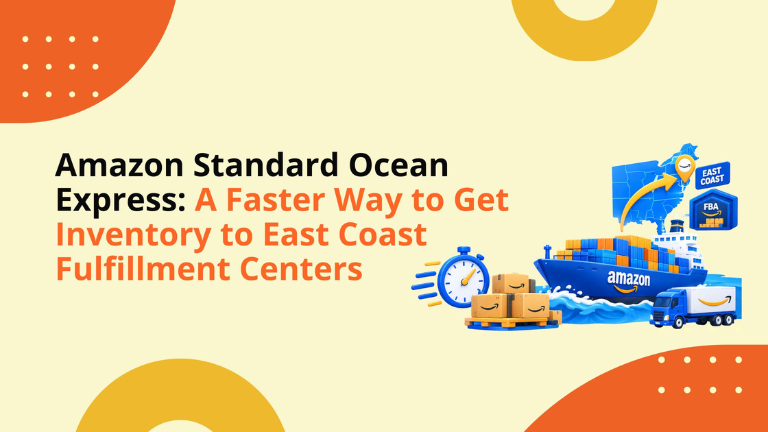
Amazon has introduced Standard Ocean Express as a new speed option for Seller Managed Placement bookings through Amazon Global Logistics. This option helps sellers move inventory to East Coast fulfillment centers faster by routing shipments through the Los Angeles port and then moving them by direct rail to East Coast fulfillment centers.
For sellers importing products into the United States, this update creates a practical way to balance cost, speed, and availability. It is especially important for brands preparing for seasonal spikes, high-demand events, or fast-moving ASIN replenishment.
Standard Ocean Express is a new Amazon Global Logistics speed option for sellers using Seller Managed Placement, also known as SMP.
Amazon Global Logistics helps sellers move FBA inventory to Amazon fulfillment centers, and Seller Managed Placement gives sellers more control over where inventory is sent within Amazon’s network. Amazon’s public Global Logistics page explains that Seller Managed Placement allows sellers to send products directly to regional Amazon facilities and can help optimize distribution across fulfillment centers.
With Standard Ocean Express, eligible East Coast shipments are routed through the Los Angeles port and then transported by direct rail to Amazon’s East Coast fulfillment centers.
The key point for sellers is simple: this is not a completely new booking system. Sellers can use the existing SMP booking flow and select Standard Ocean Express when booking shipments to the East Coast region.
Inventory delays are not just logistics problems. They can become sales problems, PPC problems, ranking problems, and customer experience problems.
When a product goes out of stock, Amazon sellers may lose sales velocity. Organic keyword ranking can weaken. Sponsored Products campaigns may lose traction. Conversion may fall if customers see unavailable listings, delayed delivery promises, or inconsistent stock levels.
For brands with strong East Coast demand, inventory that arrives faster can help maintain momentum. Standard Ocean Express gives sellers another replenishment option when standard routing may be too slow for the current demand cycle.
This is especially useful for sellers managing seasonal categories, promotional calendars, Prime event preparation, holiday inventory, or fast-moving SKUs where even a short delay can affect revenue.
Standard Ocean Express works inside the existing Seller Managed Placement booking process.
Sellers first need to have an Amazon Global Logistics profile set up. Once the profile is active, sellers can create an SMP booking as usual. When booking to the East Coast region, Standard Ocean Express can be selected in Step 2 of the booking flow.
The shipment is routed through the Los Angeles port. From there, Amazon uses direct rail movement to East Coast fulfillment centers. This routing is designed to improve transit times compared to standard routing, helping inventory become available to customers sooner.
There is no new registration process or separate documentation requirement for this speed option. That is important because sellers can test or use the option without rebuilding their logistics workflow.
The biggest benefit is faster movement to East Coast fulfillment centers.
For sellers who serve strong demand in the eastern United States, faster inbound movement can help reduce out-of-stock risk. When replacement inventory arrives sooner, sellers may have a better chance of keeping listings active, campaigns running, and products available for purchase.
Another benefit is customs support. Amazon notes that licensed brokers and certified specialists help manage customs clearance end to end. This can be valuable for sellers who want a more structured process and fewer surprises during import movement.
The third benefit is rate visibility. Sellers can view ocean rates at the point of booking, along with estimated delivery windows. This makes it easier to compare cost against speed and choose the best route based on inventory urgency.
The fourth benefit is simplicity. Since no additional setup is required beyond the normal AGL profile and SMP booking flow, sellers can use the option without adding a new logistics vendor or changing their entire inbound process.
Many sellers plan inbound shipments based only on production dates and ocean departure timelines. That is risky.
Inventory does not start helping the business until it is received, processed, and available for sale. If the product is headed to East Coast fulfillment centers, every step matters: ocean transit, port movement, customs clearance, rail connection, fulfillment center receiving, and available inventory status.
A delay in any part of that chain can create stockout pressure.
East Coast demand can also be different from West Coast demand. If a seller has strong customer concentration across New York, Florida, New Jersey, Pennsylvania, Georgia, North Carolina, or other eastern markets, inventory placement and delivery speed can influence customer experience.
Standard Ocean Express gives sellers one more way to move imported inventory toward East Coast fulfillment centers faster.
Standard Ocean Express may be useful when an ASIN has high sales velocity and limited weeks of cover.
It may also be helpful before major sales periods, including Prime events, Black Friday, Cyber Monday, holiday shopping windows, back-to-school demand, or category-specific seasonal spikes.
Sellers should also consider it when PPC campaigns are already driving demand. If ads are working and the product is close to stocking out, faster replenishment may help protect campaign learning, ranking movement, and sales history.
It can also be useful when standard routing creates too much risk for a launch or relaunch. If a product launch depends on timely inventory availability, faster routing can support a smoother rollout.
Standard Ocean Express may not be necessary for every shipment.
If an ASIN has slow sell-through, heavy overstock, weak margins, or low urgency, sellers should compare the rate carefully against the expected benefit. Faster movement is helpful only when it supports a real business need.
Sellers should also avoid choosing faster transit without reviewing demand forecasts. If the forecast is inaccurate, faster inventory movement may lead to excess stock rather than better sales performance.
The best decision depends on sell-through rate, current FBA inventory, inbound units, production timing, cash flow, storage fees, advertising plans, and seasonal demand.
Inventory availability is closely connected to Amazon advertising performance.
If a product runs out of stock, PPC campaigns can lose momentum. Sponsored Products may stop serving effectively, ranking signals may weaken, and competitors may capture demand. When the product returns, it may take time and ad spend to rebuild performance.
This is why inventory planning should not be separated from PPC strategy.
If a seller is scaling campaigns for a strong ASIN, replenishment needs to be planned early. Standard Ocean Express may help keep inventory moving fast enough to support demand generated by ads.
For high-performing ASINs, the question should not be “What is the cheapest shipping route?” The better question is “Which shipping option best protects profitable sales velocity?”
Before selecting Standard Ocean Express, sellers should review a few key items.
First, check current inventory coverage. How many days or weeks of inventory are available at the current sales pace?
Second, review inbound inventory. What units are already in production, in transit, or planned for booking?
Third, check ad activity. Are you increasing budgets, running promotions, launching new campaigns, or preparing for a peak event?
Fourth, compare the displayed ocean rate and estimated delivery window. If the faster option helps avoid a costly stockout, it may be worth considering.
Fifth, confirm your East Coast demand. If a large share of orders comes from eastern regions, faster replenishment to East Coast fulfillment centers may support customer experience and delivery reliability.
To start, go to the Amazon Global Logistics program portal and set up your seller profile if you have not already done so.
Then use the existing Seller Managed Placement booking flow. When creating a booking for the East Coast region, select Standard Ocean Express in Step 2.
Sellers should review the estimated delivery window, compare available rates, and align the booking with inventory forecasts.
After booking, continue monitoring shipment status, inventory receiving, stock levels, and advertising performance.
At Big Internet Commerce, Amazon growth is not treated as one isolated service. PPC, SEO, listing optimization, creative content, catalog health, account health, inventory planning, and fulfillment readiness all work together.
We helps Amazon sellers and D2C brands identify growth bottlenecks, optimize advertising, improve listings, strengthen product pages, review catalog issues, and build scalable marketplace strategies. The agency supports brands that are launching or already selling, with a focus on PPC, SEO, creatives, and operational growth planning.
Standard Ocean Express fits into this bigger picture because inventory speed affects everything downstream.
If stock is delayed, PPC can waste momentum. If stock runs out, organic ranking can suffer. If inventory reaches the wrong region too late, customers may choose faster competitors. Strong supply chain planning helps protect the growth work already happening across listings and campaigns.
Sellers should review upcoming East Coast replenishment immediately.
Start with your highest-value ASINs. Identify which products are at risk of stockout, which have strong PPC momentum, and which are expected to see seasonal demand increases.
Then review your AGL and SMP setup. If your AGL profile is not ready, complete it before you need urgent booking options.
Next, compare Standard Ocean Express against standard routing for shipments headed to East Coast fulfillment centers. Look at both cost and timing. A slightly faster route may be valuable when the alternative is lost sales, weaker ranking, or paused advertising.
Finally, connect logistics planning with your Amazon growth calendar. Inventory movement should align with promotions, ad scaling, product launches, and seasonal events.
Standard Ocean Express is a speed option for Seller Managed Placement bookings that helps sellers move inventory to East Coast fulfillment centers faster.
Shipments are routed through the Los Angeles port and then moved by direct rail to Amazon’s East Coast fulfillment centers.
No new setup is required beyond the existing Amazon Global Logistics profile and Seller Managed Placement booking flow.
Sellers can select Standard Ocean Express in Step 2 of the existing SMP booking flow when booking shipments to the East Coast region.
Faster replenishment may help reduce stockout risk, protect PPC performance, support organic ranking, and keep products available during high-demand periods.
We can help review inventory risk, PPC impact, catalog health, listing performance, and Amazon growth opportunities so sellers can plan replenishment more strategically.
Amazon’s Standard Ocean Express gives sellers another way to move inventory to East Coast fulfillment centers faster through Amazon Global Logistics and Seller Managed Placement.
For sellers managing imported inventory, this option can help reduce stockout risk, improve planning during peak demand, and keep products available to customers sooner.
It should not be used blindly for every shipment. But for fast-moving ASINs, seasonal inventory, and products supported by active PPC campaigns, Standard Ocean Express may be a valuable tool in the broader Amazon growth strategy.
Schedule a strategy call with our team.
Follow Big Internet Ecommerce (BIE) on Instagram & LinkedIn to stay updated with the latest trends in Amazon selling.
Fill out the form and our experts will get back
to you within 24 hours.
.webp)
.webp)
.webp)
We respect your privacy. Your information is safe with us.