October 30, 2026
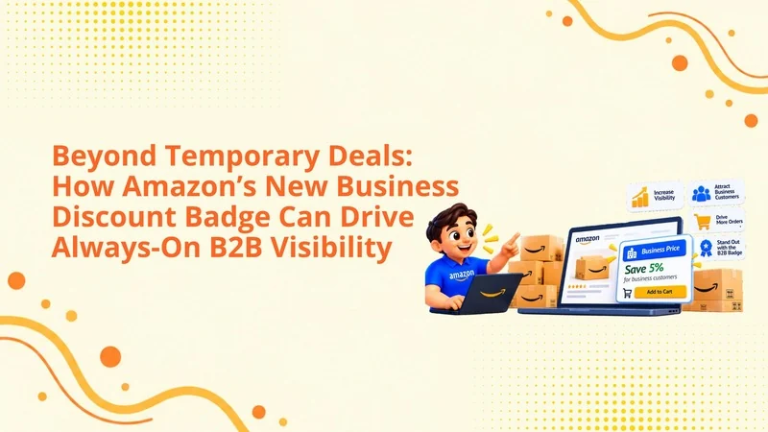
Beyond Temporary Deals: How Amazon’s New Business Discount Badge Can Drive Always-On B2B Visibility
Shopkeepers of Amazon frequently utilize discounts, coupons, and seasonal offers in order to attract buyers. These strategies help to foster a sense of urgency though not without limitations: they function for a set time frame, may involve certain fees during the holiday sale, and eventually, may disappear as soon as the sale is over.
Amazon plans to introduce Business Discount badge that would be beneficial for shopkeepers who have business-to-business clients.
In order to get an “always on” badge, a particular business price should be able to generate minimum savings of 5% against a reference price recognized. The badge will be visible to customers with strikethrough pricing and discount percentages on Amazon Business and product pages.
Discounts of at least 2% can provide shop owners with strikethrough pricing and savings visibility assuming they do not exceed the 5% threshold.
This allows sellers to increase their B2B value without triggering a series of purchases on behalf of customers or depending on limited time offers.
Amazon points out that the B2B sales growth registered for products benefitting from business pricing doubled that which occurred for the products without the business price in 2026. This is Amazon’s aggregate observation rather than a guaranteed seller outcome, but it shows why business-specific pricing deserves a more prominent place in marketplace strategy.
Amazon Business Discount badge is an upcoming pricing tag which is being designed to show registered Amazon Business customers that this offer has a great savings compared to a validated reference price.
A qualifying price block may include:
The label refers only to single-unit pricing. There is no requirement on the part of the buyer to attain a specific quantity for him or her to be successfully informed of the pricing options available for businesses.
According to Amazon, the new badge has been designed to take the place of the old Business Savings Blue Badge associated with pricing at the level of a single unit. Offers that depend on the quantity for businesses will continue to use the earlier badge, which will operate according to the existing rules.
Amazon has made public its plans to roll out the Business Discount badge soon.
The announcement does not mention the exact date of universal activation. Therefore, sellers ought to refrain from claiming that the badge can be applied to each and every product, account, and customer experience.
A better course of action would be to take preparatory steps now.
Sellers are encouraged to examine the prices of their businesses, verify if they are able to establish their reference pricing, estimate the margins, and define certain ASINs that can be eligible for the badge immediately after its introduction.
As Amazon constantly experiments with its business pricing options, sellers should also check Seller Central for the most up-to-date requirements before altering catalog prices.
The new merchandising structure has two important thresholds.
When the single-unit business price provides at least 2% savings against a validated reference price, the offer may display:
This improves price communication, but it does not automatically earn the new badge.
When the individual unit price of a product guarantees a discount of 5% from an approved reference price, the listing will receive the Business Discount badge automatically.
The merchant is not required to create a marketing campaign or submit the item for a time-limited offer.
The most important detail is that the sales price should be compared to an accepted reference price.
The business price, although discounted by 5% of the regular price, can fail to get the badge if there is no legitimate reference price available at Amazon.
The business price can be described as the special price available to only the registered Amazon business customers. It is set alongside the regular prices available to Amazon customers. This means that while sellers may provide low prices to business customers, regular customers do not have to see their prices lowered automatically.
For instance, to illustrate this, a product might have:
Discount on large volume purchases, e.g., buyers can benefit if they place the orders of 10, 25, or 50 units.
Business pricing is available only for customers registered in the Amazon business program.
Validated reference price is a crucial component of the new badge system. The reference price provides a baseline for the customers to interpret the advertised savings. Amazon may use 'reference pricing' as either a List Price or a Typical Price based on the product and available pricing information.
A seller cannot merely assume that Amazon will take in an inflated List Price.
In fact, Amazon has established requirements for reference pricing such as:
The Typical Price is dynamic, meaning that it may represent the median non-promotional price available to customers during a particular period of time. Reference prices change with the changing data and may be changed by Amazon without prior notice.
If there is no validated reference price, the offer will not include:
This means that the preparation for the badge is an example of reference price audits not just of business price calculations.
No. Amazon stated that the new Business Pricing sticker will not necessitate a minimum four-star rating.
This brings a new dimension to the earlier single unit business price sticker.
The elimination of the rating requirement paves the way for:
Removal of the requirement does not indicate that product quality and customer confidence are not considered.
No. According to Amazon, the standards for the legacy Blue Badge Business Savings quantity discount will not be modified.
In order for a quantity-based promotion to qualify for the Blue Badge Business Savings, it has to:
The first quantity tier must be the lowest threshold according to the seller's pricing scheme.
For instance, if there are tiers at 5, 10, and 25 units, then the tier at 5 must meet the requirement.
Thus, the two badges are created for different purchasing situations.
The new Business Discount badge underlines an advantage in case of one-unit purchases while the Blue Badge Business Savings awards bulk purchases.
One is also not obligated to choose between the two—it is possible to have a competitive business price for a single unit and have multiple quantity tiers that motivate buyers to buy more.
A business price is not limited to a 24-hour deal or a short promotional campaign. As long as the offer continues to qualify, the badge can provide ongoing B2B merchandising visibility.
This is why Amazon describes the badge as similar to an always-on deal badge.
Business buyers may compare several similar products based on unit price, total order value, availability, delivery, and purchasing convenience.
A visible badge, strikethrough price, and savings percentage can communicate value before the buyer opens every product detail page.
Not every business order begins with 50 or 100 units.
Small offices, local businesses, schools, clinics, hospitality operators, contractors, and independent professionals may begin by purchasing one unit.
A single-unit business discount gives these customers a reason to choose the seller before they are ready to commit to a bulk order.
A seller can use the single-unit business price as an entry point, then provide greater savings at higher quantity tiers.
The structure may look like this:
This approach can support both customer acquisition and average-order growth.
Business buyers may have different purchasing priorities and economics from individual customers.
Sellers can offer a lower business price while maintaining their standard consumer price. This creates more control than applying one discount across the entire marketplace.
Because the new single-unit badge will not require a four-star rating, sellers may be able to make qualifying newer products more visible before they accumulate an extensive review history.
A badge can attract attention, but it cannot correct weak unit economics.
Before reducing a business price, sellers should calculate:
A 5% threshold for issuing a discount does not mean that you need to issue this discount for every item in the catalog. For poor margin products, applying a discount of 5% will lead to a loss. For profitable products, a greater discount is possible.
Making the discount for all the items within the B2B catalog just for getting a discount badge does not offer an optimal solution. The right way is to analyze the products where the increase in B2B presence, frequency of orders or quantities justifies the reduction in unit price.
Potential candidates often include:
A strong candidate usually has:
Identify:
This separates quick opportunities from offers requiring more work.
Check whether the product currently displays a valid List Price or Typical Price.
If a reference price is missing, review the product’s pricing history and catalog information. Do not artificially inflate the List Price to manufacture a discount. Amazon validates reference pricing to protect customer trust.
Determine the lowest business price the seller can offer while maintaining an acceptable contribution margin.
Include normal single-unit orders as well as each quantity tier.
Quantity thresholds should reflect how business customers actually buy the product.
A product normally purchased in cases should not use arbitrary quantity levels that provide little operational or buyer value.
Amazon supports fixed-price and percentage-based quantity discounts, with up to five tiers available through its bulk-listing workflow.
A successful business discount can increase order volume and unit velocity.
Before activating a catalog-wide strategy, review:
A discount may bring the buyer to the listing, but the detail page must still close the sale.
Confirm that the listing clearly communicates:
Sellers can manage individual business prices through Manage All Inventory.
For larger catalogs, Amazon supports:
Business pricing must be managed separately for each Amazon store where the seller wants it to apply.
Do not judge the strategy only by whether the badge appears.
Track:
Compare performance before and after implementing the qualifying business price.
The objective is not merely to sell more units. It is to generate profitable B2B growth.
The Amazon Business Discount badge can make a product more noticeable, but business buyers still need a compelling reason to choose it.
Pricing should work together with:
We help Amazon sellers connect these areas through business-pricing strategy, listing optimization, PPC management, Amazon SEO, catalog health, A+ Content, inventory planning, and full marketplace management.
Our team can help identify B2B-ready ASINs, review validated reference pricing, structure profitable discounts, and improve the content supporting each business offer.
It is an upcoming badge for qualifying single-unit business prices that provide at least 5% savings against a validated reference price.
A discount of at least 2% may display strikethrough pricing and a savings percentage, but it does not reach the 5% threshold for the badge.
No. Amazon says the new single-unit Business Discount badge will not require a four-star product rating.
Yes. A validated reference price must exist for the badge, strikethrough price, and percentage-saving display.
No. Qualifying quantity offers still need at least a 3% discount at the first tier and a four-star product rating for the legacy Business Savings Blue Badge.
The strongest opportunity is not to discount every product. It is to identify the right products, set sustainable prices, and make the complete B2B offer easier to discover and buy.
To review your Amazon Business pricing, reference-price readiness, catalog, quantity discounts, and B2B growth opportunities.
Schedule a strategy call with our team.
Follow Big Internet Ecommerce (BIE) on Instagram & LinkedIn to stay updated with the latest trends in Amazon selling.
Fill out the form and our experts will get back
to you within 24 hours.


We respect your privacy. Your information is safe with us.