October 28, 2026
From FBA Inventory to Prime-Powered DTC Growth: How Amazon MCF Preferred Pricing Can Cut Fulfillment Costs
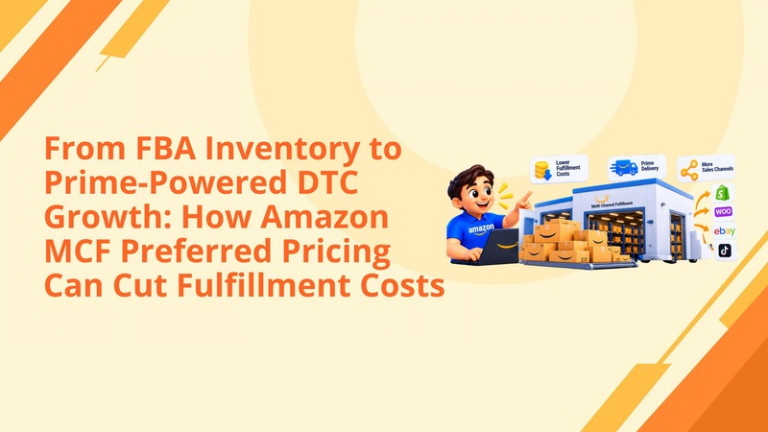
Selling on e‑commerce channels can broaden a brand’s reach but it can also make fulfillment complicated and costly.
Inventory can be split among Amazon, a third‑party logistics provider, a Shopify warehouse and other marketplace systems. Sellers may pay for storage, separate integrations, extra labor and stock transfers while still finding it hard to keep fast delivery on every channel.
Amazon Multi‑Channel Fulfillment offers another approach.
MCF lets merchants use inventory that is stored in Amazon’s fulfillment network to fill orders that come from their websites, marketplaces and social commerce channels. Amazon picks, packs and ships those orders while the merchant still manages its storefront, payments, customer communications and customer service.
Amazon has now strengthened this proposition for US merchants in two important ways.
First Amazon MCF Preferred Pricing merchants can give free Prime delivery on eligible website orders without paying an extra Prime‑delivery fee beyond the applicable MCF Standard rates.
Second, Amazon MCF Preferred Pricing can give sellers discounts of up to fifteen percent on MCF outbound fulfillment fees and FBA credits of up to one dollar for each qualifying unit.
Eligible new sellers may get a twenty‑five percent discount on their first one hundred MCF units through Amazon’s New Seller Incentives. Sellers must keep these programs apart because their eligibility, duration, limits and benefits differ.
Amazon Multi‑Channel Fulfillment is a logistics service that uses Amazon’s fulfillment network to ship orders that are placed outside the Amazon marketplace.
A seller sends inventory to Amazon’s network. When an eligible off‑Amazon order is placed that order is sent to MCF through a supported integration, API or manual workflow. Amazon then picks, packs and ships the product to the customer.
MCF can support orders from channels such as:
● Shopify stores
● Brand‑owned ecommerce websites
● Social commerce platforms
● Online marketplaces
● Compatible third‑party applications
● Custom systems connected through the Selling Partner API
This differs from Fulfillment by Amazon.
FBA mainly fulfills orders that come through Amazon’s marketplace. MCF uses the broad logistics infrastructure to serve eligible orders that come from elsewhere.
For a seller who already stores products with Amazon MCF can turn FBA inventory into a multi‑channel inventory pool.
Prime delivery for MCF lets eligible merchants show a Prime delivery option on their e‑commerce websites.
Amazon fulfills orders from the merchant’s inventory but the brand keeps control of its existing: Checkout, Payment processor, Order‑management system, Return policies, Customer service, Customer communications, Website experience.
This distinction matters.
Traditional Buy with Prime gives a Prime‑branded checkout experience. Prime delivery for MCF focuses on bringing the free Prime delivery promise into the merchant’s existing website workflow without making the brand replace its current checkout.
Amazon says Prime delivery for MCF costs nothing beyond the applicable MCF Standard fulfillment rates. Shopify merchants can use the feature through the Amazon MCF. Buy with the Prime app.
The customer sees the Prime delivery option on product pages. After ordering, confirmation and tracking messages still come from the merchant.
This can help brands add a delivery promise while keeping ownership of the customer journey.
Amazon MCF Preferred Pricing is an incentive structure that aims to lower outbound fulfillment costs and reward qualifying multi‑channel shipping activity.
Amazon provides two Preferred Pricing paths.
Eligible sellers can get a fifteen percent discount on qualifying MCF outbound fulfillment fees, a one dollar FBA credit for each qualifying MCF unit shipped and benefits for a program period subject to applicable terms.
Potential eligibility paths include:
● Participation in the MCF New Seller Incentive program with least one hundred MCF units shipped on or after October 15 2025
● First use of an eligible MCF API integration on or, after October 15 2025
● FBA sellers who sent at least 5,800 FBA units but less than 1,200 MCF units in the relevant 12‑week period are considered established. Some of these sellers join automatically; others get an invitation. Must opt in via Seller Central.
The 12‑Month Preferred Pricing Program is a plan that looks at a seller’s MCF volume over a 12‑week period. From that data the program decides the discount and FBA credit for the week.
Eligible benefits include:
- 1,200–7,000 units: 5% MCF discount and a $0.25 FBA credit for each qualifying unit.
- 7,001–13,000 Units: 8% MCF discount and a $0.50 FBA credit per qualifying unit.
- 13,001–19,000 Units: 12% MCF discount and a $0.75 FBA credit per qualifying unit.
- Than 19,001 units: 15% MCF discount and a $1 FBA credit per qualifying unit.
- Than 1,200 units: No Preferred Pricing discount or FBA credit during that benefit period.
Benefits last until a seller reaches 100,000 qualifying MCF units or until 12 months from enrollment whichever comes first. Sellers who exceed the program’s volume range can contact Amazon to discuss custom pricing.
Amazon’s ongoing MCF Preferred Pricing program offers discounts of up to 15% on outbound fulfillment fees. It also gives FBA credits of up to $1 for each qualifying unit.
The 25% discount is separate. It applies to eligible new sellers in Amazon’s New Seller Incentives and covers the first 100 MCF units, as long as the program’s terms are met.
Therefore sellers must not treat "up to 25%" as the Preferred Pricing discount for every MCF shipment.
The correct interpretation is:
- Eligible new sellers may get 25% off their 100 MCF units.
- Eligible Preferred Pricing participants may get up to 15% off qualifying MCF fulfillment fees.
- Preferred Pricing participants may also earn FBA credits of up to $1 for each qualifying unit.
- Actual savings depend on eligibility, volume, fee structure, product profile and program limits.
This difference matters when building forecasts or when comparing MCF with a third‑party logistics provider.
How Can MCF Preferred Pricing Benefit Amazon Sellers? Reduce the cost of off‑Amazon fulfillment.
A percentage discount can improve the contribution margin on qualifying websites, marketplace and social commerce orders.
The FBA credit adds another benefit because it can offset FBA fees on a seller’s Amazon business.
The full value should be measured as two components:
1. The MCF fulfillment‑fee discount
2. The FBA credit deposited into the Seller Central account
If you combine them into one percentage you can get misleading results. This is because the fixed FBA credit has a proportional value for low‑priced and high‑priced products.
Without fulfillment sellers may split inventory across FBA, a 3PL, a website warehouse and many marketplaces.
That can create:
- Duplicate safety stock.
- Transfers between facilities.
- Higher storage complexity.
- Greater risk that one channel will run out while another has excess inventory.
- More difficult demand forecasting.
MCF can let eligible orders draw from a shared Amazon inventory pool. This may improve inventory flexibility. Sellers still need to keep enough stock for Amazon marketplace demand.
Customers may hesitate to buy from a website if delivery speed is unclear.
Showing a Prime delivery option can add a familiar promise at a key point in the purchase journey. It does not guarantee that every shopper will convert. It can reduce uncertainty about fulfillment and arrival times.
Brands entering sales channels often face a difficult choice: invest in a separate fulfillment operation or delay expansion.
MCF gives a way to test and grow eligible off‑Amazon channels using the infrastructure a seller may already use for Amazon.
This can be particularly useful for:
- Brands launching a Shopify store.
- Amazon‑first sellers moving into DTC.
- Businesses testing commerce.
- Sellers expanding to additional marketplaces.
- Seasonal brands manage demand across several channels.
With delivery for MCF sellers keep their existing checkout, payment processor, customer service return policies and order communications.
This lets a brand add fulfillment value without redesigning its store experience.
Which Products Are the Best Candidates for MCF? Not every SKU will produce the result.
Strong MCF candidates often include:
● Standard‑size products
● Products with healthy gross margins
● Fast‑moving inventory
● Low‑return items
● Products sold across several channels
● Items with predictable dimensions and shipping weights
● Bundles or multi‑unit orders with favourable per‑unit economics
● Products where fast delivery can influence conversion
MCF may be less attractive for:
● Oversized or heavy products
● Very low‑margin items
● Products requiring specialised packaging
● High‑return products
● Temperature‑sensitive inventory
● Products requiring a highly branded unboxing experience
● Slow‑moving products that already carry substantial storage costs
The best decision should be made at the SKU level not simply at the account level.
A discount does not automatically make a fulfillment route profitable.
Sellers should calculate the landed fulfillment cost, including:
● MCF outbound fulfillment fee
● Product size tier
● Shipping weight
● Standard or expedited delivery speed
● Number of units per order
● Fuel and logistics‑related surcharge
● Holiday peak fulfillment fees
● Storage costs
● Integration or application fees
● Return‑processing costs
● Packaging requirements
● Customer service expenses
● FBA credits received
● Applicable channel commissions and payment‑processing fees
Amazon currently lists a 3.5 % fuel and logistics‑related surcharge for US MCF fulfillment fees.
Holiday peak fulfillment fees apply from October 15 2026 through January 14 2027.
A seller comparing MCF with a 3PL should use the assumptions for both options.
Comparing an MCF base fee with an all‑inclusive 3PL invoice—or the reverse—will not produce a conclusion.
Eligible sellers can check the Your Incentives page in Seller Central.
Look for:
● MCF Preferred Pricing – 6‑Month
● MCF Preferred Pricing – 12‑Month
● MCF New Seller Incentives
If the program status shows Eligible, review the details and select Enroll.
Invitation‑based sellers generally have 30 days from the invitation date to enroll.
Enrollment may appear within minutes although Amazon notes that account updates can sometimes take up to 24 hours.
Sellers who believe they qualify but cannot see an enrollment option should contact their MCF account manager or Selling Partner Support.
Sellers should not assume the benefits have been applied correctly without checking the reporting.
To review FBA credits:
1. Open Payments in Seller Central.
2. Go to Transaction View.
3. Review service charges associated with MCF orders.
4. Look for entries identified as an MCF Preferred Pricing seller credit.
Sellers can also download transaction files. Review the applicable amount‑type column.
For order‑level Preferred Pricing details:
1. Open the MCF Analytics dashboard.
2. Select the Multi‑Channel Fulfillment section.
3. Choose the reporting period.
4. Generate the orders report.
5. Review program enrollment, fee discounts, incentive details and seller credits.
Build a comparison that includes:
● MCF units shipped
● Gross MCF fulfillment fees
● Preferred Pricing discounts
● FBA credits earned
● Net fulfilment cost
● Cost per unit
● Cost by channel
● Returns and refunds
● Delivery performance
● Contribution margin
This turns the incentive from a headline benefit into a measurable profitability strategy.
Not every product or order will qualify. Review Amazon’s current. Test the Prime delivery option on eligible SKUs.
Using one inventory pool can improve flexibility. Off‑amazon orders can consume units that would otherwise support Amazon marketplace sales.
Set inventory thresholds. Monitor days of supply, across all connected channels.
Make sure the Prime badge and delivery promise appear correctly without conflicting with shipping messages free‑shipping thresholds or store policies.
Complete test orders. Confirm:
● Product‑page messaging
● Delivery estimates
● Checkout behaviour
● Order confirmation
● Tracking communication
● Customer-service workflow
● Return experience
Measure whether Prime delivery improves:
- Product-page conversion rate
- Checkout completion
- Cart abandonment
- Average order value
- Repeat purchase rate
- Customer acquisition efficiency
A clear delivery promise matters only if it lifts performance while keeping profit margins intact.
We see fulfillment as a growth decision.
Fulfillment must not be handled in isolation from advertising, inventory, pricing, catalog health and website conversion.
A lower MCF rate can raise margin. Only when the connected SKU has suitable size, price, demand, return pattern and channel economics.
Likewise adding Prime delivery can boost shopper confidence. The website still requires solid product positioning, persuasive content, clear images, competitive price and a smooth checkout.
We help Amazon sellers and ecommerce brands link these decisions through:
- Amazon marketplace strategy
- Full store management
- PPC management
- Amazon SEO
- Listing and catalog optimization
- A+ Content and creative strategy
- Inventory and account-health support
- Shopify and multi-channel planning
- SKU-level profitability analysis
Our goal is not just to help Amazon sellers ship orders. It is to help Amazon sellers build a fulfillment and growth system that supports sustainable expansion.
Amazon MCF Preferred Pricing is an incentive program that gives U.S. Merchants discounts on qualifying MCF outbound fulfillment fees and FBA credits, based on program eligibility and shipping volume.
Eligible new Amazon sellers may receive 25 percent off fulfillment fees for their 100 MCF units. The separate Preferred Pricing program offers discounts of up to 15 percent.
Amazon says eligible merchants can add Prime delivery at no cost beyond the applicable MCF Standard fulfillment rates.
Yes. Eligible U.S. Merchants can set up Prime delivery for MCF through the Amazon MCF. Buy with the Prime app on Shopify.
Sellers can open the Your Incentives page in Seller Central and look for a MCF Preferred Pricing or New Seller Incentive program.
If you are already using MCF—or thinking about it for Shopify, social commerce and other marketplaces—now is the time to review your eligibility, integration and SKU economics.
To evaluate your MCF setup Preferred Pricing benefits, fulfillment costs, inventory strategy and multi-channel growth opportunities.
Schedule a strategy call with our team.
Follow Big Internet Ecommerce (BIE) on Instagram & LinkedIn to stay updated with the latest trends in Amazon selling.
Fill out the form and our experts will get back
to you within 24 hours.


We respect your privacy. Your information is safe with us.