November 2, 2026
Is Your Importer of Record Ready? What U.S. Customs Changes Could Mean for Amazon Sellers
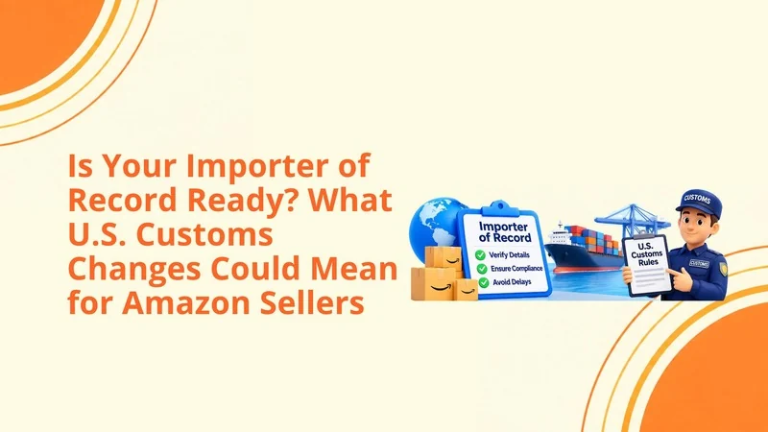
The issues with international shipping rarely occur only in one aspect. For instance, customs issues can lead to issues with FBA stock, product launch, drop in the organic ranking, or advertisements for goods that cannot be supplied anymore.
Thus, it is crucial for Amazon sellers that have business dealings in the United States to pay attention to Executive Order 14411 which is titled "Strengthening Customs Enforcement".
This executive order instructs federal agencies to modify the rules regarding the eligibility of the importer of record, strengthen the verification procedures for importers and contain additional requirements for the disclosures and bonding related to customs compliance.
It is important for both foreign and domestic importers to be aware of the fact that there may be more regulations placed upon foreign importers than on local ones.
Executive Order 14411 was issued, directing the Department of Homeland Security and customs and border protection (CBP) to improve customs enforcement by modifying importers' qualification, verification, and accountability processes. This order entails a set of tools such as:
It also orders that CBP would not allow informal entrants for foreign IORs and set other requirements for formal entrants. The operational patterns depend on CPB regulations and guidelines.
As of November 2, 2026, there is no publicly available comprehensive set of future procedures for Importer of Record matters, which does not imply, however, that the Implementation process itself will begin much later. Indeed, as of September 2026, CBP started enforcing IOR information accuracy requirements. Both new and old importers need to be sure that they provide accurate and complete data when filing Form 5106. Inaccurate data may lead to IOR number cancellation.
While general rulemaking is going on, it is clear that IOR data accuracy is being enforced.
The Importer of Record refers to the person or entity required by law to import items into the U.S. The IOR is accountable for relevant taxes in addition to fulfilling all other legal obligations associated with the importation.
The entity listed on the customs entry could be the purchaser of the goods or a licensed customs broker that has been appointed as the IOR.
For Amazon sellers, this means that the firm handling the shipment doesn’t automatically qualify as an IOR. The seller's manufacturer, forwarder, customs broker, and importer might be different companies with their own obligations.
That leads to danger in situations when a seller simply believes that the logistics provider took care of everything without being aware of:
Executive Order 14411 presents clear definitions for the terms pertaining to U.S. IORs and foreign IORs.
In order for any entity to be classified as a U.S. IOR according to the order, it has to meet specific criteria, including being constituted in accordance with U.S. laws; being located in the U.S.; being able to satisfy distinctly defined criteria for beneficial ownership; or owning important proportion of U.S. properties and land in the U.S. as determined by the government.
The term “located in the United States” fills in more important context than simply having a mailing address. The order clarifies that it also means:
Having a principal place of business in the U.S.
Having a physical presence and conducting business.
Having tangible assets in the U.S.
Any IOR failing to meet the applicable U.S. definition can be treated as a foreign IOR. Future agency clarifications will help understand how certain parameters should be interpreted and enforced.
This is particularly crucial for Amazon merchants. These vendors could have established a business in the United States. still do the majority of their operations outside of the United States. simply because of a company's U.S. incorporation. does not imply that all categorization problems are resolved.
For guidance tailored to their particular circumstances, sellers should consult a customs broker or a trade attorney. They ought not to depend on their U.S. incorporation to determine the appropriate classification for their goods. Making choices based on inclusion may result in errors.
There has been no ban on foreign vendors selling on Amazon.com. The controversy arises in relation to the customs procedure involved in the import of goods into the US.
In accordance with how the implementation takes place, the foreign IOR might be required to satisfy additional requirements relating to bonding, formal entry, ownership of assets in the US, compliance history, and verification.
Possible operational effects include:
Importers may be required to divulge specific information regarding ownership, business affiliations, import volume, and supplier chain. Sellers may have to conduct more work and documentation if their records are incomplete or dispersed.
The executive order tells CBP to look at local assets, bonding and more bond coverage. I think CBP might see this change affect the cost or structure of some importing arrangements.
Businesses that rely on unclear, inactive or wrong IOR numbers are facing risk. The current Form 5106 enforcement makes accurate IOR identity information absolutely essential for businesses that rely on IOR numbers.
The directive instructs agencies to establish additional guidelines to formal entries and to prohibit IORs from filing informal entries. Ask your customs specialists how these regulations can impact your IOR entries if you are a seller using value or highly divided shipping techniques.
Compliance and payment history must be taken into account. You may have issues that go beyond a single shipment if you continue to make mistakes, owe money, or submit information.
These results ought to be viewed as possibilities for preparedness rather than as a replacement for CBP.
Customs readiness is not only a compliance concern. It supports commercial continuity.
A customs delay can stop inventory from reaching an Amazon fulfillment center on time. That can cause stockouts, missed sales and lost ranking momentum.
Launching an ASIN while its inventory is delayed can waste advertising spend and weaken early conversion signals. Confirming the import arrangement before production leaves the factory reduces this risk.
Higher bond requirements, professional fees, documentation work or a new importing structure may increase landed costs. Identifying those expenses early makes profitability forecasts more reliable.
When sellers discover an IOR issue at the port their options are limited. Finding it earlier gives them time to compare customs brokers, freight arrangements and compliant alternatives.
Some vendors are unable to articulate exactly what their freight forwarder accomplishes for them. It is simpler to assess service quality and create a plan when the process is documented.
Therefore, even if the final rules are different from what was anticipated, preparation still benefits the firm.
Please gather the CBP Form 7501 entry summaries along with any available Form 5106 records, customs bonds, commercial invoices, powers of attorney and logistics agreements. The Form 7501 you submit must clearly show the IOR used for that entry.
Ask your customs broker or freight forwarder: Please confirm the name, IOR number and classification of the Importer of Record used for my U.S. Shipments.
Do not rely solely on a verbal response.
Confirm that the IOR’s name, address, contact information, identification number, company structure and ownership information are accurate.
Pay attention to differences between formation documents, tax records, customs forms and shipping agreements.
A provider should be able to explain why it made an assessment. If the reason for the answer comes down to having a U.S. Mailing address or a company registration then it’s best to ask for a more detailed professional review.
If your IOR may be foreign ask:
Look at how a delay or a cost increase changes:
A customs strategy is incomplete if it does not connect to these Amazon operating decisions.
Identify a customs broker or compliant importing option before you need it. Understand the onboarding time, documentation, cost and operational changes that an alternative would require.
Do not switch providers because of speculation. Build the customs broker or compliant importing option, verify it professionally and activate it only when justified.
Transportation and importer responsibility are duties. Verify Transportation entity listed on the customs entry.
The order looks at location, business activity, physical assets and ownership. The order does not focus on incorporation. It matters where the business is, what it really does, what it owns and who owns it. The mere fact that a company is incorporated is not enough.
Amazon may give rules that change how goods come in. The seller must still set up a proper import arrangement, with qualified professionals.
This is not merely a concern. Enhanced CBP enforcement is already active and inaccurate importer information may result in the IOR number being voided.
Do not form entities transfer ownership or replace an IOR based on a general announcement. Customs and corporate decisions require analysis.
A customs broker or attorney should give you information about IOR classification and compliance. But after that, the information needs to be turned into a workable Amazon plan.
When the lead time for inventories increases sellers will probably have to increase the amount of their safety stock. If the landed cost rises it may be necessary to readjust the price and PPC targets. If a launch shipment is endangered it’s essential to change the promotion dates before devoting to advertising.
We help sellers of Amazon to align their inventory planning with ads, catalog management, listing optimization, etc. BIE has worked with Amazon sellers since 2007 and provides support in PPC, SEO, A+ Content, catalog management and other areas.
Our goal is not to substitute advice by a lawyer who is a licensed customs advisor. The goal is to help avoid unnecessary complications that may cause your business problems on Amazon.
The IOR is the person or entity that brings the goods into the United States, pays any duties and meets customs requirements.
Not every operational detail is written in stone. CBP is constantly updating regulations and guidance, but enforcement of improved accuracy for Form 5106 is in place now.
To find the legal name and IOR number used for your entries, check your CBP Form 7501, your shipping contract, or ask your customs broker.
Not required. The order also looks at U.S. location, physical presence, substantial business operations, tangible assets and beneficial ownership.
While customs changes will not affect listings as such, the potential delay in shipments or higher cost of imports can affect FBA availability, pricing, promotions, advertising and profit margins.
The biggest financial risk of an IOR assessment is when you have done your inventory, scheduled your advertising and then a customs problem stops your shipment.
Lock in your importer agreement right now. Correct any misinformation you have. Check with your provider on how they prepare it. Incorporate this customs evaluation into your FBA demand forecasts, product launch timelines, pricing strategies, and promotional activities.
To develop a strong, ongoing strategy with Amazon that considers your inventory and growth goals.
Schedule a strategy call with our team.
Follow Big Internet Ecommerce (BIE) on Instagram & LinkedIn to stay updated with the latest trends in Amazon selling.
Fill out the form and our experts will get back
to you within 24 hours.


We respect your privacy. Your information is safe with us.