November 3, 2026
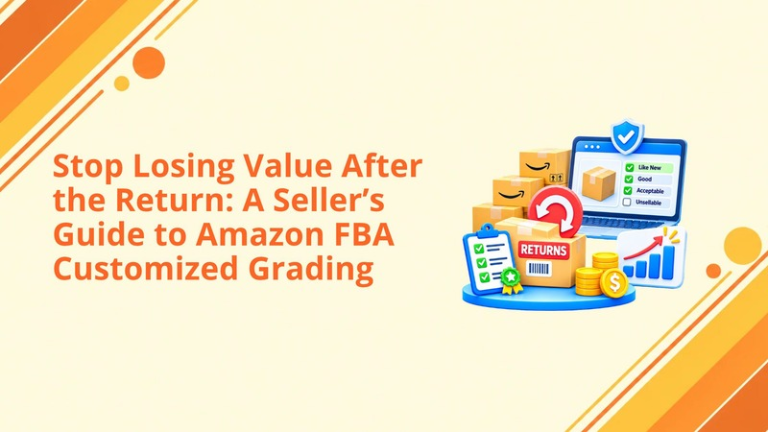
Stop Losing Value After the Return: A Seller’s Guide to Amazon FBA Customized Grading
A return does not mean a product has zero value.
Some of the items being returned are still sealed and are good to be resold. Some may have a compromised seal but still function perfectly. Some products need fresh packaging, others have to be sold as used because an accessory is missing or the original presentation is spoiled.
The problem is that Amazon cannot independently understand each product’s packaging, parts, authenticity markers, and functional specs as well as the brand or seller does.
Here’s where Amazon FBA customized grading can come to your aid.
Customized grading allows FBA sellers to set product standards that Amazon can use to evaluate returned inventory for resale. Merchants can explain what makes an item new, when an item can be refurbished to new condition, and when it should be considered pre-owned.
This can lead to a more enlightened approach to value recovery from returned stock for vendors with high return rates, costly items, complex bundles or restrictive brand regulations.
Amazon FBA personalized grading allows sellers to set their own product grading standards for certain ASINs as a way to manage returns.
When an FBA customer return arrives at Amazon, the product can be evaluated to determine if it can be:
Amazon has a grading procedure. Custom grading is not a replacement for that process or to give sellers free rein to decide on grading.
It provides Amazon more guidance on some products. Amazon takes into account the seller's specifications along with its traditional evaluation methods.
Sellers set the criteria for graders, but Amazon is responsible for the final grading process.
Two goods may come with comparable packing damage yet require entirely different resale options.
For example, a damaged exterior seal may be purely decorative for a non-sensitive home item. For another item, the same broken seal may raise questions about authenticity, cleanliness, product integrity, or completeness.
The same applies to accessories. A lost cosmetic insert may not effect usage, however a missing charger, installation component, or proprietary attachment may render the main device inoperable.
Default grading may not fully account for details such as:
Customized grading allows sellers to make these requirements clearer.
Amazon arranges customizable grading based on numerous product features. Sellers may build rules for each category and attach them to the corresponding ASINs.
Sellers can identify the seal and packaging used on a product.
Manufacturer seals, shrink wrap, sticky disks, security tags, and other formats may all be used. Boxes, polybags, blister packs, branded packaging, and other structures can all be used as packing.
Sellers can also indicate:
ASINs with various seal or packing types require distinct requirements. Combining items with very differing packing needs might render the instructions less informative.
This category allows sellers to specify which components should be included with the returned product.
Depending on the ASIN, required accessories could include:
The criteria must be used to distinguish between necessary and non-essential items. The grader must be capable of knowing if all is well with the product, without having to interpret any ambiguous marketing terms.
There are cases when certain characteristics must be applied by brands to separate authentic products from those being incorrect, substituted or possibly counterfeit.
Such characteristics might include serial numbers, security stickers, brand marking or any other unique feature of a particular product.
It is important for sellers to make sure that provided instructions remain objective and verifiable. The goal here is not to give general and unverifiable statements for the inspection process to use.
In the case of gadgets or functional products, sellers are allowed to stipulate which features should be tested.
One possible criterion could define how a gadget has to switch on, retain a charge, connect to an appropriate accessory, and perform a designated basic task.
The check that the product works requirement would be far too vague. Appropriate criteria outline the fundamental checks that indicate whether the product is functional or not.
The seller can also have extra requirements which cannot be categorized under any of the above mentioned requirements.
The extra requirements must be short, observable and relevant to the resale decision. Extra requirements may sometimes be too much or subjective.
The use of tailored guidelines allows Amazon to differentiate between a slight problem with the packaging and a situation that may impact safety, completeness, authenticity, and ability to perform. In light of this, it is possible to produce grading results that are more attuned to the actual situation with the concerned product.
When a customer gets poor-quality product, he/she might confuse a return and a product made according to standards.
With the clear criteria set, returns will comply with the standards of packing, as well as of addition, authenticity of packaging and functions of the product before the returned one gets back into stock.
An item that has been returned and is no longer suitable for resale as new still has the potential for a good resale value.
By leveraging customized grading with Grade and Resell, sellers can communicate guidelines regarding when products can be sold in a used condition. Sellers who use Grade and Resell will also be able to establish peculiar used-price percentages for:
This allows for the chance to recover some of the value from a product rather than having to resort to immediate removal, liquidation or disposal.
Sellers can apply grading rules in several ways:
This flexibility is beneficial for small brands as well as sellers with large catalogs. However, one must be cautious in implementing catalog-wide policies. An ASIN should only be subject to a rule as long as the requirements for its use are identical to those for other ASINs.
Customized grading encourages sellers to think beyond the initial refund.
A complete recovery strategy asks:
These questions turn return handling into a broader profitability exercise.
Do not begin by creating rules for every product without prioritization.
Start with ASINs that have one or more of the following:
These products are more likely to produce a measurable recovery opportunity.
Personalized grading focuses on the events that occur after a return takes place. However, it doesn't target the root cause of the return process.
Review product-level return reasons and customer comments. Look for repeated themes involving:
If a listing is generating incorrect expectations, then only tweaking the grading process won't stop returns in the future.
Make a record of what comprises a full, real, and working product.
For each ASIN, record:
This checklist can serve as the foundation for more consistent grading rules.
There are some cases in which packaging does not need to be classified.
For some types of items, it is permissible to use re-packaging or re-sealing without compromising their quality or performance and the purchaser's experience. However, there are items for which restoration is not possible due to the fact that their initial seal has been removed.
Therefore, sellers should decide on the matter after considering the nature of the product, expectations of buyers, relevant requirements and brand policy.
When you engage in the Grade and Resell program, Amazon can utilize your used-condition percentages for the respective used-condition categories.
A higher percentage may help in maintaining your profit margin but makes the offer less appealing. A lower percentage may be beneficial for selling but offers lower returns.
Consider:
The target must not be just the highest possible price used. It must instead aim for a balance between the recovery value and the chance to resell.
Sellers can access the feature in Seller Central by going to: Settings > Orders > Recovery > Customized Grading
From the customized grading area:
By utilizing a wide catalog rule, sellers are able to provide the rules applicable to the overall catalog, as well as enter their desired ASINs either by typing them in or by uploading a previously prepared CSV file.
However, before implementing a rule applicable throughout the catalog, sellers should double-check that the rule they intend to use is indeed relevant to each product in the catalog.
The use of customized grading helps Amazon gain better information, though it does not provide total control over return results.
Rather than relying solely on its established grading process, Amazon looks at the seller’s grading standards when processing returns. The introduction of the rules does not mean that a specific grade will be given to every product returned.
An ASIN that lacks a unique guideline will still undergo Amazon's conventional grading procedure.
If a seller establishes another guideline for an ASIN which already has a guideline for that category, the new guideline will take place of the previous one.
Be sure to evaluate any reviews before submitting a new criteria.
A seal and packing policy must include products having the same packaging formats. ASINs with various seals or packagings must be treated separately.
Used condition pricing percentages apply to qualifying items classified as Grade and Resell. The fact that grading is more than enough that any repackaged item is viewed as used.
Specifications like the packaging has to be good or the packaging has to be good allow for too broad interpretation.
Identify packaging type along with any requirements to accessories and observable condition.
General rules for all items is a good idea, however, it can lead to inaccuracies for products with different accessories, packaging or functionality.
Therefore, it is better to group ASINs according to their common features.
Packaging, accessory items and product types may differ. Be sure to check the grading rules when a bundle has been changed, or any presentation or product has been modified.
Getting more money from returned items is fruitful, however, it is more advantageous to avoid unnecessary returns in the first place.
It does not follow that a recovered sale makes a profit. Don’t forget about recovery costs, disposal fees, prices devaluation and the time needed to sell the good.
Ensure to assess the money left after expenses, not the number of items returned.
The customized grading service offered by FBA Amazon can help sellers maintain the inventory that has already been returned, but the benefits of this feature can be obtained only when it is used as part of a broader strategy for return and recovery.
We provides sellers with an understanding of the cause behind the returns and what needs to be resolved first.
We can support sellers with:
For instance, if the return case notes mention customers making the same mistakes regarding the size or compatibility of the item, the solution will not be just to introduce stronger grading. The product listing will likely have to be made more customer-friendly, using better images or including the features, comparison content and providing a compatibility guide.
If excessive disposal of returned whole products is taking place, the recovery may need an adjustment.
Eliminate reasons for unnecessary returns upfront and recover some of the cost afterwards.
This way one will get much better results than if dealing with each returned item separately.
No. Amazon uses your criteria as guidance alongside its standard grading process.
They continue to use Amazon’s default return-grading process.
Yes, but only use a catalog-wide rule when the same criteria genuinely apply to all included ASINs.
If you use Grade and Resell, you can set price percentages for Like New, Very Good, Good and Acceptable conditions.
Yes. A new rule replaces the existing rule for that ASIN within the same grading category.
Amazon FBA grading system allows sellers to share information about their products’ completeness, authenticity, practicality, and resellability aspects.
The best practice is to start with most significant ASINs, define clear and measurable rules, correlate evaluations with Grade and Resell options where applicable, and track recovery over the time.
Don’t stop with return grading only. Use the information received to improve the reasons the product was returned at the first place.
Contact us to get a comprehensive review of FBA returns and recovery. We can help you prioritize ASINs and upgrade your grading criteria, enhance your recovery strategy, and solve the issues with your listing or activities that lead to avoidable returns.
Schedule a strategy call with our team.
Follow Big Internet Ecommerce (BIE) on Instagram & LinkedIn to stay updated with the latest trends in Amazon selling.
Fill out the form and our experts will get back
to you within 24 hours.


We respect your privacy. Your information is safe with us.