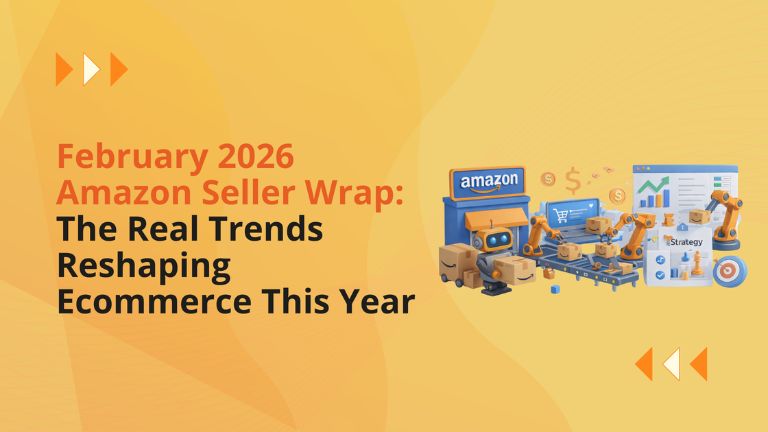
February 2026 was one of the clearest signal months Amazon sellers have had in a long time.
At first glance, the updates seemed wide-ranging: tariffs, AI checkout, TikTok integration, removal fee billing changes, FNSKU enforcement, product photography requirements, Creator Connections, Sponsored Brands restructuring, and more.
But when you step back, the pattern becomes obvious.
February revealed where ecommerce is heading in 2026: toward tighter margins, heavier operational discipline, more AI-driven infrastructure, and stronger pressure on sellers to build real systems instead of relying on momentum.
For Amazon sellers, this is not just a month recap. It is a strategic warning.
Contents
- 1 The Big Pattern Behind February’s Updates
- 2 1. Margin Pressure Is Coming From Every Direction
- 3 2. AI Commerce Is No Longer Theoretical
- 4 3. Amazon Is Favoring Structure Over Flexibility
- 5 4. Conversion Optimization Is Becoming Margin Protection
- 6 5. Multi-Channel Readiness Is Becoming a Strategic Requirement
- 7 What February Taught Amazon Sellers
- 8 How Big Internet Ecommerce Helps Sellers Adapt
The Big Pattern Behind February’s Updates
Nearly every topic we covered this month fit into one of five larger shifts:
- Margins are under pressure
- AI is moving closer to discovery, advertising, and checkout
- Amazon is rewarding more disciplined operators
- Conversion has become a core profitability lever
- Multi-channel readiness is becoming essential
Let’s break down what that means.
1. Margin Pressure Is Coming From Every Direction
One of the strongest themes in February was profitability pressure.
We covered tariff-related cost increases, FBA removal fee billing changes, Grade & Resell updates, donations programs, exporting complexity, and category-specific issues in Lawn & Garden and Beauty.
These are not isolated operational details. Together, they point to a bigger truth:
Amazon margins are being compressed from multiple directions at the same time.
Sellers are now dealing with:
- Higher landed costs
- Tighter fee visibility
- Return-related value erosion
- Cross-border complexity
- Fulfillment model decisions that directly affect profit
- Increased need for SKU-level reporting
For years, many sellers could hide weak systems behind rising revenue. That is becoming harder to do.
In 2026, the better question is not: “How do we sell more?”
It is: “Which parts of our business are silently destroying margin?”
2. AI Commerce Is No Longer Theoretical
February also made it clear that AI commerce is no longer just a future trend.
We covered:
- Google Universal Commerce Protocol
- Shopify ChatGPT Instant Checkout
- Amazon Ads MCP Server
- AI-powered Sponsored Brands product collections
These changes matter because they show that AI is moving into every major layer of Ecommerce:
- Discovery
- Recommendation
- Ad workflow execution
- Product grouping
- Checkout
- Post-purchase experience
This has major implications for Amazon sellers.
Historically, many brands treated Amazon as both the discovery engine and the conversion engine. But AI-led commerce suggests that discovery may increasingly happen elsewhere — in chat interfaces, AI assistants, search agents, and structured recommendation systems.
That means sellers need to think beyond keyword stuffing and marketplace visibility.
They need:
- Stronger product data
- Better brand trust signals
- Clearer listing structures
- Operational consistency across channels
- Fulfillment systems that can support commerce beyond Amazon
The seller who understands this early will build leverage.
The seller who ignores it may still have listings live — but lose visibility upstream.
3. Amazon Is Favoring Structure Over Flexibility
Another major February theme was the tightening of operational expectations.
We saw this through updates like:
- Mandatory FNSKU barcodes for non-Brand Registered resellers
- Reinforced product photography guidelines
- More visible per-unit removal/disposal fee processing
- Greater control through Grade & Resell enrollment
- Ad format changes that favor catalog strength over manual storytelling
These changes all reflect one larger trend:
Amazon wants cleaner systems, clearer attribution, stronger compliance, and lower friction for the end customer.
That creates advantages for sellers who already have:
- Prep SOPs
- Catalog discipline
- Strong creative assets
- Structured advertising architecture
- Accurate operational reporting
It creates pain for sellers who rely on loose workflows, poor image quality, weak listing depth, or reactive inventory practices.
Amazon is becoming increasingly friendly to real operators and increasingly punishing to casual sellers.
4. Conversion Optimization Is Becoming Margin Protection
The tariff discussion in particular made one thing clear: when prices rise, weak listings suffer faster.
As shoppers become more selective, poor conversion assets create much bigger downside:
- Weak hero images reduce click-through
- Generic bullets lower trust
- Unclear differentiation weakens willingness to pay
- Poor image galleries increase hesitation and returns
- Weak brand positioning makes discounting feel necessary
This is why conversion optimization in 2026 should no longer be viewed as just a design or copywriting task.
It is a financial defense mechanism.
Sellers who can justify price in two seconds will be more resilient.
Sellers who cannot will feel demand sensitivity more aggressively.
This is also why photography compliance, image quality, upselling logic, niche positioning, and storefront structure all matter more than they may have a few years ago.
When margins are under pressure, better conversion becomes one of the few levers that improves efficiency without requiring more traffic.
5. Multi-Channel Readiness Is Becoming a Strategic Requirement
February also showed a strong push toward multi-channel thinking.
We covered:
- Exporting
- DTC growth
- TikTok Shop Amazon integration
- Shopify + ChatGPT checkout
- Amazon vs Walmart strategic implications
- Google’s AI-led commerce direction
The message is not that Amazon is becoming irrelevant. It is still the core growth engine for many sellers.
But relying on one marketplace alone creates concentrated risk:
- Fee changes
- Policy shifts
- Ad inflation
- Account vulnerability
- Limited customer ownership
More sellers now need to think in terms of channel architecture:
- Amazon for scale
- DTC for ownership
- TikTok for discovery
- Walmart for lower-competition expansion
- Exporting for geographic diversification
- AI-commerce readiness for future discovery layers
The strongest brands in 2026 will not necessarily be everywhere.
But they will be structured so they can expand intelligently.
What February Taught Amazon Sellers
If we compress all of February into one strategic lesson, it is this:
Amazon is no longer rewarding sellers who only know how to launch. It is rewarding sellers who know how to operate.
Winning in 2026 requires stronger control over:
- Profitability
- Listing conversion
- Ad structure
- Compliance
- Inventory movement
- Brand data
- Cross-channel readiness
That is the real meaning behind this month’s updates.
How Big Internet Ecommerce Helps Sellers Adapt
At Big Internet Ecommerce, we help Amazon sellers build the systems needed for this new environment.
That includes:
- Conversion-focused listing optimization
- Hero image and gallery strategy
- Amazon PPC restructuring
- SKU-level profitability analysis
- Fulfillment and inventory planning
- Multi-channel growth strategy
- AI-readiness across ecommerce operations
We do not just help brands react to updates.
We help them build the internal structure to benefit from them.
February 2026 was not just a month of news.
It was a preview of the operating environment sellers will face for the rest of the year.
Higher pressure.
More transparency.
More automation.
More opportunity for brands with better systems.
If you are building on Amazon in 2026, this is the time to strengthen the business behind the listing.
Want help preparing your brand for what’s next?
Schedule a strategy call with Big Internet Ecommerce.
Follow Big Internet Ecommerce (BIE) on Instagram & LinkedIn to stay updated with the latest trends in Amazon selling.