
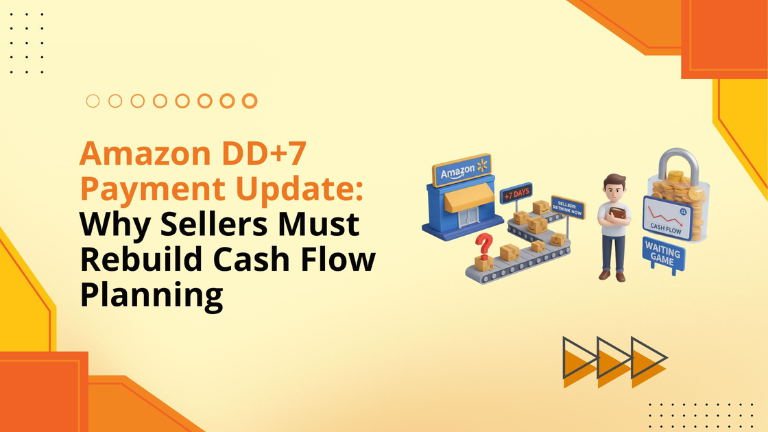
The Amazon DD+7 payment policy is changing how sellers manage cash.
Under this structure, funds are tied to delivery timing. Amazon states that funds are reserved until a shipment is delivered, plus a standard reserve period of seven days after the delivery date.
For sellers, this means revenue may show in reports before the cash is actually ready to use. That delay can affect inventory reorders, supplier payments, payroll, PPC budgets, and day-to-day operations.
A seller may be making sales but still feel short on available funds.
Contents
What Does DD+7 Mean?
DD+7 means “Delivery Date plus 7 days.”
In simple terms, Amazon may hold the payment until seven days after the customer receives the order. Some sellers are also reporting cases where certain payments move beyond the standard timeline, including DD+22 or DD+24 situations discussed in Seller Central forums.
Not every seller will face extended holds, but every affected seller should plan for a longer cash cycle.
This is not just a payment issue. It is a business planning issue.
Why This Matters for Amazon Sellers
Amazon sellers often use payouts to fund the next business move.
That may include new inventory, supplier balances, PPC campaigns, freight, storage, or listing improvements. When payouts take longer, sellers need better control over spending.
This is where Amazon Full Store Management becomes important. Sellers need to connect sales, inventory, PPC, and cash flow instead of managing each area separately.
If PPC continues aggressively while cash is delayed, the business may create pressure faster than it creates usable funds. That is why Amazon Advertising PPC Services should be aligned with inventory coverage and payout timing.
What Amazon Sellers Should Do
First, track payout timing closely. Look at delivery dates, deferred balances, available balances, and expected release dates.
Second, prioritize inventory funding. Bestselling SKUs should get cash priority before slow-moving products.
Third, control PPC spend. Do not scale ads without checking margins, inventory coverage, and available cash.
Fourth, improve conversion. If traffic is expensive, your listing must convert better. Stronger Amazon Content Optimization and Amazon Images Optimization can help sellers get more value from existing traffic.
Finally, build a cash buffer. Sellers should plan for a longer gap between sales and actual payout.
How Big Internet Ecommerce Helps
Big Internet Ecommerce helps Amazon sellers navigate the new DD+7 payment cycle by connecting cash flow, inventory, PPC, and listing optimization into a cohesive growth plan.
Our team helps sellers:
- Track and manage payouts: Monitor DD+7 timing and extended holds to avoid surprises.
- Prioritize inventory funding: Ensure bestsellers are supported even when funds are delayed.
- Align PPC and cash: Optimize ad spend to match available inventory and payout schedules.
- Improve listings and images: Boost conversion so each sale makes maximum impact.
- Plan for cash gaps: Build buffers to cover operational costs and supplier payments.
By integrating operational insight with financial planning, Big Internet Ecommerce helps sellers protect cash, reduce pressure, and scale more reliably.
Quick FAQs
What is the Amazon DD+7 payment policy?
The Amazon DD+7 payment policy means funds are generally held until seven days after the customer delivery date.
Why does DD+7 create cash pressure?
Because sellers may need to pay for inventory, ads, freight, and suppliers before Amazon funds are available.
How can sellers reduce DD+7 pressure?
Sellers can track payout timing, prioritize winning SKUs, control PPC spend, improve conversion, and build a cash buffer.
Need help adjusting your Amazon growth plan around DD+7?
Schedule a strategy call with our team.
Follow Big Internet Ecommerce (BIE) on Instagram & LinkedIn to stay updated with the latest trends in Amazon selling.