October 29, 2026
The Holiday Sale Is Only Half the Story: How Amazon’s 2026 Extended Return Window Affects Seller Profit
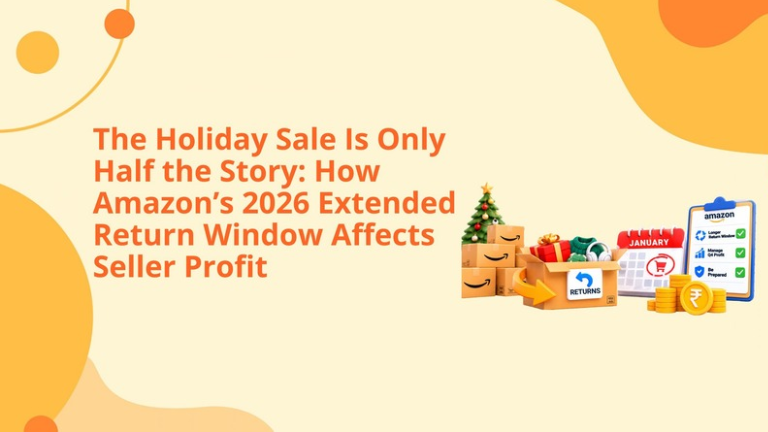
Holiday sales can make November and December look like the most profitable months of the year. However, a strong Q4 revenue report does not always show the complete financial outcome.
Some of the products sold during the holiday rush may be returned several weeks later. Refunds, return-processing costs, damaged inventory, removal fees, and recovery losses can continue affecting the business after the advertising campaigns have ended and the holiday sales reports have been celebrated.
Eligible items received and bought through Amazon.com between November 1 and December 31, 2026, have to be returned by January 31, 2027. It should be noted, though, that since January 15, 2027, customers have to return all of the Apple brand products purchased during that period.
This policy covers Amazon-qualified purchases made through retail orders, as well as through Fulfilled by Amazon and seller-fulfilled orders. There is no special enrollment needed from sellers, and Amazon confirms that the existing return and refund policies remain unchanged.
In practical terms, sellers are advised to brace for the holiday period as well as for a return cycle that will creep into the first quarter of 2027.
Amazon has a blanket return policy of allowing nearly all the products eligible for return within 30 days from the time of delivery. However, if someone purchases products during the holiday period, an extended policy allows more time to return the products purchased during the holiday season.
For the purchases made during the timeframe from November 1 to December 31, 2026, the last date for returning the products would be January 31, 2027, for non-Apple products, while the last date is fixed at January 15 for Apple products.
This principle applies regardless of whether products are being delivered by third-party vendors, and Amazon claims that just because a product has been bought during the holidays for longer returns, it does not mean that any product can be returned.
Amazon’s standard policy identifies categories and situations that may have different return conditions. Examples consist of perishables, medical supplies, custom-made products, products subject to transportation limitations, electronics, pharmaceuticals, animal medicines, motor vehicles, and limited products sold on a final sale basis. Retailers must carefully review the policy for products at the product level instead of making an assumption regarding the same date applicability to all ASINS.
Holiday shopping differs from routine ecommerce activity.
Purchasing is likely to occur well before the time of gift-giving, meaning consumers can buy products during a promotion in early November, hold them in storage until late December, and realize only upon giving a gift that the product is of incorrect size, color, type, and so forth.
Perhaps the 30-day guarantee will come to an end in this time, before the achievement of the said window.
The extended period reduces that concern. Consumers have the advantage of shopping ahead and still can return any eligible item they have purchased on Amazon even after the holiday season. The company emphasizes that this policy will not only help to enhance their shopping experience, but also provide them with sufficient customer traffic.
That can benefit sellers by encouraging earlier purchases. However, it also transfers part of the holiday transaction risk into January.
When reviewers are aware that they can return gifts until January, they will be more inclined to purchase items in November.
This situation allows retailers to profit from holiday sales earlier and capitalize on promotion events instead of depending only on the last-minute surge in December.
Return flexibility can be especially influential for products involving personal preference or compatibility, including:
A customer may feel more comfortable buying when the consequences of choosing incorrectly are lower.
Promotional events like Black Friday, Cyber Monday, and pre-holiday discounts stimulate consumers’ purchasing activity before all gift-related decisions have been made.
A longer return window creates more favorable impressions of these deals, giving customers a combination of justified deal pricing and more choices after purchase.
A surge of holiday sales can create recognizable trends that are hard to achieve in the off-season.
Return reasons may reveal that:
The risk is not simply that more time is available for returns. The larger issue is that return costs may appear after the original sales period.
A product sold in November might contribute to a strong Q4 sales report. If it is returned in January, the business may later absorb:
This means gross Q4 revenue can overstate the amount of revenue the seller ultimately retains.
Sellers should evaluate holiday performance using contribution margin after returns—not sales alone.
If an order was made using FBA, Amazon will take care of returns for customers and will take possession of the physical product at its fulfillment centers.
That reduces the seller’s direct logistics burden, but the financial and inventory consequences remain important.
After an FBA return, the unit may be:
The condition of returned inventory should be controlled by FBA vendors in order to check whether the product is truly sellable.
They should also review FBA return-processing fees. Amazon’s Returns and Recovery Insights tool shows return metrics, refund values, return reasons, critical review rates, applicable FBA return fees, and product-level recommendations.
For seller-fulfilled orders, the merchant has more direct responsibility for the return operation.
Under Amazon’s general third-party seller return requirements, a seller must provide an appropriate US return address, a prepaid return label, or a full refund without requiring the product to be returned, depending on the applicable circumstances.
FBM sellers should ensure they have enough capacity to manage:
January is a month when the business is usually occupied with all the return processing, counting the inventory, restocking items after the holiday, and preparing the company for the first quarter of the year, among other tasks and functions.
Not every ASIN carries equal holiday return risk.
Start with products that have:
A low-priced product with a moderate return rate may have less financial impact than an expensive, heavily advertised product that frequently comes back damaged.
Therefore, sellers should evaluate both return rate and total financial exposure.
Use the Returns and Recovery Insights tool to review product-level return data for both FBA and seller-fulfilled orders.
Relevant metrics include:
Amazon’s Returns and Recovery Insights tool also provides recommendations based on return patterns and supports filtered analysis by marketplace, fulfillment method, product category, and time period.
A listing should make it difficult for the wrong customer to purchase the wrong product.
Review:
The objective is not to make the item usable for everybody. Its objective is to help a specific segment of consumers grasp exactly what they are buying.
If customers complain constantly about receiving broken, damaged, wet, scratched, or incomplete products, then the issue of returns may occur even before the goods reach them.
Assess the standard of the packaging, internal security measures, seals utilized, the tags present, the product in the shipment, as well as the process of fulfilling the order.
Use historical return rates to estimate how much holiday revenue could be refunded in January.
A simple forecast can begin with:
Projected January refunds = Holiday units sold × Historical return rate × Average selling price
This projection does not account for 100% of profit calculations, but it helps merchants avoid counting every dollar earned in December as definitely kept.
A stronger forecast should also estimate:
Do not use all your holiday earnings on promotions or stock, but try not to forget any pending refunds.
For returns, set aside some part of returns if you have clothing and shoes, electronic items, gifts, expensive goods, or best-selling ASINs in your stock.
Seller-fulfilled merchants should confirm:
You cannot completely eliminate returns. The introduction of this strategy that attempts to limit the process of correct returns of merchandise may, in the long run, lead to difficulties from the side of customers and may even be contrary to the rules of retailers.
The solution is to minimize the number of returns that performed without a sufficient reason due to misunderstandings, not fulfilled expectations of a customer, packaging errors, or any quality issues.
It is important to include essential measurements in both visuals and text. Only use meaningful items in relation to size comparison.
Enumerate the prevailing and failing devices, materials, sizes and usages. Do not make consumers reach any conclusions regarding compatibility.
Variations should be named clearly to differentiate products. Avoid any form of duplication, abbreviation, or vagueness.
Provide separate images for all components that are part of the product. If something seen in a lifestyle photo is not a part of the package, make it clear.
Whenever customers mention the same mistake, it is better to revise the description rather than consider returns as individual cases.
Advertising leads to returns when the targeting is too broad or too general.
Review search terms that generate sales but also attract poor-fit customers. A sale is not profitable when it repeatedly becomes a refund.
Do not stop at revenue, units sold, or advertising ROAS.
Review:
A marketing effort can seem successful during December, but the true effectiveness may look much worse after accounting for January refunds.
For a more reliable assessment, the holiday performance must be checked once more after the deadline and processing period have passed.
Many return problems begin on the product detail page.
A misleading image, unclear size chart, incomplete compatibility statement, confusing variation, or overly broad advertisement can attract a customer whose expectations the product cannot meet.
That is why return reduction should connect:
We help Amazon sellers improve these connected areas through Amazon SEO, listing optimization, catalog management, A+ Content, creative strategy, PPC management, inventory monitoring, account-health support, and full marketplace management.
Our team can review return-prone ASINs, identify listing and targeting gaps, improve customer expectation-setting, and help calculate a more realistic return-adjusted holiday strategy.
Most eligible items purchased from November 1 through December 31, 2026, can be returned through January 31, 2027.
Eligible Apple-branded products purchased during the holiday period can be returned through January 15, 2027.
Yes. Amazon says the extended window applies to eligible FBA, seller-fulfilled, and Amazon retail orders.
No. The extended holiday return window applies automatically.
No. Existing product and category return-eligibility conditions remain in effect.
The extended holiday window can support customer confidence and stronger seasonal demand. However, sellers should not allow delayed returns to become a January surprise.
To review your return risks, listings, catalog structure, PPC performance, inventory recovery, and holiday profitability plan.
Schedule a strategy call with our team.
Follow Big Internet Ecommerce (BIE) on Instagram & LinkedIn to stay updated with the latest trends in Amazon selling.
Fill out the form and our experts will get back
to you within 24 hours.


We respect your privacy. Your information is safe with us.