Big Internet Seller Services Inc provides e-commerce Services

Get your first Product Photoshoot for FREE! Learn More

Walmart

Walmart advertising revenue vs Amazon

Walmart Advertising Growth vs Amazon: What Amazon Sellers Should Know

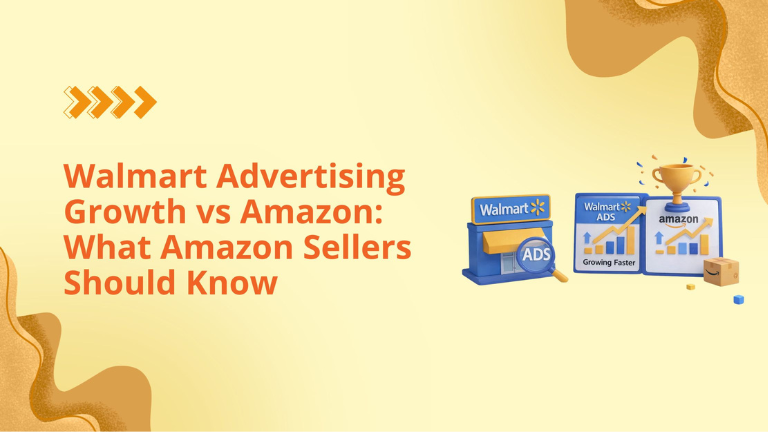
Retail media advertising has become one of the fastest-growing segments in e-commerce. For years, Amazon has dominated this space, building the largest retail media platform in the world. In 2025 alone, Amazon generated $68.6 billion in advertising revenue, making it the clear leader in marketplace advertising. However, a new competitor is expanding rapidly. Walmart’s advertising business generated $6.4 billion in revenue in 2025, growing 46% year-over-year, according to research from Marketplace Pulse. While the total revenue difference remains large, the growth trajectory suggests that Walmart’s advertising ecosystem is still in an early expansion phase. For Amazon sellers, this trend raises an important strategic question: Should marketplace advertising remain Amazon-only, or should sellers begin exploring multi-marketplace advertising strategies? In this article, we examine what Walmart’s advertising growth means for Amazon sellers and how brands should think about marketplace diversification. Understanding Walmart Advertising Revenue Growth Walmart’s advertising growth is primarily driven by Walmart Connect, the company’s retail media platform. According to Marketplace Pulse, Walmart’s advertising revenue increased to $6.4 billion in 2025, representing a 46% annual increase. Amazon’s advertising revenue grew to $68.6 billion, but its growth rate was lower at 22%. The difference highlights two key realities. First, Amazon remains the dominant retail media platform by a significant margin. Second, Walmart’s advertising ecosystem is still early in its development cycle. Advertising Penetration Comparison A useful way to compare advertising ecosystems is to measure advertising revenue relative to total marketplace sales. Amazon advertising revenue represents approximately 8% of its $830 billion e-commerce GMV. Walmart advertising revenue represents about 4% of its $150 billion e-commerce GMV. This suggests that Walmart still has substantial room to expand its advertising business as its marketplace grows. For sellers, this indicates that advertising opportunities on Walmart may still be developing. Why Amazon Sellers Should Pay Attention The rapid growth of Walmart advertising highlights a broader shift in the retail media landscape. Historically, most sellers relied almost entirely on Amazon for advertising-driven traffic. However, as other marketplaces develop their own advertising ecosystems, sellers may benefit from diversifying their acquisition channels. Potential advantages of testing Walmart advertising include: Less mature advertising competition New customer acquisition channels Additional marketplace visibility However, sellers must also evaluate whether Walmart’s current marketplace scale aligns with their growth strategy. The Role of Walmart Connect Walmart Connect has become the central driver of Walmart’s retail media expansion. The platform experienced 41% growth in Q4, indicating strong advertiser adoption. Walmart Connect allows brands to run advertising campaigns that appear in: Walmart search results Product detail pages Off-site digital placements Additionally, Walmart’s acquisition of Vizio introduces connected TV advertising opportunities that extend beyond traditional marketplace placements. This integration expands Walmart’s advertising inventory and strengthens its retail media capabilities. How Big Internet Ecommerce Can Help At Big Internet Ecommerce, we help brands build scalable marketplace growth strategies. As the retail media ecosystem expands, sellers need structured strategies to decide when and how to diversify beyond Amazon. Our team helps sellers with: Marketplace Expansion Strategy We evaluate whether brands are ready to expand beyond Amazon and identify opportunities across additional marketplaces. Cross-Platform Advertising Strategy We analyze advertising performance across platforms to identify the most efficient customer acquisition channels. Marketplace Listing Optimization Selling successfully on Walmart requires different listing strategies than Amazon. We help sellers optimize listings for new marketplaces while maintaining strong brand consistency. Amazon remains the dominant retail media platform and will likely continue to lead the market for years. However, the rapid growth of Walmart advertising signals that the retail media ecosystem is evolving into a multi-platform environment. For Amazon sellers, the key takeaway is not that Walmart will replace Amazon, but that marketplace diversification may become an increasingly important strategic consideration. Brands that monitor these shifts early will be better positioned to adapt their advertising strategies as the retail media landscape continues to evolve. If you want help evaluating your advertising strategy or exploring multi-marketplace growth opportunities, schedule a call with our team. Follow Big Internet Ecommerce (BIE) on Instagram & LinkedIn to stay updated with the latest trends in Amazon selling.

Walmart Advertising Growth vs Amazon: What Amazon Sellers Should Know Read More »
Amazon and Shopify U.S. e-commerce market share

Amazon and Shopify U.S. E-commerce Market Share Now Controls Nearly Half of Online Retail

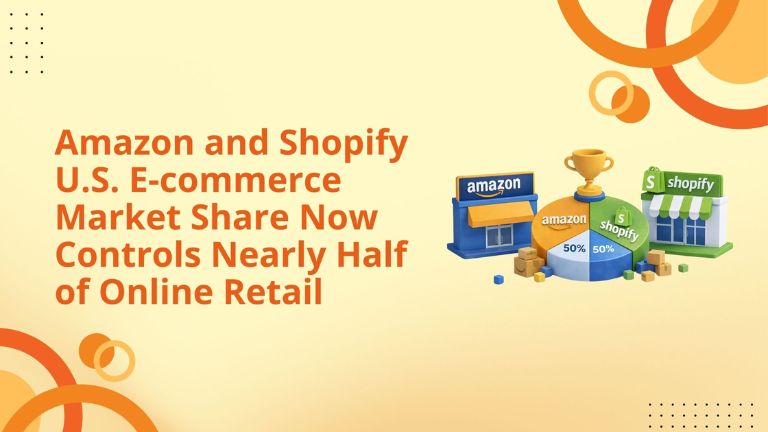
The structure of online retail is rapidly consolidating around a few dominant platforms. Recent industry data shows that Amazon and Shopify U.S. e-commerce market share now accounts for 49.7% of all online retail sales in the United States, representing nearly half of the $1.2 trillion e-commerce economy. Amazon alone generated approximately $440 billion in revenue in 2025, while Shopify merchants collectively represent 14% of the market through millions of storefronts. This dramatic rise signals a major shift in how digital commerce is structured. Sellers must now think strategically about where they build their business and how they distribute operations across platforms. Understanding the roles of both Amazon and Shopify is essential for brands aiming to scale in the modern e-commerce ecosystem. Amazon and Shopify U.S. E-commerce Market Share Dominance According to research from Marketplace Pulse, the combined market share of Amazon and Shopify has grown significantly in recent years. In 2021, these platforms accounted for approximately 43% of U.S. e-commerce sales. By 2025–2026, that number has increased to 49.7%. This means nearly half of all online retail purchases in the United States now happen either: On Amazon On Shopify-powered stores Amazon dominates marketplace commerce, while Shopify powers the infrastructure behind millions of independent brands. U.S. E-commerce Market Share Breakdown Current estimates place the market distribution as follows: Amazon – 35.7% Shopify – 14% Walmart – 6.4% Apple – 3.6% eBay – 3% Amazon remains the largest single platform in the e-commerce ecosystem. The company receives over 2.8 billion visits annually, making it one of the most visited retail websites in the world. This massive traffic volume reinforces Amazon’s role as the primary discovery platform for online shoppers. Amazon’s Role in the E-commerce Ecosystem Amazon operates a centralized marketplace where customers search for products directly on the platform. Key advantages include: Massive buyer traffic Integrated fulfillment infrastructure (FBA) Built-in trust and credibility Advanced advertising systems For many brands, Amazon represents the fastest way to reach high-intent shoppers. Sellers interested in improving their marketplace strategy can explore our Amazon growth services.  Shopify’s Growth in the Direct-to-Consumer Market While Amazon dominates marketplace commerce, Shopify powers the infrastructure behind direct-to-consumer brands. Key Shopify statistics include: Nearly 7 million active stores globally Merchants operating across 235 countries Over $490 billion in economic activity The Shopify ecosystem enables brands to control: Customer relationships Branding and design Marketing campaigns First-party data The Shopify App Store also plays a major role in the platform’s growth, with more than 25 million installed apps enhancing merchant capabilities. According to Shopify statistics compiled by Josh Howarth, the platform controls approximately 20% of the e-commerce platform market. Why Sellers Must Understand This Market Structure The increasing dominance of Amazon and Shopify changes how sellers should approach growth. Platform strategy is now critical. Many brands mistakenly view the decision as: Amazon vs Shopify. However, the most successful companies leverage both platforms. Amazon provides customer acquisition through marketplace discovery, while Shopify builds long-term brand value and customer retention. Strategic Opportunities for Sellers Sellers can leverage the strengths of both platforms through a structured strategy. Amazon Best for: Product discovery High-intent search traffic Marketplace scale Shopify Best for: Brand building Customer ownership Repeat purchases By integrating both channels, brands can create a balanced growth model that combines marketplace exposure with direct-to-consumer control. The Future of E-commerce Platforms Industry projections suggest that online retail will continue expanding rapidly. Global e-commerce sales are expected to reach: $6.3 trillion in 2024 $7.9 trillion by 2027 As this growth continues, Amazon’s massive infrastructure and Shopify’s merchant ecosystem will likely remain dominant forces shaping the future of online commerce. Sellers who understand how these platforms interact will be better positioned to scale their brands in an increasingly competitive market. The rise of Amazon and Shopify U.S. e-commerce market share to nearly 50% signals a major shift in the structure of online retail. Amazon leads product discovery through marketplace traffic, while Shopify empowers brands with direct-to-consumer control. Rather than choosing one platform over the other, successful sellers increasingly build strategies that leverage the strengths of both ecosystems. For brands seeking long-term growth, understanding how to navigate these platforms effectively is becoming a critical competitive advantage. If you want help building a scalable Amazon growth strategy or integrating your marketplace and DTC channels: Schedule a strategy call.  Follow Big Internet Ecommerce (BIE) on Instagram & LinkedIn to stay updated with the latest trends in Amazon selling.

Amazon and Shopify U.S. E-commerce Market Share Now Controls Nearly Half of Online Retail Read More »

Amazon surpasses Walmart revenue 2026

The 2026 Retail Re-shuffling: Strategic Implications of Amazon Surpassing Walmart in Total Revenue

For over a decade, the peak of the corporate mountain belonged to a single company in Bentonville, Arkansas. Today, the flag flying at the summit bears the Amazon smile. Following the 2025/2026 financial reporting cycle, Amazon ($716.9 Billion) officially surpassed Walmart ($713.2 Billion) in total annual revenue. It’s a historic milestone. But for third-party sellers, the headline hides the real strategic insights. To plan your 2026 growth, you have to understand how the crown was taken—and how Walmart is fighting back. The Catalyst: How Amazon Won the Crown Amazon didn’t beat Walmart by selling more paper towels and televisions. They won by building an inescapable digital infrastructure. The AWS Engine: Amazon Web Services brought in nearly $129 billion. It accounts for a fraction of total sales but generates over half of Amazon’s operating profit. The Ad Machine: Amazon’s digital advertising revenue sits at a staggering $68+ Billion. If you remove the cloud and the ads, Walmart is still the king of retail. But Amazon has successfully turned its marketplace into a high-margin service business, where third-party sellers pay for fulfillment, visibility, and software. Walmart’s Defense: The 27% Counter-Punch If you think Walmart is fading, look at the data. They are executing one of the most successful digital transformations in history. Omnichannel Mastery: Walmart is leveraging its 4,600+ U.S. stores as e-commerce fulfillment hubs, driving a massive 27% U.S. e-commerce growth rate. The Wealthier Shopper: Historically known as a discount retailer, Walmart reported that the majority of its recent market share gains came from high-income households (earning over $100k annually). Their digital customer base is wealthy and ready to spend. Strategic Takeaways for Sellers The Amazon vs. Walmart dynamic is no longer an “either/or” decision. It is a dual-engine requirement. The Amazon Strategy (Scale & Efficiency) Amazon offers unmatched scale and the seamless FBA network. However, because their revenue growth is increasingly tied to third-party fees and ad revenue, your margins will constantly be under pressure. Success here requires surgical PPC management and flawless inventory flow. The Walmart Strategy (Growth & Arbitrage) Walmart is your “Blue Ocean.” Because the marketplace is highly curated, you face far less saturation. Furthermore, Walmart Connect (their ad platform) generated $6.4 Billion compared to Amazon’s $68 Billion—meaning ad inventory is less competitive and clicks are cheaper. Where Big Internet Ecommerce (BIE) Fits In Transitioning from a single-channel Amazon seller to an Omnichannel brand is difficult. We remove the friction. Authorized Walmart Partnership: We use our API-level clearance to mirror your Amazon catalog directly to Walmart, bypassing the manual errors that plague most new sellers. WFS Integration: We handle the complex inbound routing required to get your products into Walmart Fulfillment Services (WFS), ensuring you win the coveted 2-Day Delivery badge. Blended Ad Strategy: We manage both your Amazon PPC and Walmart Connect budgets, shifting capital to whichever platform is delivering the lowest Customer Acquisition Cost on any given day. Don’t let the battle of the giants crush you. Learn to surf the waves they create. Book a consultation today! Follow Big Internet Ecommerce (BIE) on Instagram & LinkedIn to stay updated with the latest trends in Amazon selling.

The 2026 Retail Re-shuffling: Strategic Implications of Amazon Surpassing Walmart in Total Revenue Read More »

Walmart Authorized Partner

The “Authorized” Advantage: Unlocking Walmart’s Hidden Tier

In the world of online marketplaces, there’s a meaningful distinction between standard sellers and Walmart Authorized Partners. On some platforms, that line can get blurred. On Walmart, it’s clearly defined — and that has implications for scaling your business. Walmart maintains a network of Approved Solution Providers and partners in the Walmart Connect Partner Network, which include third-party companies vetted to help sellers manage and optimize their Marketplace and advertising operations. Working with a Walmart Authorized Partner isn’t just a badge — it can unlock capabilities and efficiencies that standard seller accounts often find harder to access. Big Internet Seller Services Inc. has now joined this ecosystem as an Authorized Walmart Solution Provider and Connect Partner, giving our clients access to enhanced integration, automation, and strategic support. Below are key areas where this status translates into real benefits. 1. Operational Confidence Through Official Integration Becoming an approved Walmart Solution Provider requires demonstrating the ability to operate within the technical and operational frameworks Walmart expects. Walmart carefully vets solution partners — including how they integrate and manage marketplace data — before approving them. What this means for you: Your integration is backed by a Walmart Authorized Partner whose processes meet Walmart’s operational and compliance standards. You can leverage structured systems that are built to align with Walmart’s performance expectations. It reduces technical friction compared to ad-hoc manual processes, giving you a smoother path from setup to scale. 2. API-Driven Automation Walmart Marketplace provides APIs designed to automate inventory, listings, orders, pricing, and other business data, enabling sellers and solution providers to sync operations with fewer manual steps. Standard Seller Challenges: Manual flat file uploads in Seller Center can create latency and increase the risk of errors. What a Walmart Authorized Partner Can Do: Integrate your systems directly via API or with a partner-managed connection to streamline updates. Facilitate automated checks for inventory and order status. Reduce reliance on manual uploads, shortening operational cycles and improving accuracy. Benefit: More efficient operations and fewer manual touchpoints — which can help minimize fulfillment mishaps and keep performance metrics healthier over time. 3. Wider Advertising Insights Through Walmart Connect Walmart Connect’s advertising solutions help brands reach shoppers across Walmart.com, in-store screens, and digital channels. The Walmart Connect Partner Network lists third-party partners who provide enhanced advertising support and services beyond standard dashboard reporting. Standard Seller Experience: Self-serve advertising tools provide core visibility into campaign performance. Partner Advantage: Through expanded APIs and partner tools, partners can access more granular reporting and attribution support. Partners can build strategies that capture broader performance signals, helping advertisers understand performance beyond immediate direct sales. Benefit: Better insight into advertising performance helps inform smarter optimization decisions and can unlock growth opportunities that standard dashboards might not reveal as clearly. 4. Enhanced Content & Catalog Support Approved Solution Providers offer a range of eCommerce services, including catalog optimization, enhanced content support, and connected content workflows. These services are designed to help sellers maintain accurate, shopper-friendly item pages — an important factor in conversion performance. Examples of Partner-Delivered Support: Rich media enrichment (images, structured attributes, enhanced descriptions). Catalog cleanup to improve listing quality. Catalog optimization for better search rank and visibility. Benefit: Content that aligns with Walmart’s structured catalog system can help your listings perform better and attract more customers. 5. Support Through Walmart Fulfillment Services (WFS) Walmart Fulfillment Services (WFS) is Walmart’s fulfillment solution that handles storage, packing, shipping, and returns for sellers who enroll. This can help brands offer fast delivery tags and leverage Walmart’s logistics network. How Partners Help: Partners can assist sellers in navigating the onboarding process, ensuring documentation, SKU setup, and operational readiness. They can also help align inbound and inventory procedures with Walmart’s systems and expectations. Benefit: Streamlined fulfillment processes and access to customer-preferred delivery badges can help increase conversion rates and customer satisfaction. The Walmart Authorized Partner Benefits Summary Becoming an Approved Walmart Solution Provider and Connect Partner means: Structured operational integration aligned with Walmart’s standards.  API-powered automation for listings, inventory, pricing, and orders.  Enhanced advertising insights via partner tools and reporting. Content and catalog optimization support. Assistance with advanced fulfillment options, including WFS These benefits help sellers tap more of what Walmart’s ecosystem offers, moving beyond manual processes and basic dashboards to a more optimized and scalable approach. Working with a certified Walmart partner isn’t just about delegation; it’s about unlocking a deeper set of tools and capabilities available through Walmart’s official solution provider and Connect partner ecosystem. Whether you’re aiming for smoother backend operations, smarter advertising insights, or fulfillment efficiencies, the Walmart Authorized Partner Benefits can be a strategic advantage in your marketplace playbook. Book a 20-min session with BigInternetEcommerce.com today! Book a call to get your customized strategy roadmap today. Follow Big Internet Ecommerce (BIE) on Instagram & LinkedIn to stay updated with the latest trends in online selling.

The “Authorized” Advantage: Unlocking Walmart’s Hidden Tier Read More »

Scroll to Top