
Big Internet Seller Services Inc provides e-commerce Services

Get your first Product Photoshoot for FREE! Learn More

March 2026

What is an enterprise business

What is an Enterprise Business, and How Can Amazon Sellers Use This Strategy to Scale?

We often focus on short-term growth, optimizing listings, and scaling through ads. However, understanding what enterprise businesses are and how they operate can provide powerful insights into long-term growth. An enterprise business is defined by complexity, scalability, and the use of advanced systems to drive operations. While this model is often associated with large corporations, its principles can be applied to Amazon sellers looking to scale. In this blog, we’ll explore: The definition of an enterprise business Key characteristics that make these businesses unique How Amazon sellers can apply these principles for growth What Defines an Enterprise Business?  An enterprise business is a large-scale organization known for: Scale and Scope: These companies often have thousands of employees and generate revenue in the hundreds of millions or billions. Organizational Complexity: Enterprises typically feature multiple layers of management, diverse departments, and complex workflows. Technology Infrastructure: Enterprise businesses implement ERP systems, CRM software, and other technologies to streamline operations. Regulatory Compliance: Enterprises often deal with rigorous regulatory requirements. Why Should Amazon Sellers Care About Enterprise Strategies?  While most Amazon sellers are not yet enterprise-level, the principles that guide these organizations can be applied to smaller businesses looking to scale: Operational Systems: Enterprises use sophisticated ERP and CRM systems to optimize supply chains and customer relationships. By incorporating these tools, Amazon sellers can automate and streamline workflows. Customer Retention: Enterprise businesses focus on building long-term relationships with customers. Amazon sellers can benefit from implementing loyalty programs and personalized marketing. Data-Driven Decisions: Enterprises rely heavily on data analytics to make decisions. Amazon sellers should use Amazon Brand Analytics and customer insights to optimize pricing, inventory, and marketing strategies. How Amazon Sellers Can Scale to Enterprise Level  1. Scale Operations with Technology Implement tools like ERP (Enterprise Resource Planning) and CRM (Customer Relationship Management) to automate manual processes, track customer data, and manage inventory. This will help you scale more efficiently as your business grows. 2. Adopt Data-Driven Marketing Enterprises use advanced marketing tools to reach their target audience. Amazon sellers can use Amazon Sponsored Ads, A/B testing, and product video integration to drive higher conversion rates and improve marketing ROI. 3. Build Customer Loyalty Focus on retaining customers through personalized experiences and Subscribe & Save options. This model not only ensures repeat business but also helps you build customer lifetime value (CLTV). How Big Internet Ecommerce Can Help At Big Internet Ecommerce (BIE), we specialize in helping Amazon sellers scale to enterprise-level operations. Our team assists in implementing the strategies and technologies that enterprises use to streamline operations and optimize performance. Here’s how we can help: 1. Automation & System Integration We help sellers adopt enterprise-level automation systems to streamline workflows and integrate ERP and CRM tools into your Amazon operations. This ensures you have the right infrastructure in place to scale your business efficiently without compromising quality or customer experience. 2. Data-Driven Marketing & Insights Our team leverages Amazon Brand Analytics, A/B testing, and advanced reporting tools to help you make data-driven decisions. We optimize your PPC campaigns, product listings, and ad creatives to ensure maximum ROI and increased conversion rates, just like enterprise businesses. 3. Customer Relationship Management (CRM) We implement customer retention strategies for your brand, including personalized email marketing, loyalty programs, and Subscribe & Save features, to increase customer lifetime value (CLTV). This helps you build long-term relationships with your customers, just as large enterprises do. 4. Brand Story and A+ Content Optimization We ensure that your Brand Story is fully optimized and aligns with Premium A+ Content requirements. By doing so, we increase your brand’s visibility and enhance customer engagement, making your product pages stand out and convert better, just like enterprise-grade listings. 5. Scalable Fulfillment Solutions We help design scalable fulfillment strategies using FBA and FBM solutions, ensuring that your supply chain is flexible, efficient, and able to handle growing demand. We also advise on integrating Amazon’s Multi-Channel Fulfillment (MCF) system for a smooth cross-platform experience. The enterprise business model offers valuable insights for Amazon sellers looking to scale their operations. By adopting enterprise-level systems, focusing on customer retention, and utilizing advanced technology, sellers can position themselves for long-term success. If you want to learn how to scale your Amazon business with enterprise-level strategies, schedule a call with us today. Follow Big Internet Ecommerce (BIE) on Instagram & LinkedIn to stay updated with the latest trends in Amazon selling.

What is an Enterprise Business, and How Can Amazon Sellers Use This Strategy to Scale? Read More »
Amazon and Shopify U.S. e-commerce market share

Amazon and Shopify U.S. E-commerce Market Share Now Controls Nearly Half of Online Retail

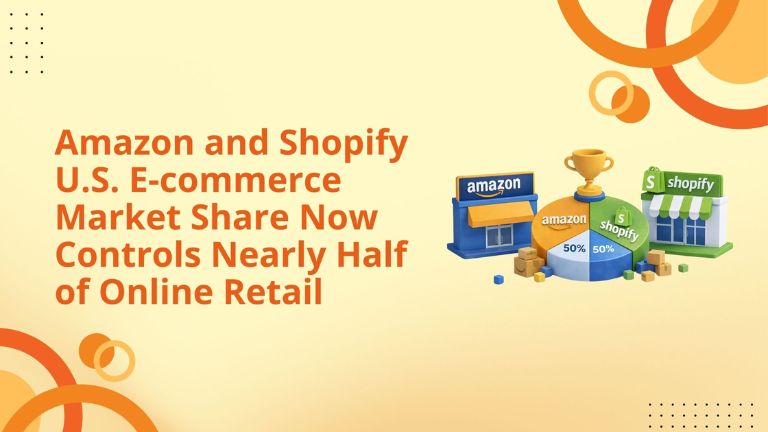
The structure of online retail is rapidly consolidating around a few dominant platforms. Recent industry data shows that Amazon and Shopify U.S. e-commerce market share now accounts for 49.7% of all online retail sales in the United States, representing nearly half of the $1.2 trillion e-commerce economy. Amazon alone generated approximately $440 billion in revenue in 2025, while Shopify merchants collectively represent 14% of the market through millions of storefronts. This dramatic rise signals a major shift in how digital commerce is structured. Sellers must now think strategically about where they build their business and how they distribute operations across platforms. Understanding the roles of both Amazon and Shopify is essential for brands aiming to scale in the modern e-commerce ecosystem. Amazon and Shopify U.S. E-commerce Market Share Dominance According to research from Marketplace Pulse, the combined market share of Amazon and Shopify has grown significantly in recent years. In 2021, these platforms accounted for approximately 43% of U.S. e-commerce sales. By 2025–2026, that number has increased to 49.7%. This means nearly half of all online retail purchases in the United States now happen either: On Amazon On Shopify-powered stores Amazon dominates marketplace commerce, while Shopify powers the infrastructure behind millions of independent brands. U.S. E-commerce Market Share Breakdown Current estimates place the market distribution as follows: Amazon – 35.7% Shopify – 14% Walmart – 6.4% Apple – 3.6% eBay – 3% Amazon remains the largest single platform in the e-commerce ecosystem. The company receives over 2.8 billion visits annually, making it one of the most visited retail websites in the world. This massive traffic volume reinforces Amazon’s role as the primary discovery platform for online shoppers. Amazon’s Role in the E-commerce Ecosystem Amazon operates a centralized marketplace where customers search for products directly on the platform. Key advantages include: Massive buyer traffic Integrated fulfillment infrastructure (FBA) Built-in trust and credibility Advanced advertising systems For many brands, Amazon represents the fastest way to reach high-intent shoppers. Sellers interested in improving their marketplace strategy can explore our Amazon growth services.  Shopify’s Growth in the Direct-to-Consumer Market While Amazon dominates marketplace commerce, Shopify powers the infrastructure behind direct-to-consumer brands. Key Shopify statistics include: Nearly 7 million active stores globally Merchants operating across 235 countries Over $490 billion in economic activity The Shopify ecosystem enables brands to control: Customer relationships Branding and design Marketing campaigns First-party data The Shopify App Store also plays a major role in the platform’s growth, with more than 25 million installed apps enhancing merchant capabilities. According to Shopify statistics compiled by Josh Howarth, the platform controls approximately 20% of the e-commerce platform market. Why Sellers Must Understand This Market Structure The increasing dominance of Amazon and Shopify changes how sellers should approach growth. Platform strategy is now critical. Many brands mistakenly view the decision as: Amazon vs Shopify. However, the most successful companies leverage both platforms. Amazon provides customer acquisition through marketplace discovery, while Shopify builds long-term brand value and customer retention. Strategic Opportunities for Sellers Sellers can leverage the strengths of both platforms through a structured strategy. Amazon Best for: Product discovery High-intent search traffic Marketplace scale Shopify Best for: Brand building Customer ownership Repeat purchases By integrating both channels, brands can create a balanced growth model that combines marketplace exposure with direct-to-consumer control. The Future of E-commerce Platforms Industry projections suggest that online retail will continue expanding rapidly. Global e-commerce sales are expected to reach: $6.3 trillion in 2024 $7.9 trillion by 2027 As this growth continues, Amazon’s massive infrastructure and Shopify’s merchant ecosystem will likely remain dominant forces shaping the future of online commerce. Sellers who understand how these platforms interact will be better positioned to scale their brands in an increasingly competitive market. The rise of Amazon and Shopify U.S. e-commerce market share to nearly 50% signals a major shift in the structure of online retail. Amazon leads product discovery through marketplace traffic, while Shopify empowers brands with direct-to-consumer control. Rather than choosing one platform over the other, successful sellers increasingly build strategies that leverage the strengths of both ecosystems. For brands seeking long-term growth, understanding how to navigate these platforms effectively is becoming a critical competitive advantage. If you want help building a scalable Amazon growth strategy or integrating your marketplace and DTC channels: Schedule a strategy call.  Follow Big Internet Ecommerce (BIE) on Instagram & LinkedIn to stay updated with the latest trends in Amazon selling.

Amazon and Shopify U.S. E-commerce Market Share Now Controls Nearly Half of Online Retail Read More »

Amazon Shoppable Collections Beta ended

Amazon Shoppable Collections Beta Ended: What Sellers Must Do

Amazon has removed the Shoppable Collections Beta module on February 27, fundamentally reshaping how brand storytelling appears on Product Detail Pages (PDPs). For Amazon sellers, this is not a minor visual adjustment. It represents: A structural shift inside A+ Content Manager Consolidation of storytelling into Brand Story A direct impact on Premium A+ eligibility The introduction of Content Quality Analysis scoring Sellers who adapt quickly can turn this update into a revenue opportunity. Those who ignore it may see weaker PDP engagement and lost cross-sell surface. What Is Changing? The Shoppable Collections module will: Be removed from PDPs Be removed from A+ Content Manager Automatically replaced by Brand Story (if published) Leave a gap if Brand Story is missing Additionally, Amazon is launching a Content Quality Analysis beta that scores A+ pages weekly based on: Readability Information completeness Visual structure Conversion effectiveness This signals that content quality is becoming a measurable performance metric. Shoppable Collections vs Brand Story Shoppable Collections was designed for: Curated SKU discovery Lifestyle-led visuals Video support Lateral browsing Brand Story traditionally focuses on: Brand narrative Founder messaging Linear scroll experience The shift consolidates discovery and storytelling into a single module. Brands must now intentionally design Brand Story to serve both purposes. Why This Matters for Conversion Shoppable Collections encouraged lateral browsing. Customers explored complementary SKUs. This increased: Time on page Cross-sell rate Basket size Without proper Brand Story restructuring, that browsing friction increases. Premium A+ eligibility requires Brand Story published across catalog. Premium A+ has been shown to increase sales up to 20%. Therefore: Brand Story now affects both compliance and revenue. Action Plan for Sellers Step 1: Audit Your Catalog Confirm Brand Story is published across all ASINs. Step 2: Rebuild SKU Architecture Use Brand Story to: Group complementary products Highlight collections Showcase routines Drive basket logic Step 3: Optimize for Content Scoring Improve: Readability Visual clarity Information depth Conversion messaging Step 4: Align With Premium A+ Ensure eligibility requirements are met. Learn more about Amazon growth strategies. Strategic Implications This update reflects Amazon’s broader trend: Consolidation of features. Quality scoring. Performance-based content evaluation. Brands that treat A+ as a strategic funnel asset — not decorative branding — will benefit. The Amazon Shoppable Collections Beta ending is not a loss — it is a consolidation. Brand Story now becomes: Your merchandising surface Your storytelling engine Your cross-sell architecture Your Premium A+ gateway If you want help restructuring your Brand Story before this impacts your PDP performance. Schedule a strategy call with us today! Follow Big Internet Ecommerce (BIE) on Instagram & LinkedIn to stay updated with the latest trends in Amazon selling.

Amazon Shoppable Collections Beta Ended: What Sellers Must Do Read More »

Amazon BSA updates March 4, 2026

Amazon BSA Updates (March 4, 2026): AI & Automation Compliance Guide for Amazon Sellers

Amazon sellers operate in one of the most policy-driven ecosystems in ecommerce. Every update to the Amazon Services Business Solutions Agreement (BSA) carries operational consequences — especially when it affects automation, AI tools, agencies, and third-party integrations. Effective March 4, 2026, Amazon is rolling out significant updates to the Business Solutions Agreement, including the introduction of a new Agent Policy and stricter language surrounding AI usage and automated access to Amazon Services. Sellers who continue using Selling Services after this date automatically accept the revised terms. For sellers relying on repricers, SP-API apps, browser automation, AI-powered workflows, or virtual assistants, this update is not administrative — it is operationally critical. Failure to comply may result in restricted access to services or enforcement actions. This guide explains: What changed in the Amazon BSA How the new Agent Policy affects AI and automation Which tools are most impacted What immediate actions sellers should take How to protect your account while maintaining growth This article is for informational and operational guidance purposes only and does not constitute legal advice. Sellers should consult qualified legal counsel for contractual interpretation. What changed and why sellers should care Amazon announced updates to the Amazon Services Business Solutions Agreement (BSA) effective March 4, 2026, adding a new Agent Policy and tightening rules that affect AI tools and automation systems used by sellers. For sellers, this matters because many day-to-day operations now rely on third-party access: Pricing and repricing tools Inventory and replenishment automation Listing optimization tools Analytics dashboards Agencies/virtual assistants SP-API applications Amazon’s update makes it clear that automated access must follow specific rules — and sellers are responsible for ensuring their tool stack complies. Important (YMYL/Legal): This article is educational and operational in nature and is not legal advice. For legal interpretation, consult qualified counsel. Key requirements in the new Agent Policy Amazon’s notice states that automated software or AI agents that access Amazon Services must: Clearly identify themselves as automated systems Comply with the Agent Policy at all times Cease access if Amazon requests That third requirement is being widely discussed as a “kill switch” operational requirement meaning sellers should have a reliable way to immediately disable automation or revoke access. Amazon also noted updated AI and machine learning restrictions, including limits on using Amazon materials/services for AI development and stronger protection against reverse engineering. Additional structural changes include “Developer Site” terminology being replaced by references to the Solution Provider Portal. What tools are most likely impacted Based on Amazon’s stated focus on automated access + AI usage restrictions, sellers should review: AI tools used inside Seller Central workflows (listing edits, messages, bulk actions) Automation scripts (pricing, inventory, keyword updates, bulk category edits) Browser automation / macros / headless browsing Scraping or reverse-engineering-style data tools Agencies/VAs using shared logins or untracked extensions SP-API apps and third-party integrations tied to your account Seller compliance playbook (action steps) Here’s a practical plan sellers can implement before March 4. 1) Build an “Agent Inventory” list Create a spreadsheet with: Tool/vendor name What it does How it accesses Amazon (login / SP-API / extension / script) Who owns it internally How to disable it immediately 2) Confirm “stop access” controls (kill switch readiness) You should be able to: Revoke app authorization Disable or pause automations Remove permissions or users Rotate credentials quickly 3) Clean user permissions and old vendor access Many enforcement events come from: Old agencies that still have access Secondary users not being monitored Former employees’ credentials Legacy SP-API authorizations 4) Put documentation in place If Amazon ever questions activity, clean internal documentation helps demonstrate operational control and accountability (who did what, what tool did it, and how you stopped it). How Big Internet Ecommerce can help Big Internet Ecommerce helps sellers reduce compliance risk while protecting growth: Full tool + vendor audit (agents, apps, VAs, agencies) Permission cleanup + access mapping Automation design with control layers (pause/disable protocols) Listing and PPC performance protection during tool changes If your current stack is heavy on automation, we can also strengthen your fundamentals so your business isn’t fragile: Amazon Listing Optimization Services Amazon Advertising (PPC) Services Want a seller-safe compliance checklist and tool audit plan before March 4? Schedule a call with us today! Follow Big Internet Ecommerce (BIE) on Instagram & LinkedIn to stay updated with the latest trends in Amazon selling.

Amazon BSA Updates (March 4, 2026): AI & Automation Compliance Guide for Amazon Sellers Read More »

Scroll to Top